Why Is My Espresso Bitter Fix: Quick Fixes for Better Coffee
That harsh, aggressive taste in your morning espresso almost always points to one culprit: over-extraction. It's what happens when hot water hangs around in your coffee grounds for too long, pulling out not just the good stuff, but all the bitter, nasty compounds as well.
Understanding Why Your Espresso Tastes Bitter
Pulling a great shot is a balancing act. You're trying to coax out the perfect amount of flavour—the sugars, oils, and acids that make coffee so wonderful—without letting the bitter compounds that dissolve later in the process crash the party. When that balance is off and the extraction drags on, bitterness is what you get.
I always think of it like brewing tea. Leave the bag in for just the right amount of time, and you get a beautiful, flavourful cuppa. But let it sit for ten minutes, and it turns into a bitter, astringent mess. Espresso works on the exact same principle, just compressed into a matter of seconds.
Before we dive into the fixes, it's useful to have a quick reference. If you're in a hurry, this table should point you in the right direction.
Quick Fixes For Bitter Espresso
Use this table to quickly identify your problem and find the most effective solution.
| Symptom | Most Likely Cause | Primary Solution |
|---|---|---|
| Shot runs for 40+ seconds and tastes harsh | Grind is too fine | Coarsen your grind setting one or two notches. |
| Shot tastes burnt and astringent | Water is too hot | Lower your machine's temperature to 90-94°C. |
| Shot is bitter, even with perfect timing | Roast is too dark | Try a medium or light roast bean instead. |
| Channelling is visible (spurts of coffee) | Poor puck prep | Improve your distribution and tamping technique. |
This table covers the most common issues, but let's break them down properly so you can diagnose the problem with confidence.
The Science of Extraction
Over-extraction may be the main villain, but it usually has a few accomplices helping it ruin your coffee. Getting to grips with these is the first step to permanently fixing the problem. The usual suspects behind a bitter espresso shot fall into one of these categories:
- Grind Size: If your grind is too fine, it creates a dense, tightly packed puck of coffee that water can barely squeeze through. This massively prolongs the contact time.
- Brew Time: This one’s straightforward. A shot that runs for too long—generally anything over 35 seconds—is guaranteed to start pulling out those harsh, bitter notes.
- Water Temperature: Water that’s scorching hot (anything above 95°C) will literally burn the grounds and extract the bitter compounds far too quickly.
- Bean Choice: Some beans are just naturally more prone to bitterness. Exceptionally dark roasts, for example, have developed more of these characteristics during the roasting process itself.
The journey to a perfect espresso is all about control. By methodically adjusting one variable at a time, you can isolate the cause of the bitterness and systematically eliminate it from your brew.
Hitting that sweet spot requires you to tweak these variables until you achieve a balanced shot. The character of the coffee beans also plays a massive role. The way a coffee is roasted fundamentally shapes its final flavour profile. If you want to get ahead of the game, learning about different coffee roasting profiles and how they affect taste gives you a huge advantage, helping you select beans that naturally align with your preferences and avoid inherent bitterness from the start.
Now, let’s walk through exactly how to diagnose and correct each of these issues.
How To Diagnose and Correct Over-Extraction
Over-extraction is the number one culprit behind bitter espresso. It’s what happens when water hangs around with the coffee grounds for too long, pulling out all the harsh, nasty-tasting compounds long after the sweet, desirable flavours have already dissolved. Nailing this requires a bit of detective work, starting with a few simple observations.
Your best diagnostic tool is your stopwatch. A classic, well-balanced espresso shot should pour in about 25-30 seconds. If your shot is creeping towards 40 seconds or even longer, that’s a massive red flag. It tells you the water is struggling to push through the coffee puck—a textbook symptom of over-extraction.
While you're timing the shot, keep an eye on how it looks. Watch the espresso as it flows from the portafilter spouts. A beautiful extraction starts dark and rich, then gradually fades to a lighter, honey or caramel colour. This is called "blonding." If your shot stays dark and syrupy for way too long before it starts to lighten, that’s another visual clue that you’re over-extracting.
Adjusting Your Grind Size for a Sweeter Shot
The quickest and most effective fix for a slow, bitter shot is to adjust your grind size. When your coffee is ground too finely, it creates a dense, compacted puck that water can barely get through. This forces the water to spend far too much time in contact with the grounds, which leads directly to that bitter taste you’re trying to escape.
By making your grind just a little coarser, you create more space between the individual coffee particles. This gives the water an easier path, letting it flow through at a better pace and cutting down the overall contact time. The result? Those bitter compounds stay locked in the grounds, not in your cup.
The key is to make small, incremental changes. Don't just jump from a super-fine setting to a really coarse one. Adjust your grinder one tiny notch at a time, pull another shot, and taste it. This methodical process, known as "dialling in," is the absolute foundation of balanced espresso. A high-quality coffee grinder with precise, stepless adjustments makes this a whole lot easier and more repeatable, giving you the fine-tuned control you need to banish bitterness for good.
This simple flowchart helps visualise the first steps to take when a bitter espresso shot has you stumped.
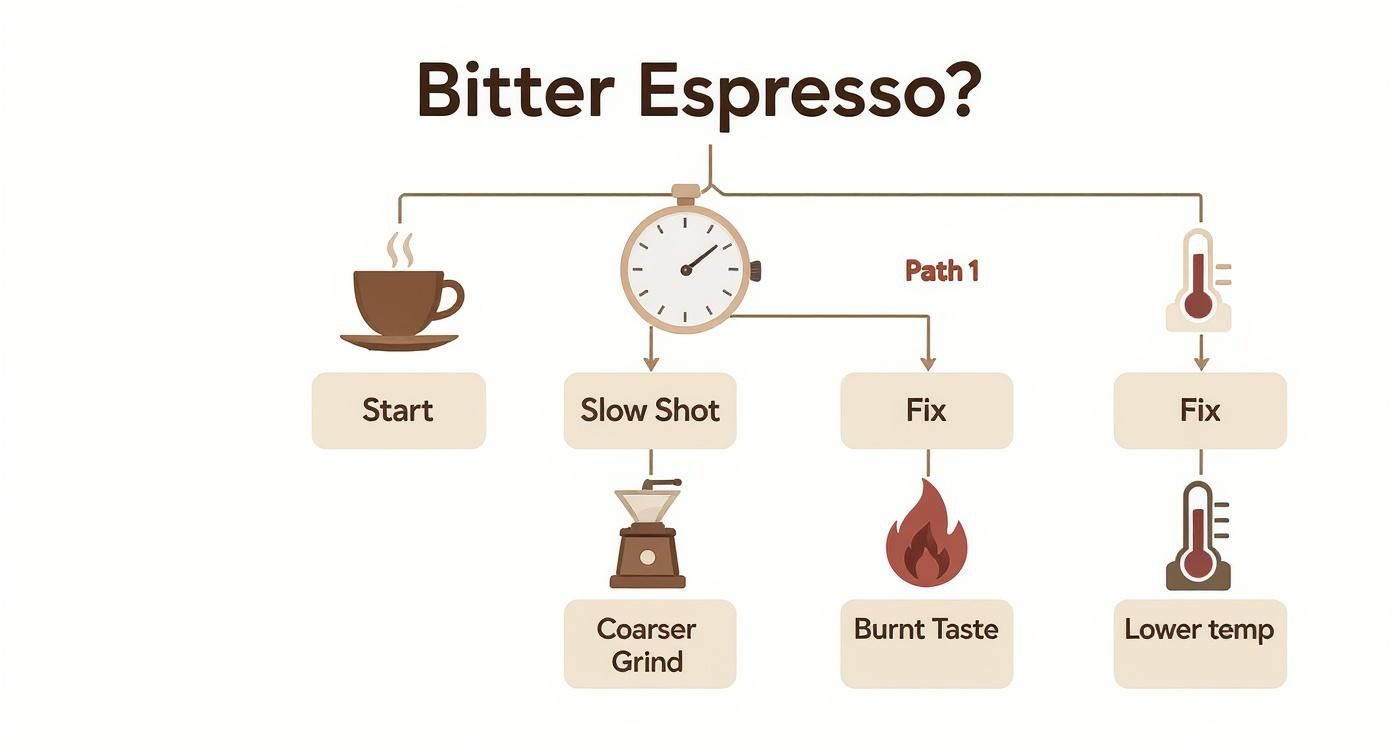
As you can see, a slow shot time points directly to coarsening your grind. It's almost always the first and best place to start.
The Bigger Picture in the UK
This focus on extraction isn’t just for coffee nerds; it’s a massive issue across the country. In fact, over-extraction is a primary cause of bitter espresso in the UK, a problem that’s grown with our coffee habits. With café prices on the rise, around 58.1% of UK consumers are now trying to make barista-style coffee at home. This often means getting to grips with the tricky art of extraction without any formal training, making over-extraction a very common hurdle.
Key Takeaway: Your grinder is your main weapon in the fight against bitterness. Making the grind slightly coarser is the fastest way to fix a shot that's running too long and tasting harsh.
While your grind size is critical, it doesn't work in isolation. It goes hand-in-hand with your dose (how much coffee you use) and your yield (how much espresso you get out). Perfecting your grind won't mean much if your recipe is out of whack. Understanding how to dial in your espresso ratio is the next vital step to get your shot time, input weight, and liquid output all working together in perfect harmony.
Choosing The Right Coffee Beans and Water
Even if your technique is perfect, you can't brew your way out of bad ingredients. The coffee beans and water you use are the absolute foundation of your espresso's flavour. Getting them right isn't just a recommendation; it's a non-negotiable step if you want to fix a bitter brew.
The Problem Might Be Your Beans (And Your Water)
Think of your coffee beans as the main character in your espresso's story. If you start with a character that’s inherently bitter, it's almost impossible to craft a sweet ending. This is especially true for very dark roasts, where the intense roasting process can develop a lot more of these bitter-tasting compounds.
If you’ve tweaked your grind, dialled in your timings, and are still getting harsh, unpleasant shots, it’s time to look at the beans themselves. The simplest experiment? Try a different roast profile.
A medium roast is often the perfect place to start. These beans tend to have a much more balanced profile, letting sweetness and other nuanced flavours come through instead of being overpowered by that classic roasty bitterness. You’re simply giving yourself a better shot at pulling something smooth and rich.
Far more important than the roast level, however, is the ‘roasted on’ date. Coffee is a fresh product, and stale beans are a one-way ticket to a bad-tasting espresso. Once beans get more than a month past their roast date, they start losing the vibrant, aromatic oils that carry all the good flavours. What’s left behind often produces a flat, woody, and disappointingly bitter extraction.
This leads us to the other half of the flavour equation: water.
Your espresso is over 98% water. If the water tastes bad, your coffee will taste bad. It's an ingredient, not just a solvent.
Even the world's best beans can be completely ruined by the wrong water. Two main factors are at play here: its temperature and its mineral content.
Brewing with water that’s too hot—anything consistently above 95°C—is a surefire way to scorch your delicate coffee grounds. This instantly rips out all those harsh, bitter notes you're trying to avoid. The ideal range to aim for is 90-94°C.
Using filtered water is another game-changer. Hard tap water, which is common across the UK, is packed with minerals that can bind with flavour compounds in all the wrong ways, leading to a dull or aggressively bitter taste. This guide highlights the importance of filtered water for coffee brewing. Honestly, even a simple water filter can make a world of difference.
For those ready to dive deeper into finding the perfect beans for your machine, our detailed guide on choosing coffee beans for your espresso machine offers more specific advice on origins and flavour notes to look for.
Perfecting Your Dose, Tamp, and Puck Prep
So much of what makes a great espresso shot happens long before you even think about pressing the brew button. Your puck preparation—that little ritual of dosing, distributing, and tamping your coffee—is where the magic really starts. Get it right, and you're on your way to a sweet, balanced shot. Get it wrong, and you're practically inviting bitterness to the party.
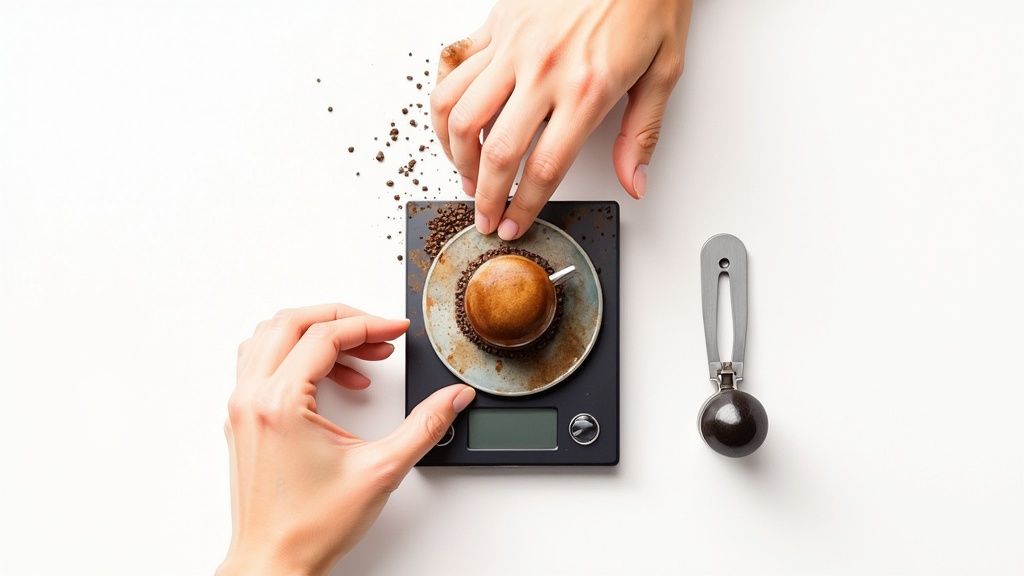
One of the most common missteps I see is simply using the wrong dose for the basket. Overdosing, or cramming way too much coffee into the portafilter, creates a puck that’s dense and compacted like a brick. This forces the water to fight its way through, slowing everything down and leading to a classic case of over-extraction and that harsh, bitter flavour we all want to avoid.
The fix? It’s all about precision. Using a decent set of digital coffee scales to weigh your dose every single time is non-negotiable if you’re serious about consistency. Dosing by volume or just 'eye-balling' it throws far too much guesswork into the mix, making it impossible to figure out what’s actually going wrong. Stick to your recipe, and you’ve just eliminated a massive variable.
Tamping and Distribution: The Keys to Consistency
Once you’ve nailed your dose, the next job is to create a perfectly level and evenly compressed bed of coffee. A lot of beginners think tamping is about brute force, but it’s not. The goal isn't to press as hard as you can; it's to create a flat, uniform surface.
An uneven or slanted tamp is one of the biggest causes of channelling. This is where water finds the path of least resistance—little cracks or weak spots in the puck—and just rushes through, completely bypassing other parts of the coffee. These channels become tiny motorways for water, causing the coffee along those paths to get massively over-extracted. This dumps a whole load of bitterness into your cup while leaving other areas under-extracted.
Puck preparation is your best defence against channelling. A well-prepared puck encourages water to flow evenly through the entire bed of coffee, ensuring every single particle contributes to a balanced and sweet flavour profile.
To fight back against channelling, a quality tamper that fits your basket snugly and a distribution tool are fantastic investments. A distribution tool, like a WDT (Weiss Distribution Technique) tool, is designed to break up clumps and spread the grounds out evenly before you tamp. It creates a fluffy, consistent foundation, which is exactly what you need for a level tamp.
Using a tool like a WDT tool before tamping is one of the single most effective things you can do for your espresso. It gently rakes through the grounds, getting rid of clumps and making sure there are no hidden dense spots or air pockets. This simple action dramatically reduces the risk of channelling and gives you a much better chance of pulling that sweet, balanced shot you’re chasing.
If you really want to get this technique down, check out our comprehensive puck prep guide which explains WDT and distribution in detail.
Why A Clean Machine Is Your Secret Weapon
So, you’ve meticulously dialled in your grind, perfected your puck prep, and your espresso is still stubbornly bitter. Before you blame the beans again, the culprit might be hiding in plain sight. Believe it or not, your espresso machine itself can become a source of foul, bitter flavours, completely undermining all your hard work.
Over time, a sticky residue of old coffee oils and microscopic grounds builds up inside the group head, on the shower screen, and all over your portafilter. These oils don't stay fresh for long; they go rancid, imparting a stale and intensely bitter taste to every single shot you pull. A quick flush with hot water after brewing just isn’t enough to dissolve and remove these stubborn, oily deposits.
Establishing a Simple Cleaning Routine
To combat this, you need a dedicated cleaning routine using specialised products designed to break down those coffee oils. This isn’t just an occasional chore but a crucial, non-negotiable part of your coffee-making process. Honestly, the difference it makes to the flavour in your cup is genuinely remarkable.
A basic but incredibly effective schedule looks something like this:
- Daily: After your last coffee of the day, give the group head a good scrub with a brush and run a plain water backflush. It takes seconds.
- Weekly: This is when you do a full backflush using a dedicated espresso machine cleaner. While you're at it, soak your portafilter and baskets in a solution of the same cleaner to dissolve any built-up gunk.
- Monthly: Take a closer look at your shower screen. If it’s clogged with heavy build-up, it might be time for a deeper clean or even a replacement.
This simple maintenance prevents rancid oils from ruining your coffee and is one of the easiest fixes for persistent bitterness. Investing in some essential cleaning supplies like brushes and powders is a tiny price to pay for consistently delicious espresso.
The Link Between Cost and Home Brewing Habits
This attention to detail at home has become more relevant than ever. Economic shifts in the UK have certainly influenced how we approach our daily coffee. With coffee shop prices jumping by roughly 17% between 2022 and 2025, it’s no surprise many of us have turned to our home setups to get our caffeine fix. To get more bang for their buck, some home baristas start experimenting with techniques that can cause bitterness, like grinding way too fine or letting shots run for far too long. You can find more details on UK coffee market trends and statistics in this report.
Keeping your equipment impeccably clean ensures that any bitterness you taste comes from your technique—which you can adjust—and not from old, rancid coffee residue you can't control.
Beyond the daily and weekly wipe-downs, periodic descaling is also vital for your machine's health and performance. Limescale build-up can wreak havoc on temperature stability, which is another sneaky cause of bitterness. For a detailed walkthrough, you might be interested in our guide on how to properly descale your coffee machine. It's another crucial step towards eliminating bitterness for good.
Still Puzzled? Common Questions on Fixing Bitter Espresso
Even after getting the basics down, it’s completely normal to have a few nagging questions about a bitter shot. Sometimes you fix one thing, only to find another problem pops up. Or maybe the usual advice just isn’t clicking with your specific setup. This is where we tackle those last few hurdles that home baristas often face.
Let's dive into some of the most common scenarios I see and get you that much closer to pulling a consistently perfect, balanced shot.
My Grind Is Coarser, But My Espresso Is Still Bitter. What Next?
This is a classic head-scratcher. You've made the grind coarser, but the bitterness just won't go away. When this happens, the next two places to look are your dose and your brew time. Often, even with a coarser grind, you might have too much coffee packed into the portafilter basket. This creates a dense puck that water struggles to get through, extending the shot time and leading right back to over-extraction.
First, try reducing your dose by just 0.5g. It doesn't sound like much, but it can make a huge difference in how freely the water flows.
Next, double-check your recipe. Are you still hitting that classic 1:2 ratio (say, 18g of coffee in for 36g of espresso out) within the golden 25-30 second window? If your shot is still running long even with a coarser grind, your dose is almost certainly the culprit. If your dose and time are spot on, the final suspect is water temperature. Anything creeping over 95°C can start to scorch the grounds, pulling out those harsh, bitter notes no matter what else you do.
Can My Espresso Machine Cause Bitterness?
Absolutely, your machine can be a factor, but it’s usually more about stability than a fundamental flaw. For example, many entry-level machines can have pretty wild temperature swings while pulling a shot. If the water temperature suddenly spikes mid-extraction, it’s going to scald the coffee and introduce those bitter, ashy flavours.
Inconsistent pressure is another potential issue, which can cause channelling and lead to pockets of over-extracted coffee in your puck. Before you blame the gear, though, make sure your own technique is rock solid. Perfect your puck prep, keep your dose consistent, and be sure your grind is appropriate for the beans. The truth is, you can make fantastic coffee on almost any machine once your fundamentals are dialled in.
Remember, the machine is just the tool. The barista's technique—from puck prep to dialling in—has a far greater impact on the final taste in the cup than the machine itself.
Does a Dark Roast Always Make a Bitter Espresso?
Not necessarily, but dark roasts are definitely walking a finer line. The longer roasting process creates more of those compounds that our taste buds perceive as "roasty" and bitter. It doesn't mean you can't get a balanced shot, you just have to adjust your recipe to work with the beans, not against them.
Try pulling back on the water temperature a bit, somewhere around 90-92°C, to take the edge off the extraction. A slightly coarser grind and a quicker shot can also work wonders. You could even aim for a tighter ratio, like a ristretto, to highlight those rich, chocolaty notes without dragging out the bitterness. If you've tried all that and it's still too intense for you, your palate might simply prefer the brighter, sweeter character of a medium roast. And that’s perfectly okay!
At Seven Sisters Coffee Co, we believe everyone deserves a superb cup of coffee. Explore our collection of freshly roasted beans and premium accessories to banish bitterness for good. Find your perfect brew at https://sevensisterscoffee.co.uk.