What is an Espresso Macchiato: A Quick Guide to the Classic Drink

Ever wondered what an espresso macchiato is? At its heart, it’s a shot of rich, intense espresso that’s been ‘marked’ with a tiny spoonful of steamed milk. This isn't a milky coffee like a latte; the espresso is the undisputed star here, with the milk serving only to soften its boldest edges. Understanding what an espresso macchiato is can transform your coffee experience, especially if you love the bold taste of a great coffee bean.
What Is an Espresso Macchiato?

The name itself gives the game away. In Italian, "macchiato" means "marked" or "stained," which beautifully captures how the drink is made. You have a pool of dark, potent espresso, which is then marked by a small dot of bright white milk foam. It’s a beautifully simple concept that puts the quality of the coffee right in the spotlight.
A great way to think about its character is in musical terms. If a latte is a full-on choir where lots of voices blend into one, the espresso macchiato is a powerful soloist. The espresso's complex notes sing out loud and clear, while the milk provides just a single, subtle harmony to round things out without stealing the show.
Its Place in the Coffee World
The macchiato holds a special, often misunderstood, spot on the café menu, frequently overshadowed by its milkier cousins. It’s the perfect drink for anyone who loves the intensity of a straight espresso but wants a slightly smoother, less acidic kick.
It’s a world away from other drinks where milk takes centre stage:
- Latte: A large, milk-forward drink where the espresso flavour is significantly toned down.
- Cappuccino: A balanced affair with equal parts espresso, steamed milk, and a thick cap of foam.
- Cortado: A Spanish creation with a roughly 1:1 ratio of espresso to milk, making for a much more blended and less intense drink than a macchiato.
The whole point of a traditional macchiato is to celebrate the espresso. That minimal touch of milk isn't meant to create a new flavour profile, but to refine the one that's already there. It’s a true coffee lover’s drink.
Getting to grips with the espresso macchiato opens up a more authentic side of the coffee world. It’s a classic for a reason, offering a pure taste of quality beans with just a touch of elegance. For a deeper look at how it and other popular drinks stack up, you might find our guide to the different types of coffee drinks useful.
The Italian Origins of the Macchiato
Every great coffee has a story, and the tale of the espresso macchiato begins with a stroke of simple, practical genius. To really get to the heart of it, it helps to understand the wider espresso coffee origin and just how central it is to Italian culture. It was in the nation’s bustling coffee bars that the need for this particular drink first came about.
Picture the scene: a busy Italian café, orders are flying, and waiters are rushing between tables. Baristas needed a quick, foolproof way to tell a plain espresso apart from one with just a splash of milk for the waiting staff. Their solution was brilliantly straightforward.
They would simply ‘mark’ the espresso with a tiny dollop of steamed milk foam. This little visual cue was all it took to prevent mix-ups during a hectic service.

From Practical Mark to Beloved Drink
This clever shorthand is exactly where the name comes from. In Italian, "macchiato" means "marked" or "stained," perfectly describing that small, white dot of foam sitting atop the dark crema. What began as a purely functional solution soon evolved into a beloved drink in its own right.
Customers started to realise that this tiny amount of milk did something quite special. It didn't hide the espresso's flavour but instead gently softened its sharpest edges, creating a drink that was more balanced and approachable, yet still wonderfully intense.
The history of the macchiato is a testament to the sheer practicality of coffee culture. Its creation wasn’t about inventing a new flavour, but about solving a problem, which accidentally created a perfectly balanced drink for connoisseurs.
This origin story really reveals why the macchiato is still considered a purist's choice. It’s a drink born from a deep respect for the coffee itself, designed to celebrate the quality of the espresso shot rather than mask it. This minimalist philosophy is the very heart of its enduring appeal in authentic coffee shops across the UK and beyond.
Macchiato vs Cortado vs Latte: What's the Difference?
Navigating a speciality coffee menu can feel like a pop quiz. Macchiato, cortado, latte… what's the real difference? While they might seem similar, it all comes down to one simple thing: the balance of espresso and milk.
Think of it as a spectrum. At one end, you have the bold, coffee-forward experience of the espresso macchiato. At the other, the creamy, mellow comfort of a latte. And sitting perfectly in the middle? That’s the cortado. Each drink offers a unique way to enjoy the same core ingredients.
Macchiato vs Cortado
Hailing from Spain, the cortado gets its name from the Spanish word for "to cut." And that’s precisely what it is: a shot of espresso ‘cut’ with an equal amount of steamed milk. This creates a beautifully balanced, smooth drink where neither the coffee nor the milk dominates.
Unlike the macchiato, where foam is just a finishing touch, the cortado fully marries the two elements into a harmonious partnership. It's the ideal choice if you find a macchiato a bit too intense but a latte too diluted. If you’re keen to master this balanced brew, you can find our guide on how to make a cortado at home.
Macchiato vs Latte
The latte is easily one of the most popular and recognisable coffee shop staples in the UK. It consists of a single or double espresso shot drowned in a generous serving of steamed milk, all topped with a light layer of microfoam. The milk-to-espresso ratio is often 1:5 or even higher, resulting in a creamy, mild, and incredibly approachable coffee.
The real difference is one of purpose. A macchiato uses milk to accentuate the espresso. A cortado uses milk to balance the espresso. A latte, on the other hand, uses espresso to flavour the milk.
Espresso Drink Comparison at a Glance
Here’s a quick breakdown of how these popular espresso-based drinks stack up against each other in terms of their core components, size, and flavour focus.
| Drink | Espresso Shots | Milk Volume | Milk Texture | Primary Flavour |
|---|---|---|---|---|
| Espresso Macchiato | 1–2 | 1–2 tsp | Dollop of foam | Bold, espresso-led |
| Cortado | 1–2 | ~60 ml | Lightly textured | Balanced coffee & milk |
| Latte | 1–2 | 150-250+ ml | Steamed with foam layer | Creamy, milk-led |
Ultimately, choosing between these drinks is purely a matter of personal taste. Do you want to celebrate the raw, complex flavour of the espresso? Or would you rather find that perfect fifty-fifty partnership? Perhaps you just want to sink into a comforting, milky cup. Each drink offers a completely different experience, all starting from that same, wonderful shot of espresso.
How to Make an Authentic Espresso Macchiato

Ready to roll up your sleeves and craft a proper espresso macchiato at home? It’s a beautifully simple drink that hinges on just two things: a great espresso and a dollop of perfectly textured milk. Once you nail the technique, you'll be able to create a drink that puts the pure flavour of the coffee front and centre.
With more people than ever investing in high-quality home espresso machines and commercial coffee grinders, making cafe-standard coffee in your own kitchen has never been more achievable. It’s all about getting the details right.
Step 1: Pull the Perfect Espresso Shot
Everything starts with the espresso. A poorly pulled shot—one that’s bitter or sour—will completely throw off the balance, and no amount of milk can save it. You’re aiming for a rich, aromatic extraction with a thick, stable layer of crema on top.
- Dose: Use the right amount of finely ground coffee for your basket.
- Tamp: Press the grounds down firmly and evenly.
- Extract: Aim for a 25-30 second extraction for a balanced shot of around 30ml.
A traditional macchiato is built on a single shot, but if you fancy something a little more robust, a double shot works beautifully. If you're looking to sharpen your skills, our guide on how to make espresso at home is packed with tips.
Step 2: Steam a Small Amount of Milk
The "mark" in a macchiato only needs a tiny amount of milk foam, usually just a spoonful or two. Using a small milk frothing jug is key; trying to steam such a small volume in a large jug is a recipe for frustration and wasted milk.
- Pour Cold Milk: Add just enough cold, whole milk to your pitcher to cover the bottom of the spout. Whole milk’s fat content is key for creating a creamy, velvety foam.
- Aerate Briefly: Dip the steam wand just below the milk’s surface and turn it on. That gentle hissing sound is what you’re after. Let it aerate for only 1-2 seconds—any longer and you’ll get stiff, bubbly foam.
- Create a Whirlpool: Submerge the wand a little deeper and angle the pitcher to get the milk spinning into a vortex. This step is crucial for breaking down any large bubbles and creating that glossy microfoam.
- Heat to Temperature: Stop steaming once the pitcher is warm to the touch, around 55-60°C. If it’s too hot to hold, you’ve gone too far and scalded the milk, which ruins the sweet flavour and texture.
The aim is a smooth, glossy foam with the consistency of wet paint—not the stiff, airy froth you’d find on a traditional cappuccino. This silky microfoam is what defines the macchiato's character.
Step 3: Mark Your Espresso
This is the final touch, the moment that gives the drink its name. With your fresh espresso waiting in a demitasse cup, it’s time to bring it all together.
Grab a spoon to hold back the liquid milk in your pitcher. Gently scoop just the foam from the top and place one or two small dollops directly onto the centre of the crema. This creates that iconic white "mark," or macchia, which perfectly softens the espresso's intensity without overpowering it.
Choosing the Right Coffee Beans for Your Macchiato
In a drink as beautifully simple as the espresso macchiato, the coffee beans aren't just an ingredient—they are the main event. With so little milk to alter the flavour, your choice of bean and roast profile will directly define the entire experience. This is where you can truly tailor the drink to your personal taste.
The quality of your espresso shot is paramount. Choosing wisely ensures the coffee's inherent characteristics—be it fruity, chocolatey, or nutty—remain the hero of the drink. A poor-quality bean will result in a harsh or bland shot, and no amount of milk foam can hide it.
Roast Profiles for Your Macchiato
The roast level dramatically impacts the final flavour in your cup. While there's no single "correct" choice, certain profiles are traditionally favoured for their ability to complement that small touch of milk.
- Medium Roast: This is a fantastic starting point. Medium roasts offer a balanced profile, preserving many of the bean's origin flavours while introducing roasted notes like caramel and nuts. They create an espresso that is complex yet smooth, and the milk foam helps to soften any lingering acidity.
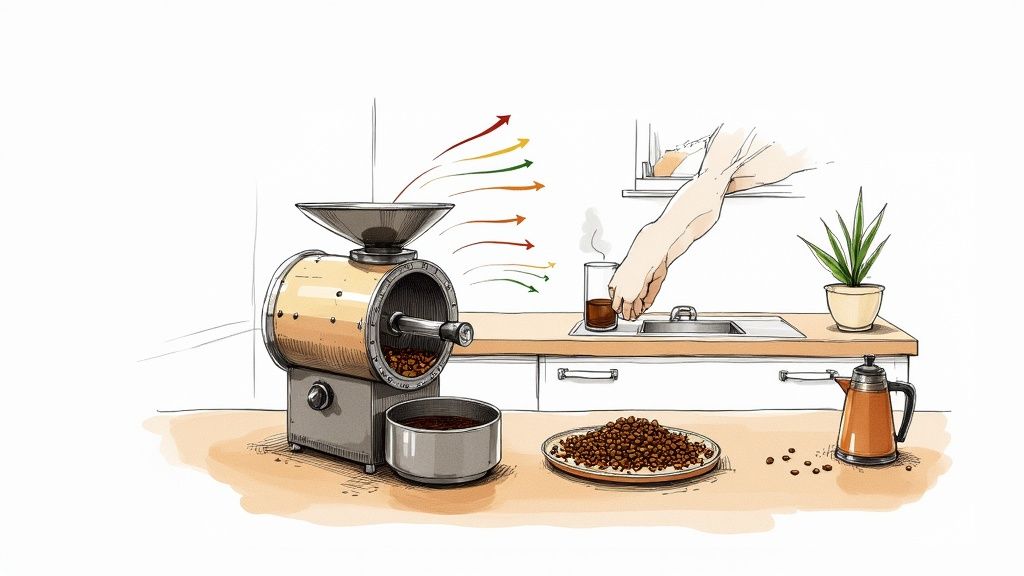
- Dark Roast: For those who love a bold, classic Italian-style macchiato, a dark roast is the way to go. These beans deliver rich, deep flavours of dark chocolate, tobacco, and roasted nuts. The minimal milk foam in a macchiato cuts through the intensity just enough to create a powerful, satisfying, and low-acidity drink.
- Light Roast: While less common for a traditional macchiato, a light roast can be an exciting choice for adventurous palates. These beans are high in acidity and showcase bright, floral, and fruity notes. The milk foam can help to temper the acidity, creating a uniquely vibrant and complex drink.
The macchiato is a test of your coffee's quality. A well-chosen bean will produce an espresso that stands strong, with the milk serving only to round off its sharpest edges and enhance its natural sweetness.
Single-Origin or Blend?
Another key decision is whether to use a single-origin bean or a blend. Single-origin coffees come from a specific farm or region and are prized for their unique and distinct flavour profiles. A blend, on the other hand, combines beans from different origins to create a more balanced and consistent flavour.
For a drink that highlights complexity, a single-origin is an excellent choice. However, for a reliable and well-rounded daily driver, a quality blend like those found in our range of whole bean coffee is hard to beat. You can also explore a curated selection of coffee beans ideal for espresso machines to find the perfect starting point for your next macchiato.
The Macchiato in Modern UK Coffee Culture
The classic espresso macchiato has found a comfortable home in the UK’s sophisticated and ever-expanding coffee scene, yet its name has also been borrowed for some very different modern drinks. This has led to a bit of a split identity. Order a "macchiato" in a large high-street chain today, and you might be served something that bears little resemblance to the traditional Italian original, sparking confusion even for seasoned coffee drinkers.
For a nation with a growing appetite for specialty coffee, the classic macchiato is a perfect fit. It's a true test of a barista's skill and the quality of the coffee beans themselves. It has become the go-to choice for those who value concentrated flavour and expert craft over sheer volume, a sentiment that resonates deeply within the UK's independent cafés.
Traditional vs Modern Interpretations
The main source of this confusion is the latte macchiato, a drink popularised by large coffee chains. It’s almost an inversion of the original. Instead of espresso being ‘marked’ by a dash of milk, a large glass of steamed milk is ‘marked’ by a shot of espresso poured through it. The result is a much milkier, layered, and less intense drink.
In stark contrast, the traditional espresso macchiato remains a purist’s drink. It's a small but mighty coffee where the espresso's character is the star of the show. It’s a drink that truly respects the bean.
The rise of specialty coffee in the UK means more people are actively seeking out authentic experiences. They are learning to appreciate the nuanced difference between a true espresso macchiato and its sweeter, milk-heavy high-street counterpart.
The UK's espresso coffee market, which includes drinks like the macchiato, is showing impressive growth. Brits already get through an incredible 98 million cups of coffee daily, and with the market projected to expand significantly between 2026 and 2030, the demand for high-quality, well-crafted coffee is only going to increase. If you're interested in the numbers, you can explore the full UK coffee market analysis from Research and Markets.
Common Questions About Espresso Macchiatos
Even after you get to grips with the basics, a few questions always seem to surface about this classic Italian drink. Getting these cleared up will round out your knowledge, helping you order, make, and enjoy your next macchiato with complete confidence.
We’re seeing a huge demand for high-quality roasted beans and the gear to brew them properly. In 2024 alone, UK coffee lovers bought 103.4 million kilograms of coffee, with roasted beans accounting for a massive 54.3% of that. You can dig into the numbers in the latest UK coffee statistics from Lavazza Professional.
Can you make a macchiato without an espresso machine?
While a true macchiato is built on a proper espresso shot, you can get surprisingly close at home without the big machine. The secret is brewing a really strong, concentrated coffee using a Moka pot or an AeroPress.
Once you’ve got your strong coffee base, just whip up a little foam with a handheld milk frother or even a French press. The taste won't be a perfect match, but it’s a brilliant way to enjoy the macchiato spirit.
The heart of a macchiato is the strong coffee base. As long as you can achieve a powerful coffee concentrate, you're most of the way there. The "mark" of foam is the finishing touch.
Is a macchiato stronger than an Americano?
Yes, absolutely. In terms of flavour intensity and concentration, a macchiato is a much stronger drink. Both start with a shot of espresso, so the caffeine content is usually about the same.
Where they differ is in the preparation:
- An espresso macchiato is just "marked" with a tiny bit of milk foam, leaving the bold, intense flavour of the espresso front and centre.
- An Americano is diluted with a good amount of hot water, creating a larger, milder-tasting coffee that’s closer in strength to a filter coffee.
How much caffeine is in an espresso macchiato?
The caffeine in an espresso macchiato comes almost entirely from the espresso itself. A standard single shot of espresso typically contains around 63mg of caffeine.
Because the drink only has a tiny splash of milk, the overall caffeine level is virtually identical to a straight shot of espresso. If you want a more detailed walkthrough, we have a complete guide on how to make a macchiato from scratch.
At ADS Coffee Supplies, we believe the best macchiatos start with the finest beans. Explore our collection of freshly roasted coffee, perfect for pulling that rich, flavourful espresso shot that makes all the difference. We also stock essential barista tools to help you craft the perfect cup at home or in your cafe.