
Tamping pressure how much for espresso: expert tips

When it comes to tamping pressure, how much force you really need is a classic debate in the coffee world. But let's cut through the noise: the sweet spot is generally between 15-30 pounds (about 7-14 kg) of consistent pressure. Honestly, the exact number isn't nearly as important as achieving a repeatable, perfectly level tamp every single time.
Debunking the Tamping Pressure Myth
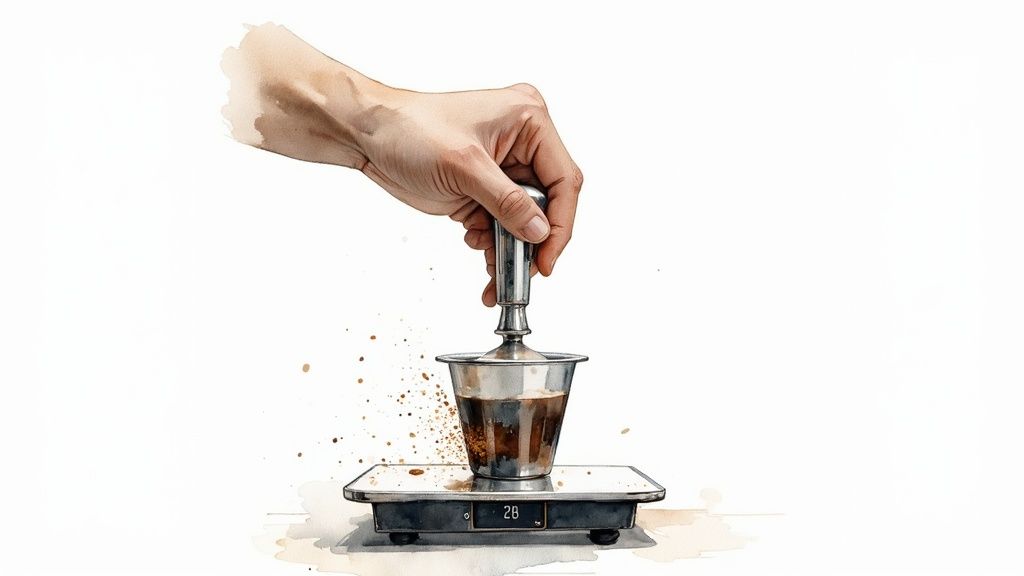
So many home baristas get hung up on hitting a precise number, thinking that more force somehow equals better coffee. The truth is, the point of tamping isn’t to crush the coffee grounds into oblivion. It’s all about creating a perfectly level and evenly compacted puck.
This uniform density is absolutely crucial. When your espresso machine shoves hot, pressurised water into the portafilter, an even puck makes sure that water flows through all the grounds at the same rate. This is extraction, and it’s where all the delicious flavour is born.
Why a Level Puck Matters More Than Brute Force
Think of your coffee puck as the foundation of your shot. If that foundation is uneven or has tiny cracks, water will always find and exploit those weaknesses. This nasty little phenomenon is called channelling, and it’s the number one killer of a good espresso.
When channelling happens, water bypasses most of the coffee and just rushes through the easiest path it can find. The result? A confusing shot that’s both under-extracted (sour, weak) and over-extracted (bitter, harsh) because different parts of the puck gave up their flavour at completely different rates.
The goal of tamping is to remove air pockets and create a uniform bed for even water flow. Consistency in your technique will always beat raw power.
Getting this right involves more than just downward pressure; it starts with good distribution of the grounds and a level press. It's also deeply tied to your grind. Having the right consistency in your grounds makes creating that perfect puck so much easier. For a deeper dive, our comprehensive coffee grind size guide can really shine a light on how grind impacts your whole espresso routine.
So, how do you stop guessing and start tamping with purpose? You have to let go of the obsession with a specific number and focus on three key things instead:
- Even Distribution: Make sure your coffee grounds are level in the portafilter before you even think about tamping. You can explore our range of distribution tools to help with this.
- Consistent Pressure: Apply the same amount of force every time, landing somewhere in that 15-30 lb range.
- Level Tamp: Keep your wrist straight. This ensures the tamper presses down perfectly flat, not at an angle.
Nailing these fundamentals is the first real step toward pulling consistently delicious, café-quality espresso right in your own kitchen.
Why Consistent Tamping Is Key to Great Extraction
Ever wondered why we even bother with tamping? It all boils down to creating the right conditions for a brilliant extraction. A perfectly tamped puck of coffee creates just enough resistance, forcing that hot, pressurised water to work its way evenly through every single ground, pulling out all the delicious flavours, oils, and aromas.
Think of the coffee in your portafilter as a gatekeeper. Your job, with the tamper, is to arrange those grounds into a firm, level barrier. Get it right, and the water flows through uniformly, leading to a balanced and genuinely tasty shot of espresso.
The Dangers of an Inconsistent Tamp
When your tamp is too light or, worse, uneven, it's like trying to brew coffee through a pile of loose gravel. Water is lazy; it will always take the easiest path. It blasts through any weak spots, carving out little rivers—or channels—that bypass most of the coffee.
This messy business, known as channelling, is the number one culprit behind a disappointing espresso. The result? A fast, watery, and unpleasantly sour shot. You've essentially just washed the coffee instead of properly brewing it.
On the flip side, going overboard with the pressure or tamping at an angle creates an overly dense, compacted puck. This barrier becomes almost impermeable, forcing the water to struggle to get through. You’ll see the machine strain, the flow slow to a pathetic drip, and the final shot will likely be bitter, harsh, and over-extracted.
The consistency of your tamping pressure is far more important than the exact force you apply. An even, repeatable tamp creates a predictable environment for water flow, which is the secret to unlocking consistent flavour.
Finding the Right Balance
Nailing that perfect balance is really a game of consistency. The goal is to compress the coffee just enough to stand up to the machine's 9 bars of pressure, but not so much that you choke the flow of water completely. This sweet spot ensures the water spends the perfect amount of time mingling with the coffee grounds.
This balance is also directly tied to your brew ratio and shot timing. A well-prepared puck is what allows you to control those other variables with any kind of precision. If you want to get a better handle on this, understanding how to dial in your espresso ratio is a crucial next step.
Ultimately, tamping isn't about brute force; it’s a skill with a bit of nuance. It’s about creating the ideal stage for a perfect extraction by managing how the water behaves. Once you master this, you take real control over the final taste in your cup, turning what can be a frustrating variable into a rewarding part of your daily ritual.
Developing Your Tamping Technique
Forget the numbers for a moment. Perfecting your tamping is less about hitting a specific pressure figure and more about building consistent, reliable muscle memory. It’s a physical skill, and once the core mechanics click, your entire espresso routine will feel more natural.
The whole process starts with your stance. Get comfortable and place the portafilter on a dead-level surface. A sturdy tamping mat is ideal for this. The key is to align your shoulder, elbow, and wrist in a straight line directly over the tamper. This vertical setup ensures all your pressure goes straight down, preventing an angled tamp—one of the most common reasons for an uneven coffee puck.
Mastering the Grip and Press
How you hold the tamper is surprisingly important. Grip it like you’re turning a doorknob, with your thumb and index finger near the base and your palm resting squarely on top. This gives you far more control and helps you feel any tilting. Tamping with just your fingertips is a recipe for a wobbly, uneven press.
Think of the actual motion as a smooth, two-part action:
- The Settling Press: First, give it a light, gentle press. This isn’t about compressing the grounds yet; you’re just settling them into a nice, level surface, preparing the bed for the main event.
- The Main Compression: Now, with your arm properly aligned, apply that firm, downward pressure. Push straight down until you feel the coffee puck become solid and push back. The moment the coffee stops compressing is your signal to stop.
As you release the pressure, finish with a gentle "polishing" twist. This little move just smooths out the surface of the puck. Here’s a pro tip: use the rim of your tamper as a visual guide. If it’s perfectly parallel with the rim of the portafilter basket, you've nailed a level tamp.
With a bit of practice, this conscious effort will become a single, fluid motion. Of course, the right tools help enormously. A tamper that fits your hand well makes the whole process more comfortable and repeatable.
The diagram below shows exactly how different levels of pressure can take your shot from sour to bitter.
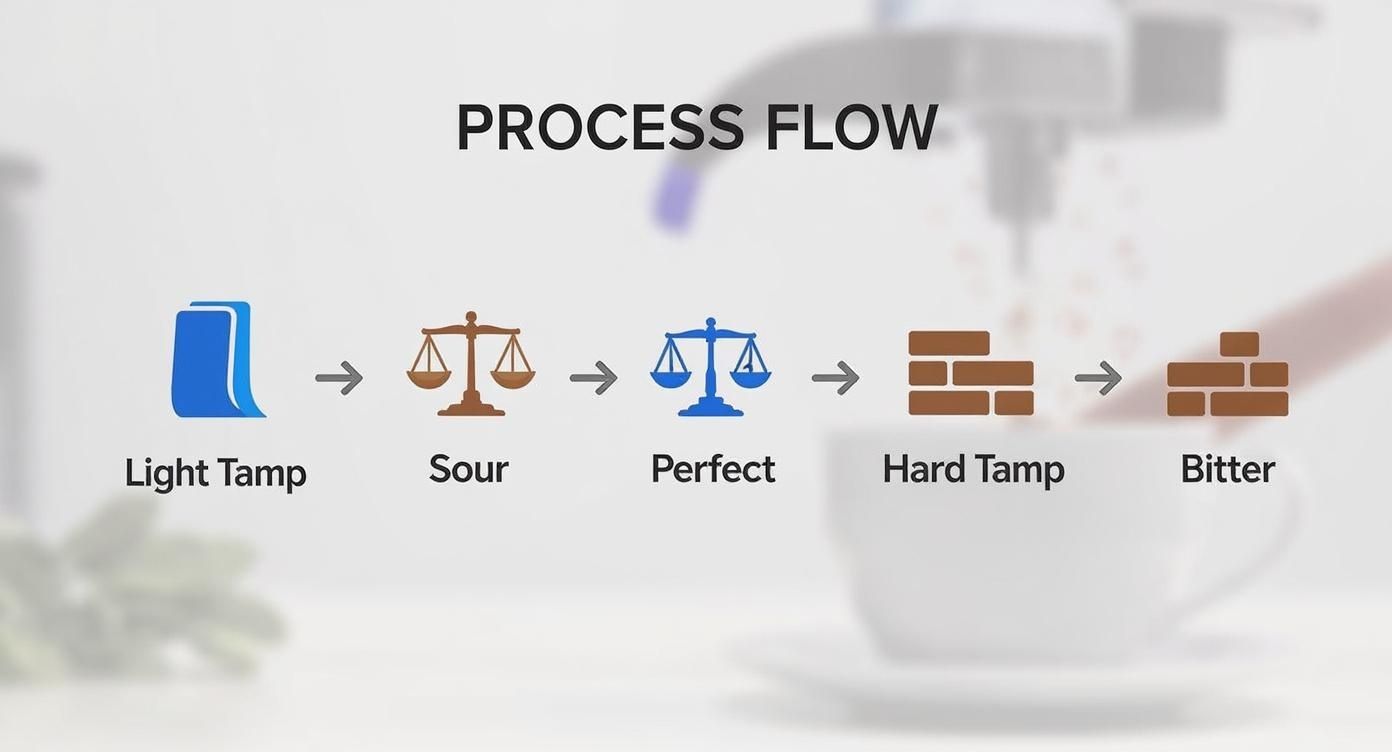
It’s easy to see how finding that sweet spot—that balanced, even pressure—is critical.
The Importance of a Solid Foundation
Interestingly, the idea of using controlled pressure for compaction isn’t unique to coffee. You can see parallels in heavy industry, like the mechanised railway tamping machines developed in the UK. Back in the 1960s, early hydraulic systems were applying 10 to 15 tonnes of controlled pressure to compact track ballast, creating a stable foundation for the rails.
Your goal with tamping is simple: eliminate any inconsistencies in the coffee bed before the machine's high-pressure water finds them for you. A straight, even tamp creates a resilient puck that encourages water to flow through it uniformly.
While you won’t be generating tonnes of force, the principle is identical: consistent, controlled pressure builds a stable foundation. But tamping is only half the battle. If your coffee grounds aren't evenly distributed before you tamp, you’re already fighting a losing battle against channelling.
To get the full picture, check out our complete puck prep guide covering WDT and distribution. When you combine proper distribution with a masterful tamping technique, you're setting the stage for a truly exceptional espresso.
How To Measure And Calibrate Your Tamp
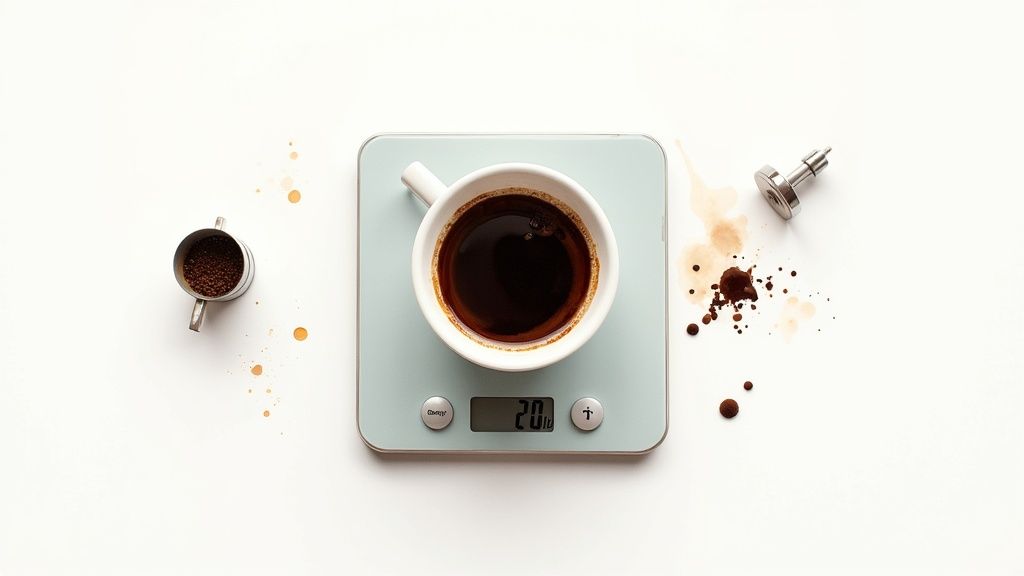
While consistent technique is vital, it’s tough to ‘feel’ the right amount of force every single time. Taking the guesswork out of the equation is one of the fastest ways to improve your espresso, and thankfully, it's pretty easy to measure and calibrate how much pressure you're actually applying.
The most accessible method uses a tool you almost certainly have in your house: a set of bathroom scales. It’s a classic trick for a reason—it works perfectly for building muscle memory. Just place your portafilter on the scales, zero them out, and press down with your tamper until you reach your target weight.
Aim for somewhere in the 20 lb (around 9 kg) range as your starting point. Do this a few times, really paying attention to how that pressure feels in your hand and arm. The goal isn't to use the scales forever, but to train your body to replicate that exact pressure instinctively.
The Bathroom Scale Method
To get an accurate measure, it helps to understand the basic idea of what is force measurement and how the scales give you a simple, visual representation of it.
- First, place a folded tea towel on your scales. This protects them and creates a stable base.
- Next, rest your portafilter on the towel and hit the 'tare' or 'zero' button.
- Get into your usual tamping stance and press down firmly and evenly on the portafilter until the scale reads 20 lbs.
- Hold that pressure for a few seconds to memorise the feeling. Repeat this a handful of times until you can hit the number reliably without much thought.
This simple exercise can make a massive difference to your consistency. After just a few sessions, you'll be surprised at how accurately you can judge the pressure without any help.
Upgrading To A Calibrated Tamper
For those who crave absolute consistency and just want to eliminate any doubt, a calibrated tamper is a fantastic investment. These clever tools are designed with an internal spring mechanism that gives you real-time tactile feedback. You'll feel a distinct 'click' or a slight yielding sensation once you've reached a pre-set pressure.
A calibrated tamper removes the single biggest variable in tamping: inconsistent human force. It ensures that every single puck is compressed with the exact same pressure, shot after shot.
This simple upgrade can completely transform your espresso routine by making one crucial step perfectly repeatable. While developing a good feel for tamping is a rewarding skill, a calibrated tool provides certainty from day one. For any home barista who values precision, our selection of calibrated tampers are the perfect solution for achieving flawless consistency.
Fixing Common Tamping and Extraction Problems
Even when you think you’ve got your technique down, a disappointing shot can still happen. Let’s treat this section as your diagnostic toolkit, helping you figure out what went wrong and how your tamping might be the hidden culprit.
The most common—and frustrating—issue you'll encounter is channelling. This is what happens when pressurised water finds the path of least resistance in your coffee puck and blasts right through it. Instead of a nice, even flow, you get an uneven extraction, which is the number one reason a shot can taste both sour and bitter at the same time.
Spotting the Signs of Channelling
Keep a close eye on the shot as it pulls. If you’re lucky enough to have a bottomless portafilter, you might see tiny "geysers" of water spurting out from the basket. Another dead giveaway is the shot blonding (turning pale yellow) way too quickly. These are crystal clear signs that water isn't flowing through the coffee puck uniformly. More often than not, an uneven tamp is to blame.
Once the shot is done, have a look at the spent coffee puck. Are there little pinholes, cracks, or is it just a soupy, muddy mess? A well-extracted puck should be firm, relatively dry, and knock out of the portafilter in one solid piece. Any sign of disturbance means water has forced its way through a weak spot.
Connecting Taste to Tamping Flaws
Ultimately, the taste of your espresso is your best feedback. It tells you exactly what went wrong and points you towards a solution. Learning to read these flavour cues is a game-changer for any home barista.
Here’s a quick guide to diagnosing your shot by taste:
- Consistently Sour or Acidic: This almost always points to under-extraction. The water has rushed through the coffee too fast, probably because your tamp was too light or, more likely, uneven. This created channels for the water to zip through.
- Harsh, Bitter, and Dry: This is a classic sign of over-extraction. The water struggled to push through the coffee puck, which can happen if your tamp was excessively hard or you compressed it at an angle, creating dense spots that choked the machine.
Remember, a level puck is far more important than a forceful one. A slightly lighter but perfectly even tamp will always produce a better-tasting shot than a heavy, crooked one.
The solution often starts before you even pick up your tamper. Using a distribution tool can make a world of difference by breaking up clumps and creating an even bed of coffee grounds. This simple step makes achieving a level tamp much easier and dramatically reduces the risk of channelling. For more tips on pulling the ideal shot, our guide on how to make perfect espresso provides a great overview of the entire process.
Your Tamping Pressure Questions Answered
Let's get into some of the most common questions that pop up when you're trying to nail your tamping technique. Think of this as your quick reference guide for those little details that can make a huge difference in the final cup.
We'll cut straight to the point and give you the practical advice you need to pull consistently great shots.
Should I Change Tamping Pressure For Different Beans?
This is a fantastic question, but the short answer is almost always no. While it's true that different beans, roast levels, and even the age of the coffee will behave differently in the basket, your tamping pressure should be the one thing you keep constant.
If you find a new bag of beans is pulling too fast or too slow, your first port of call should always be the grind size. Changing your tamp pressure just adds another variable into the mix, making it much harder to figure out what's going wrong. Instead, keep that tamp consistent—aim for that 15–30 lb sweet spot—and adjust your grinder to be finer (to slow the shot) or coarser (to speed it up). It’s simply the most reliable way to dial in a new coffee.
Is a Calibrated Tamper Really Worth It?
For any home barista who’s serious about consistency, a calibrated tamper is an absolutely brilliant investment. It takes all the guesswork out of the equation. These tools have a built-in spring mechanism that gives a satisfying click or yields at a pre-set pressure, so you know you're applying the exact same force every single time.
You can definitely develop a good feel for the right pressure using the old bathroom scale trick, but a calibrated tool gives you that certainty right from the start. If you're pulling your hair out over inconsistent shots, this one upgrade could be the key to unlocking repeatable, delicious espresso. We highly recommend having a look at our range of premium coffee tampers to find one that fits your setup.
So, what’s more critical: hitting a precise pressure or making sure the tamp is perfectly level? While both matter, a perfectly level coffee bed is the undisputed champion.
An uneven tamp, even with the "perfect" amount of force, is a one-way ticket to channelling. Water is lazy; it will always find the path of least resistance, exploiting any low-density spots. This leads to a shot that's simultaneously sour and bitter—the worst of both worlds. A slightly lighter tamp that's perfectly flat will always beat a heavy but crooked one, producing a far more balanced and better-tasting espresso.
Focus on getting that coffee bed perfectly level first, and then work on being consistent with your pressure.
At Seven Sisters Coffee Co, we believe the right tools and a bit of know-how make all the difference. Explore our full range of barista accessories and freshly roasted beans to elevate your home coffee experience at https://sevensisterscoffee.co.uk.