How to use a cafetière: Master the French Press in 5 Simple Steps

Using a cafetière couldn't be simpler, really. You add some coarsely ground coffee, pour in hot water, give it a stir, and wait four minutes. Then, you just gently press the plunger down. It's this straightforward immersion technique that unlocks a rich, full-bodied flavour that’s hard to beat.
Rediscovering the Richness of Cafetière Coffee
Diving into the world of cafetière coffee is like rediscovering a classic ritual that promises—and delivers—an exceptional cup every single time. It's a beautifully simple, hands-on method that coffee lovers have cherished for years, all because of the deep, robust flavour it coaxes from the beans. Here at ADS Coffee Supplies, from our roastery in East Sussex, we're big fans, and we'll walk you through how to get it just right.

Forget about complicated machines and fussy gadgets. We believe that with the right beans and a bit of know-how, you can turn your daily brew into something truly special. Think of this guide as your go-to companion for mastering the art of the French press, making sure every cup is a roaring success.
In the UK, an incredible 98 million cups of coffee are consumed every single day, and a huge number of those are brewed right at home. The cafetière is perfectly suited for this, as its immersion technique can extract 20-25% more flavourful oils than standard drip methods, which is the secret to its richer, more satisfying taste.
The enduring popularity of this method really comes down to a few key things:
- Full-Bodied Flavour: Its simple metal filter lets all the natural oils and fine particles through, creating that rich texture and satisfying mouthfeel you just don't get with paper filters.
- Beginner-Friendly: It’s an accessible and inexpensive way to get into brewing high-quality coffee at home without needing a load of specialised equipment.
- You're in Control: You have direct say over the important stuff—like water temperature, grind size, and how long you let it steep.
Why The Cafetière Stands Out
What really makes this brewer a standout is its elegant simplicity and the sheer quality of the coffee it produces. To get a better handle on picking the perfect beans, have a look at our guide on the best coffee for a French press. The direct, prolonged contact between the grounds and the water guarantees a thorough extraction, bringing out all the unique character locked inside the beans.
If you're thinking of an upgrade, a good quality Double Walled Colored French Press can really elevate your brewing game by keeping your coffee hotter for much longer. Consider this guide your starting point for making consistently delicious coffee with one of the most timeless brewers around.
Setting Up Your Home Brewing Station
Before a single bean gets near the grinder, having the right kit on hand makes all the difference. Honestly, getting your setup sorted is the first real step in learning how to use a cafetière properly. It turns a simple morning chore into a ritual you'll actually look forward to.
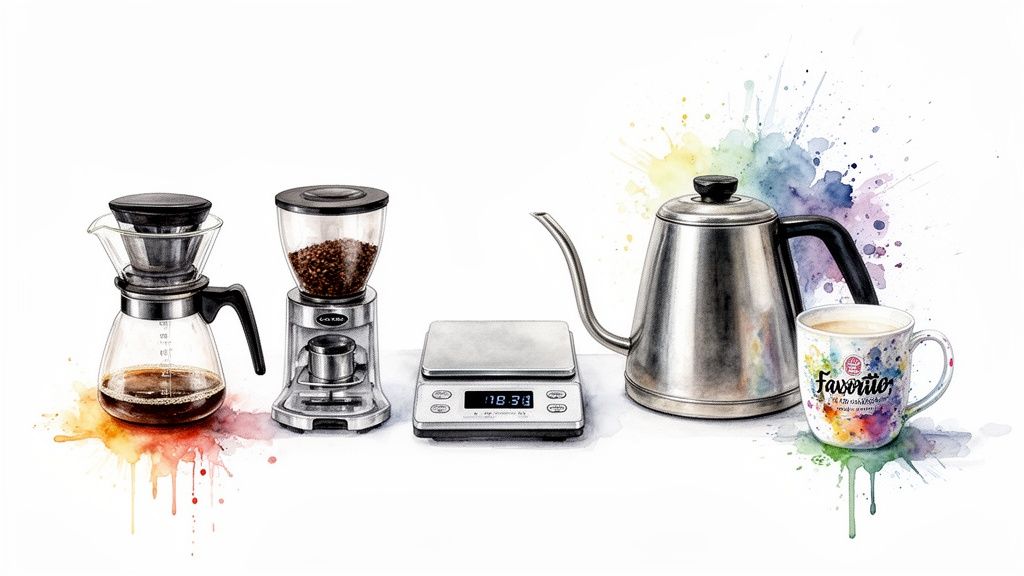
The centrepiece, of course, is the cafetière itself. Maybe you love a classic glass one where you can watch the magic happen, or perhaps a tough stainless steel version that holds its heat is more your style. Either way, it’s a personal choice.
Essential Brewing Companions
Beyond the press itself, a few other items will seriously level up your coffee game. Getting these ready beforehand just makes the whole process smoother and a lot more fun.
- A Quality Burr Grinder: This is the one thing I'd call non-negotiable for a great cafetière brew. Burr grinders give you a nice, consistent coarse grind, which is exactly what you need to avoid that sludgy, bitter taste you get from the uneven chop of a blade grinder. You can find excellent options in our coffee grinders collection.
- Digital Scales: Precision is your best friend. Weighing your coffee and water is the only way to guarantee you can make that perfect cup again and again.
- A Kettle: A fancy gooseneck kettle gives you amazing pouring control, but for a cafetière, any standard kettle will do the job just fine.
- A Timer: Four minutes is the golden rule for steeping time. Just use the timer on your phone or a simple kitchen one to take all the guesswork out of it.
The choice between a manual or electric grinder usually boils down to your budget and how much effort you want to put in. Electric grinders are quick and easy, but a good hand grinder gives you fantastic control and is often a more affordable way to get started on your home brewing journey.
Figuring out the right grinder is a big decision. If you're still on the fence, we've put together a detailed comparison of a hand grinder vs an electric coffee grinder to help you work out which is the best fit for you.
And finally, don't forget your favourite mug. Picking out the cup you’re going to enjoy your coffee from is that last, personal touch. With all your gear in place, you’re perfectly set up to brew a truly exceptional cup.
Finding the Perfect Beans and Grind
The quality of your final cup rests almost entirely on the coffee you start with. When you're learning how to use a cafetière, choosing the right beans and getting the grind spot-on is where the real magic happens. This is what turns a good coffee into a truly memorable one.
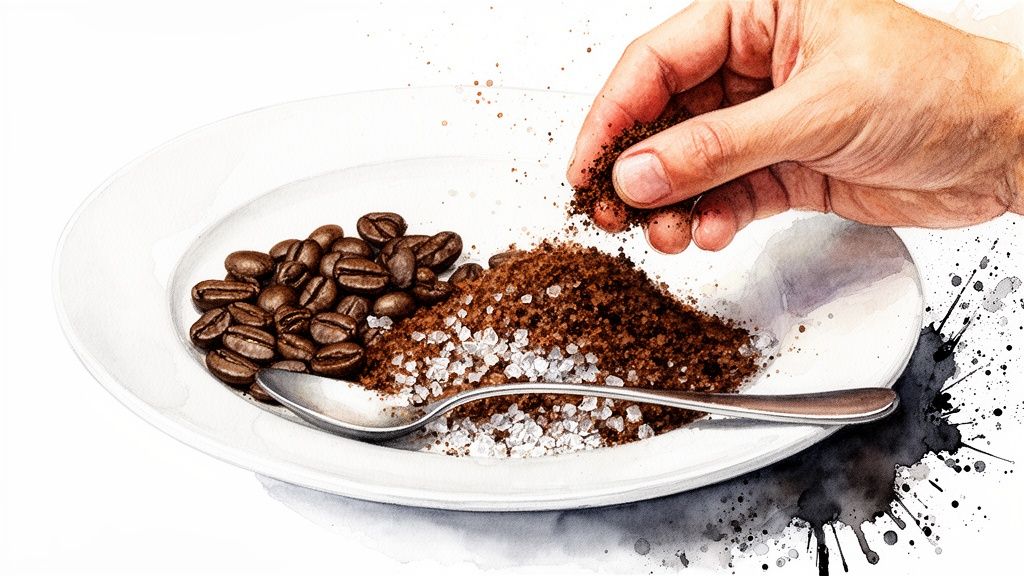
If there's one non-negotiable rule for cafetière brewing, it's the grind size. You absolutely need a coarse grind, with particles looking a bit like sea salt. A finer grind will over-extract in the hot water, creating that bitter, silty sludge at the bottom of your cup that nobody wants.
Why Freshly Ground Beans Matter Most
I can't stress this enough: grinding your beans just seconds before you brew makes a world of difference. The moment coffee is ground, it starts losing its volatile aromatic compounds—the very soul of its flavour and aroma. Our oxygen-free roasting process is specifically designed to lock in that freshness, so don't let it escape into the air.
By grinding whole beans yourself, you capture the coffee at its absolute peak. It's a small extra step that pays off massively in the final taste.
Choosing whole beans over pre-ground isn't just about freshness; it’s about control. It lets you dial in your grind size perfectly for the cafetière, which is the key to achieving a clean, sediment-free brew every single time.
Selecting the Right Coffee Profile
The full immersion style of a cafetière is brilliant at showcasing the unique character of different coffees. Because the grounds and water spend a good few minutes together, all those nuanced flavour profiles have time to fully develop. This makes your choice of bean especially important.
Here are a couple of our recommendations from our single origin coffee range that are perfectly suited to this brew method:
- For a Bright, Nuanced Cup: If you enjoy coffee with vibrant, fruity, and floral notes, a single-origin like our Ethiopian Yirgacheffe is an outstanding choice. Its delicate complexity really shines through with the full-bodied extraction of a cafetière.
- For a Classic, Full-Bodied Brew: Prefer something richer and more balanced? Our signature ADS House Blend from our coffee blends collection is a fantastic option, with classic notes of chocolate and nut. It delivers a consistently smooth and satisfying cup that’s a real crowd-pleaser.
Getting to grips with grind size is essential for mastering your brew. For a much deeper dive, you can explore our comprehensive coffee grind size guide which breaks down the specifics for every type of brewer. Ultimately, experimenting with different beans is half the fun—it’s how you’ll discover the profiles that you truly love.
Mastering the Four-Minute Brewing Ritual
This is where the magic really happens. Think of the next few minutes less like a rigid set of instructions and more like a mindful practice—a quiet moment to create something genuinely satisfying. It’s a simple ritual that, once you get the hang of it, will reward you with a consistently delicious cup of coffee every single day.
We'll start with what’s often called the 'golden ratio' of coffee to water. While you can definitely tweak this to your personal taste later on, a brilliant starting point is 1:15. In simple terms, that’s 1 gram of coffee for every 15 millilitres of water.
For a standard 1-litre cafetière, this works out to about 60 grams of coffee to 900ml of water. Don't worry if you're making a smaller amount; the ratio scales perfectly. A 350ml cafetière, for example, would need around 23 grams of coffee. Using digital scales is the secret to getting it right every time.
The Importance of Water Temperature
The temperature of your water is more critical than you might think. Water that's boiling hot will scorch the coffee grounds, leaving you with a bitter, unpleasant taste. The sweet spot is between 92-96°C.
An easy way to hit this temperature without a thermometer is to let your kettle click off and then just wait for about 60 seconds before you pour. This small pause allows the water to cool down just enough to be perfect for extraction. For those who want to dive deeper into the science, our guide on the best water temperature for coffee has all the detail you need.
Once your water is ready and your coarse grounds are in the pre-warmed cafetière, it's time for the bloom.
The Bloom and The Steep
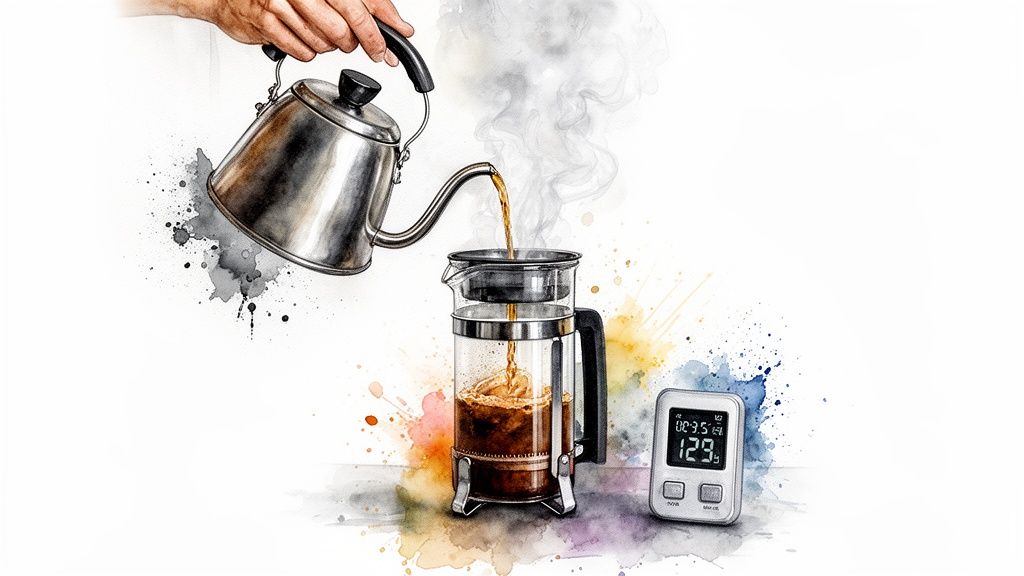
Start your timer and pour in just enough hot water to completely saturate all the grounds—roughly double the weight of the coffee itself is a good rule of thumb. You’ll see the coffee bed bubble up and expand. This is the 'bloom', a crucial 30-second phase where trapped carbon dioxide escapes from the fresh grounds.
After 30 seconds, give it all a gentle stir to make sure every particle is wet, then pour in the rest of your water. Pop the lid on with the plunger pulled all the way up, but don’t press it down yet.
Now, we wait. The total steeping time, including that initial bloom, should be four minutes. This is when the water works its magic, drawing out all the oils and soluble compounds that give your coffee its unique body and flavour.
The Final Press and Pour
When your four-minute timer dings, it’s time to plunge. The key here is to go slow and steady. If you push the plunger down too quickly or aggressively, you’ll stir up all the fine coffee particles at the bottom, forcing them back into your brew. The result? A silty, muddy cup.
Apply gentle, even pressure and take about 20-30 seconds to press the plunger all the way down. This calm, measured approach is vital for a clean and flavourful result. As soon as you've plunged, pour all the coffee into your mugs immediately to stop the brewing process.
If you're keen to truly master the art, you can find more detail in a comprehensive guide to making French Press coffee. By focusing on these details—the right ratio, perfect temperature, and a patient technique—you'll perfect your own brewing ritual in no time.
Troubleshooting Common Cafetière Problems
So, you've followed the steps, but your coffee isn't quite hitting the mark. Don't worry, it happens to everyone. Even seasoned pros need to tweak their technique now and then. Think of it less like a failure and more like fine-tuning your personal recipe. Every small adjustment you make is a step closer to that perfect cup, teaching you exactly how you like your coffee.
Nine times out of ten, any issues you're having will come down to one of three things: the grind size, your water temperature, or how long you let it brew. By tackling these one by one, you can quickly get to the bottom of the problem and make sure your next cafetière is spot on.
Diagnosing Your Brew
Is your coffee tasting a bit weak, watery, or even slightly sour? That’s a tell-tale sign of under-extraction. It basically means the water hasn’t pulled enough of the good stuff—the flavours, the oils, the sweetness—out of the coffee grounds.
Here’s how to fix it:
- Go a little finer. Your grind is probably too coarse. Adjusting it to be slightly finer gives the water more surface area to work with, helping it extract more flavour.
- Double-check your ratio. You might just need a bit more coffee. If you've been eyeballing it, now’s the time to grab some scales. Our guide on how many tablespoons per cup of coffee is a great place to start if you're unsure.
- Give it more time. Try adding another 30-60 seconds to your four-minute steep. That little bit of extra time can make a world of difference, adding some much-needed depth.
Correcting Bitter or Muddy Coffee
On the other hand, if your coffee has a bitter, harsh taste, you've likely gone too far the other way into over-extraction. This happens when the water has stripped too much from the grounds, including the unpleasant compounds that create that bitter flavour. Another common complaint is that gritty, sludgy layer at the bottom of your mug.
Let’s get that sorted:
- Coarsen up the grind. This is the number one culprit for both bitterness and sludge. A grind that's too fine allows for too much extraction and lets tiny particles slip through the filter. Dial your grinder to a coarser setting.
- Plunge gently. Slamming the plunger down in a hurry is a classic mistake. It forces fine grounds straight through the mesh filter. Aim for a slow, steady press that takes around 20 seconds.
- Watch the heat. It’s easy to assume boiling water is best, but it can actually scorch the coffee. Water that’s too hot is a common cause of bitterness. The sweet spot is around 95°C. Using water at this temperature helps the coffee retain up to 25% more of its delicate aromatic compounds, which massively boosts the final aroma and flavour.
A Quick Tip for a Cleaner Cup: If you really want an incredibly clean brew, try this little trick. After the four-minute steep, use a spoon to gently break the crust on top. Scoop off any foam and floating grounds, then let it sit for another five minutes before you plunge. This gives the sediment time to settle at the bottom, leaving you with a much cleaner cup.
Your Cafetière Questions Answered
Even when you think you've got the hang of it, a few questions always seem to bubble up. Let's tackle some of the most common ones we hear, helping you fine-tune your technique and get that perfect cup, every single time.
Can I Use Pre-Ground Coffee in My Cafetière?
Technically, yes. But should you? We’d strongly advise against it if you’re chasing the best possible flavour. Most pre-ground coffee is simply milled too fine for a cafetière, which almost always leads to a silty, over-extracted brew with a bitter finish. A coarse grind is essential for this method to work its magic.
If you find yourself in a pinch, look for a bag specifically labelled 'coarse grind for French press'. For a truly superior cup that unlocks all the bean’s aromatic potential, though, there's no substitute for grinding your own whole beans right before you brew.
What Is the Best Way to Pour to Avoid Sediment?
A little bit of fine sediment is part of the cafetière's charm, but you don't want a mouthful of it. To keep your cup clean, the secret is a slow, steady pour as soon as you've finished plunging.
Pour everything in one continuous, gentle motion—try not to stop and start. As you near the bottom of the pot, just leave the last centimetre or so of coffee behind. That's where most of the silt settles, and leaving it in the pot makes a world of difference to the final cup.
One of the biggest mistakes people make is leaving coffee in the cafetière after plunging. You have to decant it all immediately. Any coffee left sitting on the grounds will keep extracting and quickly turn bitter and harsh. Pour it into your mugs or a thermal flask to lock in that perfect flavour.
How Should I Clean My Cafetière Properly?
A clean pot is non-negotiable for fresh-tasting coffee. First things first, scoop or spoon the used grounds into your food waste, compost, or bin. Never wash them down the sink—they’re a fast track to serious plumbing blockages.
Next, take the plunger mechanism apart completely. Give the glass carafe and all the filter components a good wash with warm, soapy water and a non-abrasive sponge, then rinse everything well. For an occasional deep clean to get rid of stubborn coffee oil buildup, a specialised coffee equipment cleaner will keep your cafetière in prime condition. This simple habit stops old, stale flavours from ruining your next brew.
At ADS Coffee Supplies, we believe everyone deserves a brilliant cup of coffee. Explore our full range of ethically sourced, freshly roasted beans and find your perfect match today at https://ads-coffee-supplies.co.uk.