How to Make Lungo at Home: A Perfect Brew Every Time

Making a lungo at home is much simpler than it sounds. At its heart, you're just pulling a shot of espresso but using roughly double the amount of water. This little tweak creates a larger, milder, yet still richly flavoured coffee that hits a beautiful sweet spot—it’s less intense than a straight espresso but packs more character than your typical Americano.
What Is a Lungo and Why Brew It at Home?

Ever spotted "lungo" on a café menu and wondered what really separates it from its more famous Italian cousins? In Italian, lungo literally translates to "long," which is the perfect clue. It’s a "long pull" espresso, meaning the extraction process is stretched out, letting more water flow through the same amount of coffee grounds.
This is a crucial distinction. Unlike an Americano, where hot water is simply added to a finished espresso shot, a lungo develops its unique flavour throughout one continuous extraction. This extended process coaxes out different compounds from the coffee, creating a profile that’s entirely its own.
A lungo offers a beautiful middle ground. It captures the aromatic crema and body of an espresso but delivers it in a larger, more sippable volume. It’s perfect for those moments when a tiny espresso just won't cut it.
The Appeal of the Home-Brewed Lungo
Bringing the lungo experience into your own kitchen is about more than just copying a café drink. It’s about having complete control, saving a bit of money, and the quiet satisfaction of mastering a new brewing skill. When you brew at home, you get to fine-tune every single detail—from the beans you choose to the exact water ratio—to create a cup that’s perfectly dialled in for you.
Here in the UK, we've seen a real shift towards quality home brewing. Making your own lungo taps right into this trend, where the daily coffee ritual has become a cherished part of home life. While instant coffee still has its place, a growing number of us, especially millennials, are investing in proper ground coffee and home espresso machines.
In fact, the average UK coffee lover spends around £16 per month on coffee for home use. That figure really highlights our commitment to enjoying a quality brew without having to leave the house.
Understanding the Key Differences
To really get what makes a lungo special, it helps to see how it stacks up against other common espresso-based drinks. The magic is all in how water is used.
To make things crystal clear, here’s a quick breakdown of how a lungo compares to its close relatives, the espresso and the Americano.
Lungo vs Espresso vs Americano: A Quick Comparison
| Characteristic | Lungo | Espresso | Americano |
|---|---|---|---|
| Preparation | Single "long" extraction | Single short extraction | Espresso shot + hot water |
| Water Ratio | High (e.g., 1:3 or 1:4) | Low (e.g., 1:2) | Variable (water added after) |
| Volume | Larger (~60-90 ml) | Small (~30 ml) | Largest (150 ml+) |
| Flavour Profile | Milder, more body, slightly bitter | Intense, concentrated, rich | Diluted espresso flavour |
| Crema | Thinner, lighter colour | Thick, rich, dark | Thin or dissipated |
As you can see, it's the continuous, longer extraction that gives the lungo its unique body and flavour profile, setting it apart from just adding water later.
This fundamental difference is why a lungo has a character all its own. It’s just one of the many fascinating variations in the coffee world, and you can learn more by checking out our guide to the 10 common types of coffee drinks. Once you understand these distinctions, you're well on your way to perfecting your favourite style of coffee right in your own kitchen.
Choosing Your Equipment for the Perfect Lungo
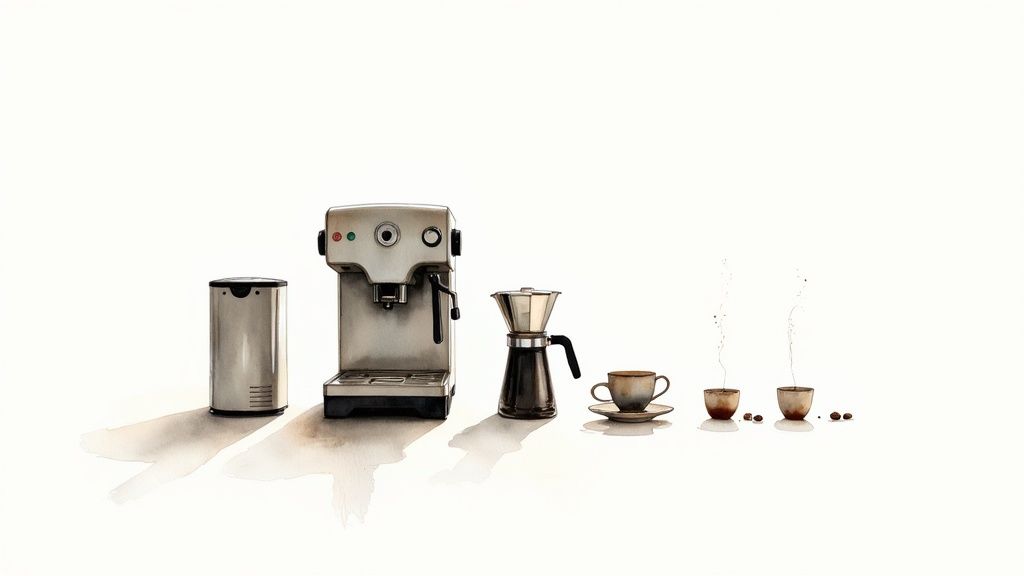
The secret to a brilliant home-brewed lungo isn’t about having the most expensive gear. It’s about choosing the right tools that fit your kitchen and your personal brewing style. Whether you love the hands-on control of a manual setup or just want a great coffee with one touch, there's a perfect machine waiting for you.
Home coffee making in the UK has come a long way. While we all love a trip to the local coffee shop, a huge 90% of all coffee is actually consumed outside of cafés. This tells us there's a real desire to bring that café quality home. Brewing a proper lungo is the perfect example of this shift, letting you craft your favourite drinks without stepping out the door.
The Espresso Machine: The Gold Standard
For the true enthusiast looking to master how to make lungo at home, a semi-automatic espresso machine is the ultimate choice. It gives you complete control over every single variable that shapes your final cup—from the grind and dose to the water temperature and extraction time.
While they come with a bit of a learning curve, the payoff is immense. You can experiment with different beans and fine-tune your ratios, dialling in a shot that’s perfectly suited to your palate. It’s a rewarding process that turns your daily coffee into a genuine craft. If you're weighing your options, our detailed comparison of espresso machines versus bean-to-cup models can help you decide which path is right for you.
Pro Tip: When pulling a lungo on a manual machine, watch the stream from the portafilter closely. Once it turns pale and watery (what we call ‘blonding’), it’s time to stop the shot. This prevents those bitter, over-extracted flavours from creeping into your cup.
Pod Machines: The Path to Consistency
If your mornings are more about speed and simplicity, a pod machine is an excellent and reliable alternative. Many modern machines from brands like Nespresso and Lavazza have a pre-programmed "lungo" button, designed to push the perfect amount of water through their dedicated lungo pods.
What you might trade in customisation, you absolutely gain in convenience and consistency. This makes pod machines a fantastic entry point for anyone wanting a reliable lungo without the fuss of grinding beans and tamping grounds.
Here’s a quick look at the main options:
- Semi-Automatic Espresso Machine: Offers maximum control for the dedicated home barista. You dictate the grind, dose, tamp, and extraction.
- Pod Machine: Delivers convenience and consistency with pre-set lungo functions. Perfect for busy mornings when you still want a quality coffee.
- Moka Pot or AeroPress: Budget-friendly and versatile brewers that can produce a strong, lungo-style coffee with the right technique.
Creative Alternatives: Moka Pot and AeroPress
You don't necessarily need a high-pressure machine to enjoy a lungo-style coffee. With a bit of creative thinking, you can get surprisingly close using more traditional, budget-friendly brewers.
Making a Lungo with a Moka Pot
The Moka pot, a stovetop classic, brews a strong, concentrated coffee that makes a great base. To adapt it for a lungo, simply dilute the finished brew with a little hot water. Try a ratio of about two parts Moka pot coffee to one part water. This creates a drink with a robust body and rich flavour, very much in the spirit of a true lungo.
Using an AeroPress for a Lungo-Style Brew
The AeroPress is famous for its versatility, and it can definitely produce a lungo-like coffee. Start by brewing a concentrated shot using a fine grind and a quick plunge. Then, top it up with hot water—similar to an Americano, but aiming for that higher 1:3 or 1:4 coffee-to-water ratio that defines a lungo. This approach gives you a clean, full-bodied cup that beautifully highlights the coffee's character.
Ultimately, the best equipment is whatever fits seamlessly into your daily routine and helps you brew a coffee you genuinely love.
Selecting the Best Coffee Beans for Your Lungo
Choosing the right beans is really the secret to getting a great lungo at home. Because a lungo pulls about twice as much water through the grounds as a standard espresso, the coffee's character gets stretched thin. If you use the wrong bean, you'll end up with a cup that’s weak, sour, or just plain bitter. Not what we're aiming for.
That longer extraction time means we need a coffee with enough backbone to stand up to the extra contact without falling apart. This is where the roast profile and origin become so important. Lighter roasts, with all their bright, delicate, and often acidic notes, tend to turn sharp and unpleasant in a lungo. All that extra water just seems to amplify their acidity in a way that isn't very flattering.
Instead, your best bet is always going to be a medium to dark roast. These roasts have had more time to develop those deeper, richer flavours that are just perfect for a longer pull. The roasting process tones down the zesty acidity and brings out notes of chocolate, nuts, and caramel—exactly the kind of flavours that hold up beautifully in a lungo, giving you a balanced, full-bodied, and satisfying drink.
What to Look for in a Lungo Bean
When you're browsing for beans, keep an eye out for flavour profiles that sound rich and comforting. You'll want to think less about "citrus" and "floral" and lean more towards descriptions like "dark chocolate," "toasted almond," or "brown sugar." These are usually a dead giveaway that the coffee has the body and depth to make a fantastic lungo.
- Low Acidity: A coffee that's naturally low in acidity will help you sidestep that sourness that can sometimes creep in with a longer pull.
- Good Body: You're looking for a bean that gives the final drink a satisfying weight and texture, even with the extra water.
- Rich Flavour Notes: Look for descriptions that mention chocolate, caramel, nuts, or even some subtle smoky notes.
For a classic, crowd-pleasing lungo, you really can’t go wrong with a high-quality single-origin from South America. We’re big fans of the Brazilian single-origin from Fazenda São João. Its profile of milk chocolate and hazelnut, paired with its naturally low acidity, makes it an absolutely perfect choice for a smooth and delicious lungo, time after time.
Why Blends Can Be a Great Choice
While single-origin beans are fantastic for exploring specific flavours, don't overlook a well-crafted blend. Roasters create blends to hit a specific, consistent, and balanced flavour profile that you might not find in any single bean. A good espresso blend is often designed for versatility, meaning it holds up well in all sorts of drinks—including the lungo.
For a perfectly balanced cup that’s consistently smooth, the Seven Sisters Signature Blend is an exceptional choice. It’s been expertly put together to deliver a rich, full-bodied experience with a sweet finish, making it another brilliant option for your daily lungo. If you want to go even deeper into choosing the right coffee, our article on finding the best beans for espresso coffee has a lot more detailed advice.
The most important factor, regardless of origin or roast, is freshness. Coffee is at its absolute best within a few weeks of being roasted. Always check for the "roasted on" date on the bag to make sure you're getting the most vibrant and aromatic cup possible.
Ultimately, picking the best bean boils down to your personal taste. Don't be afraid to try out a few different medium-to-dark roasts to see what you enjoy most. Paying a little attention to the bean's profile is the first major step towards mastering that perfect lungo at home.
Mastering the Lungo Brewing Process
Alright, you’ve got your equipment sorted and some fantastic beans ready to go. Now for the fun part: pulling a truly exceptional lungo. This is where the magic really happens, and it all comes down to understanding a few key variables and how they play together to create that balanced, rich, and satisfying cup you’re after.
This simple chart gets to the heart of what matters most: picking the right roast, knowing its flavour profile, and making sure it's absolutely fresh.
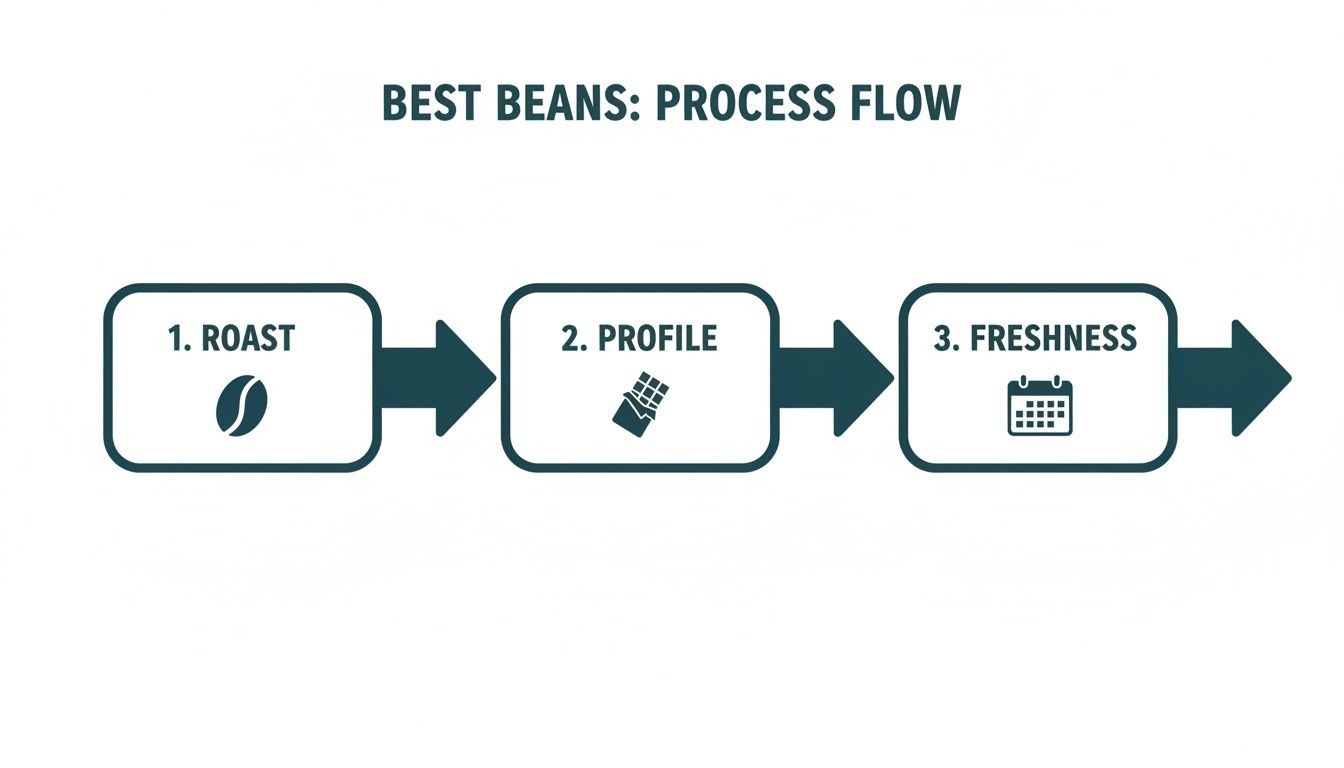
It’s a great reminder that a brilliant lungo starts long before you even touch the grinder. It begins with choosing a coffee that has the depth and character to stand up to a longer extraction.
Nailing the Grind Size
First things first, and arguably the most important step, is getting your grind right. For a lungo, you need a grind that’s slightly coarser than your standard espresso setting. This is a non-negotiable adjustment. Why? Because the water is in contact with the coffee for much longer, a fine espresso grind will lead to over-extraction. The result? A bitter, harsh, and frankly unpleasant taste.
Think of it like brewing tea. If you let a very fine tea steep for too long, it gets tannic and astringent. It’s the same principle here. A slightly coarser grind lets the water flow through a bit more freely, pulling out all those delicious flavours without dragging the unwanted bitter compounds along with them.
A good starting point is to dial in your grinder for a normal espresso, then adjust it one or two notches coarser. You’ll probably need to experiment a little to find the sweet spot for your specific beans and machine, but this will get you in the right ballpark.
Perfecting Your Dose and Tamp
Consistency is king when it comes to a good extraction, and that starts with your dose and tamp. For a standard double-shot portafilter, a dose of around 18-20 grams is the industry standard. The main thing is to use the same amount every single time to ensure your results are repeatable.
Once your grounds are in the portafilter, it’s time to tamp. The goal is simple: create a flat, level, and evenly compressed puck of coffee.
- Distribute Evenly: Before tamping, a few gentle taps on the side of the portafilter will help settle the grounds and create a level surface.
- Tamp with Firm, Even Pressure: Place your tamper on the grounds and press down firmly and evenly. You don’t need to go full Thor on it; consistent pressure is far more important than brute force.
- Keep it Level: A level tamp is crucial. If your puck is uneven, you’ll get channelling – where water finds the easy way through and bypasses chunks of coffee, leading to a weak, under-extracted, and unbalanced shot.
Tamping is less about how hard you press and more about creating a uniformly dense puck. This forces the water to pass through the entire bed of coffee evenly, extracting flavour consistently from all the grounds.
The Art of the Extraction
This is the moment of truth. With your portafilter locked and loaded, it’s time to start the brew. For a proper lungo, you’re aiming for a brew ratio of 1:3 to 1:4. In simple terms, for every gram of dry coffee you use, you want 3 to 4 grams of liquid espresso in your cup.
So, if you started with an 18-gram dose, you’ll be looking for a final drink weighing between 54 and 72 grams. Trust me on this: using a small coffee scale to weigh your output is the single best way to guarantee a consistent brew, day in and day out.
The entire pull should take somewhere between 45 and 60 seconds. That’s a lot longer than a typical espresso, which usually clocks in around 25-30 seconds.
This home-barista trend is growing, and it’s no surprise. While UK coffee consumption is a modest 2.9 kg per person per year, there’s a massive culture around speciality drinks. In fact, 80% of UK adults visit coffee shops weekly. That exposure to great coffee naturally inspires people to experiment at home, making drinks like the lungo a popular choice for those wanting to get the most out of their machines.
Keep an eye on the pour itself. It should begin as a dark, rich stream that slowly lightens in colour. When the stream becomes very pale and watery (what baristas call 'blonding'), you’ve extracted all the good stuff. It's time to stop the shot to avoid a thin, bitter finish.
For a much deeper dive into getting these numbers just right, our guide on how to dial in your espresso ratio is packed with detailed, practical advice.
Troubleshooting Common Lungo Brewing Problems
Even with the best beans and the slickest setup, some days your lungo just won’t play ball. It happens to all of us, from seasoned baristas to home brewers just getting started. The real skill isn't always pulling the perfect shot, but knowing how to figure out what went wrong and fix it.
Most brewing headaches boil down to one of two things: under-extraction or over-extraction. Think of extraction as the magic moment water pulls all the delicious flavours from your coffee grounds. Nailing that balance is the secret to a truly great cup.
Diagnosing a Sour or Acidic Lungo
If your lungo hits you with a sharp, sour taste—sometimes even a bit salty—you’re almost certainly dealing with under-extraction. This is what happens when the water zips through the coffee grounds too fast, not giving it enough time to grab all the sweet, rich compounds. It’s like pulling a cake out of the oven ten minutes early; all the right ingredients are there, they just haven't had time to come together.
To fix this, you need to slow things down. Here are the best ways to do it:
- Fine-tune Your Grind: This is your number one tool. A grind that’s too coarse leaves big gaps for water to rush through. Try adjusting your grinder just one or two notches finer. This creates more surface area and resistance, giving the water more time to work its magic.
- Check Your Dose: Not using enough coffee can also lead to a speedy shot. Make sure you’re dosing consistently, usually somewhere between 18-20 grams for a standard double basket.
- Perfect Your Tamping: A soft or uneven tamp creates little rivers, or channels, where water bypasses the coffee instead of flowing through it evenly. Aim for firm, level pressure every single time to create a solid, uniform puck.
The trick is to make small, deliberate changes. Tweak one thing at a time, pull another shot, and taste the difference.
Solving a Bitter or Burnt Taste
On the other end of the spectrum, if your lungo is overwhelmingly bitter, harsh, or tastes a bit burnt and hollow, you’ve strayed into over-extraction territory. This happens when water hangs around in the coffee for too long, stripping out not just the good stuff but all the unpleasant, bitter compounds too.
To get back on track, you need to speed up the water's flow. It's basically the reverse of fixing a sour shot.
It’s easy to confuse a strong, rich flavour with bitterness. A well-pulled dark roast should be bold and intense, but never acrid. True bitterness is that lingering, dry taste that sticks to the back of your palate.
Your goal is to make the water's journey through the grounds a little easier.
- Coarsen Your Grind: If your grind is too fine, it’s like trying to push water through concrete. This chokes the machine and leads to a long, slow extraction. Nudging your grinder to a slightly coarser setting will let the water flow more freely and cut down the extraction time.
- Reduce Your Dose: Dropping your dose slightly (say, from 19g to 18g) can also speed up the shot without you having to touch the grinder.
- Check Your Water Temperature: Water that’s too hot can literally scorch the grounds, leading to bitterness. Most espresso machines are set between 90-96°C, but if yours is adjustable and running a bit hot, try dialling it back a touch.
Addressing a Weak Lungo or No Crema
So, what if your lungo isn't sour or bitter, just… weak? Watery, lifeless, and missing that gorgeous layer of crema? This frustrating problem can pop up for a few different reasons.
First, take a look at your beans. Coffee that was roasted weeks or even months ago has lost most of the volatile oils and CO2 needed to produce a rich crema and a full-bodied cup. Freshly roasted beans are non-negotiable for the best results.
Next up, channelling is a major culprit. This is when water finds a weak spot and punches a hole straight through the coffee puck instead of saturating it evenly. Your best defence against this is a good, level tamp.
Finally, the issue could be a lack of pressure from your machine, which often points to a need for a good clean or descale. Limescale can build up over time and really hamper performance. If you suspect this is the problem, check out our guide on how to descale a coffee machine to get it running like new again.
Your Lungo Questions Answered
Even after you've pulled a few successful lungos, some questions tend to pop up. Nailing these final details can be the difference between a pretty good coffee and a genuinely great one. Let's walk through some of the most common queries to get you brewing with total confidence.
Can I Use Any Coffee Bean for a Lungo?
While you technically can try it, you'll find the results are much, much better with specific roasts. The longer extraction time of a lungo is notorious for drawing out unwanted bitterness or sourness, especially from lighter, more acidic roasts. That extra water has a way of amplifying those qualities, and not always in a good way.
For a consistently balanced and rich cup, your best bet is to stick with medium to dark roasts. These coffees naturally have more body and lower acidity, which is exactly what you want for a longer pull. Look for beans with those classic, comforting flavour notes like chocolate, nuts, or caramel. Many of the roasts from Seven Sisters Coffee Co, for instance, are perfect because they’re selected to hold up beautifully to that extra water, delivering a smooth, satisfying experience every time.
The secret to a delicious lungo is choosing a coffee robust enough to handle the extended brewing process. A good medium or dark roast will reward you with depth and sweetness, not sharpness.
What Is the Difference Between a Lungo and a Long Black?
This is a fantastic question, and it's one we get all the time. The two drinks can look similar in the cup, but they are made in completely different ways. The key distinction is all about the order of operations and when the water meets the coffee.
- Lungo: This is one single, continuous extraction. We're passing more water through the same puck of coffee grounds to create one long shot. The unique flavour profile is created during this extended brewing time.
- Long Black: This starts with hot water already in the cup. A standard shot of espresso (or a double) is then pulled directly on top of it. This method does a better job of preserving the intense, punchy flavour of the espresso and often leaves a thicker, more stable crema sitting on top.
So, think of it this way: a lungo is extracted long, while a long black is an espresso that's diluted after extraction.
Is a Lungo Stronger Than Regular Coffee?
It really depends on what you mean by "stronger." The answer isn't a simple yes or no, as it changes depending on whether you're talking about caffeine or flavour.
When it comes to caffeine, a lungo generally has more than a standard espresso shot. Because the water is in contact with the coffee grounds for longer, it has more time to dissolve and extract caffeine into the final drink.
But if we're talking about flavour intensity, a lungo is actually less concentrated and more diluted than a shot of espresso. It has a milder taste.
Compared to a standard cup of filter coffee, the caffeine content can be similar, sometimes even a touch higher. The flavour, however, is worlds apart. The pressurised brewing method gives the lungo that characteristic espresso-style body and crema you just don't get from filter coffee.
Ready to explore the perfect beans for your next home-brewed lungo? Seven Sisters Coffee Co offers a curated selection of freshly roasted, sustainably sourced coffees ideal for this brewing method. Discover your new favourite by exploring our range of speciality coffee beans today.