How Many Teaspoons of Coffee Per Cup: how many tsp of coffee per cup

For a standard UK cup of coffee, the golden rule is beautifully simple: one to two level teaspoons of ground coffee.
Think of it as the perfect starting point. One teaspoon gives you a lighter, smoother brew that’s easy to drink any time of day. Fancy something with a bit more oomph? Two teaspoons will deliver a bolder, more robust flavour that’s perfect for kick-starting your morning.
Your Quick Guide to the Perfect Cup
When people ask, "how many teaspoons of coffee per cup?" the answer isn’t a single, rigid number. It’s more like seasoning a dish—you start with a solid guideline and then tweak it until it’s just right for you. It’s all about the relationship between coffee, water, and your personal taste.
This simple approach has been a cornerstone of British coffee culture for decades. For home brewers, it’s a reliable way to get great flavour. One teaspoon (roughly 2-3g) is spot on for a milder, Americano-style brew, while two teaspoons (5-6g) are perfect for a richer filter coffee. You can find a fantastic selection of ground filter coffee at ADS Coffee Supplies.
Finding Your Preferred Strength
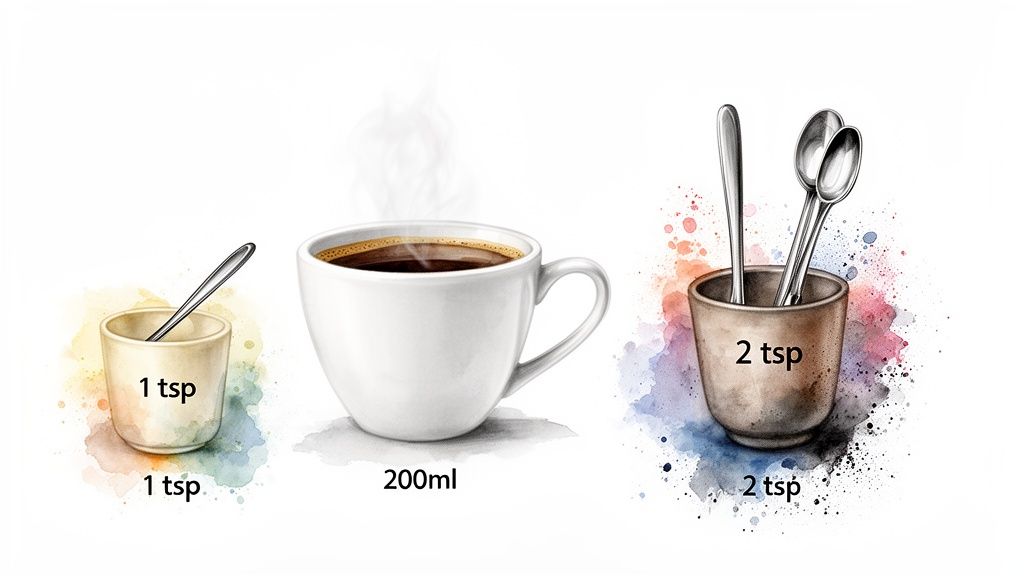
To make things even clearer, let's break down how many teaspoons to use for a typical 200ml UK mug. This quick guide will help you dial in your preferred strength right away, no guesswork needed.
The goal here is to establish a reliable baseline. Once you find a ratio you love, you can replicate it every single day or confidently experiment with small adjustments to fine-tune your brew.
This little table gives you a solid foundation for your daily coffee ritual.
Quick Guide to Teaspoons Per Cup
This is a great starting point for anyone using a standard UK mug (around 200ml).
| Desired Strength | Recommended Teaspoons (Level) | Best For |
|---|---|---|
| Light & Smooth | 1 level teaspoon | An easy-drinking afternoon cup or for those who prefer a more delicate flavour profile. |
| Balanced & Medium | 1.5 level teaspoons | The perfect middle ground that offers good body and flavour without being overpowering. |
| Bold & Strong | 2 level teaspoons | Kick-starting your morning or for anyone who enjoys a rich, full-bodied coffee experience. |
Remember, these are starting points. The type of bean you're using, how it's ground, and your brewing method will all play a part in the final taste. In the next sections, we’ll explore these details to help you take your daily coffee from simply good to truly exceptional.
Why Your Mug Size Changes Everything
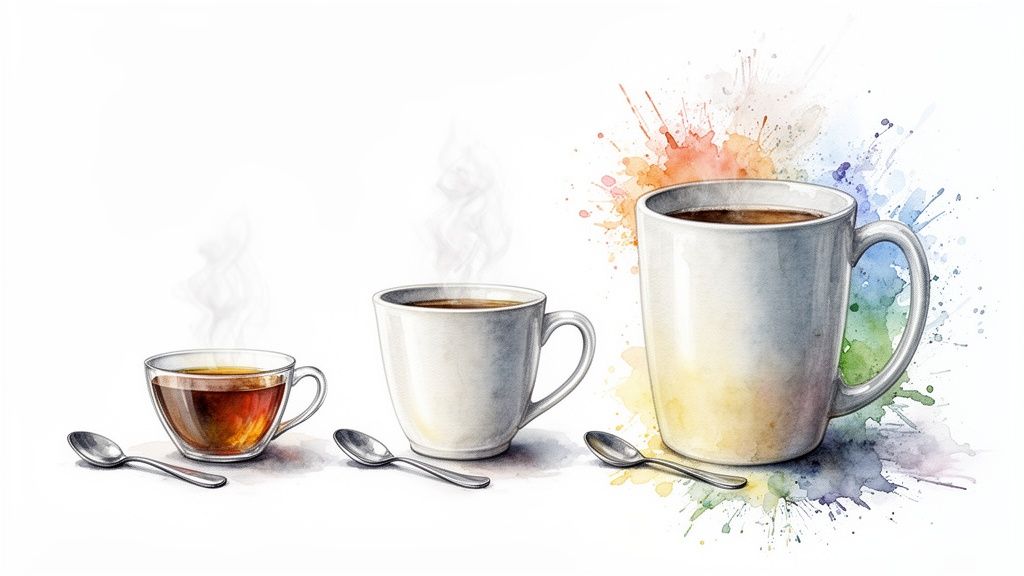
Have you ever followed a coffee recipe down to the last teaspoon, only for it to taste disappointingly weak? The culprit is almost certainly the mug in your hand. In the world of coffee, ‘a cup’ is a dangerously vague term because, let’s be honest, not all cups are created equal.
Getting a handle on your mug’s true volume is the first real step toward a consistently great brew. A standard, old-fashioned teacup might only hold around 150ml. The generous mug sitting on your desk right now? It could easily be 350ml or more. Two level teaspoons of coffee might make a powerful, rich brew in the smaller cup, but it’ll be a watery, underwhelming disaster in the bigger one.
From Teacups to Travel Mugs
The difference in volume completely changes the coffee-to-water ratio, which is the secret behind every delicious brew. Think of it like making a glass of squash: the same splash of concentrate will taste worlds apart in a tiny tumbler versus a pint glass. Your coffee is no different.
Knowing the size of your vessel is non-negotiable for consistency. Whether you’re brewing into a small ceramic cup or a giant travel mug, the volume dictates how many teaspoons of coffee per cup you actually need.
And if you’re brewing for those big commutes, the capacity of things like large 25oz and 40oz travel mugs is absolutely essential to nail the perfect ratio. The key is simply to match your dose of coffee to the amount of water your specific mug holds.
How to Measure Your Favourite Mug
You don’t need any fancy kit for this. Just fill your go-to mug with water, then pour it into a standard kitchen measuring jug. Don’t be surprised if your "regular" mug is actually holding 300ml, 400ml, or even more.
Once you know its true volume, you can finally adjust your coffee dose to match and start making that perfect, repeatable brew every single time. For more tips on getting that consistency spot on, you might like our guide on how to brew coffee perfectly at home.
The Difference Between Spoons and Scales
When it comes to measuring your coffee, the big debate usually comes down to two tools: the humble teaspoon and the precise digital scale. Starting out with a teaspoon is perfectly fine—it’s quick, easy, and everyone has one in the kitchen drawer. It gives you a great starting point for figuring out how you like your brew.
But here's the catch: a teaspoon measures volume, not weight, and that’s where things can get a bit wobbly. Not all coffee is the same. A dark roast, for instance, is actually less dense than a light roast because the beans expand and lose moisture during roasting. This means a level teaspoon of a dark roast weighs less than a level teaspoon of a light roast.
The Problem with Scooping
Even the way you scoop can throw off your measurements. A loosely scooped spoonful holds less coffee than one that’s been packed down a bit as you dig into the bag. These little variations might seem tiny, but they add up, leading to a coffee that tastes spot-on one day and disappointingly weak the next.
This is where a digital scale becomes your secret weapon for that café-quality precision. It takes all the guesswork out of the equation.
Using a scale is like switching from baking with measuring cups to grams—it’s the single biggest step you can take towards guaranteeing the same delicious result, every single time. It ensures consistency, no matter the roast level, grind size, or how you scoop.
If we look at UK coffee habits, the link between measurement and taste is clear. A fascinating statistic shows that 17% of Brits add exactly one teaspoon of sugar to their coffee. This often goes hand-in-hand with the typical coffee dose, as the British Coffee Association notes that most home brews use around 2g of coffee (roughly one level teaspoon) for a 150-200ml cup. You can dig deeper into these national trends by exploring the insights from the British Coffee Association.
The Golden Ratio and Precision Brewing
For anyone ready to step up their brewing game, the 'Golden Ratio' is the industry benchmark for a perfectly balanced cup. The Specialty Coffee Association recommends a ratio of 1 gram of coffee to every 15-18 grams of water (that’s 1:15 to 1:18). This ratio is the sweet spot for optimal extraction, drawing out the full spectrum of flavour from your beans.
Trying to hit this ratio with a teaspoon is nearly impossible, but it’s a piece of cake with a scale. Just pop your mug or brewer on the scale, press 'tare' to zero it out, add your coffee, and then pour in hot water until you hit the target weight. If you're weighing up which tool is right for you, check out our guide on espresso scales versus timers to learn more.
Switching to a scale is a small change that makes a massive difference. For a selection of reliable and accurate options, take a look at our curated range of digital coffee scales at ADS Coffee Supplies and start brewing with complete confidence.
Matching Your Method to Your Measurement
There’s no single magic number for how many teaspoons of coffee to use per cup. The right amount is a moving target, shifting dramatically based on the brewing kit you're using.
Each method coaxes flavour out of the beans in its own unique way, demanding specific tweaks to your coffee-to-water ratio and grind size to hit that perfect sweet spot. A coarse grind that’s perfect for a French press would be a disaster in a Moka pot, so your measurements have to adapt too.
Getting this harmony right is what separates a decent cup from a truly memorable one. It’s a bit like the world of tea, where getting it wrong can ruin the flavour—a lesson found in precise Sencha brewing instructions.
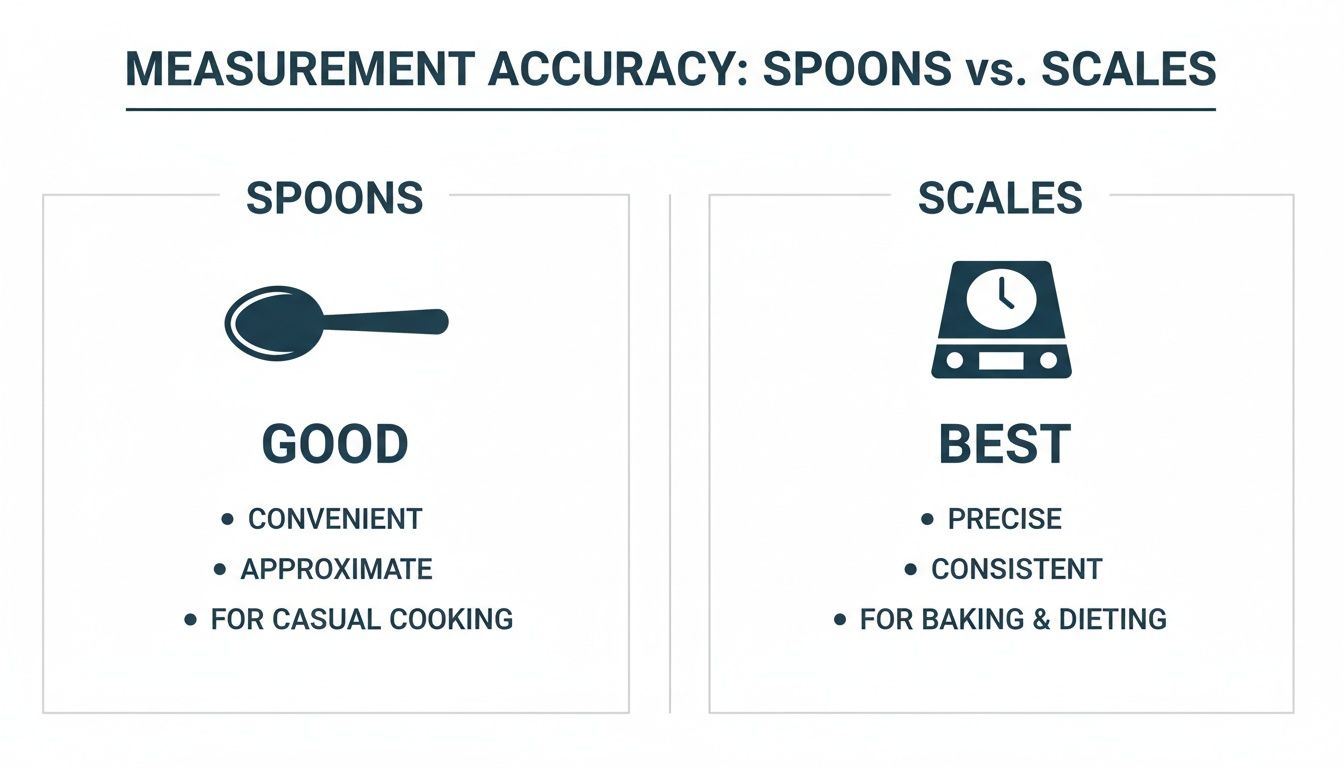
As the infographic shows, while a teaspoon is a great, easy-to-grab starting point, a digital scale is your best friend for consistently fantastic coffee. It’s the difference between guessing and knowing.
French Press: The Full-Bodied Classic
The French press is loved for its rich, heavy-bodied brew. To get that signature texture, you’ll need a coarse grind—think chunky sea salt. This stops the coffee from turning sludgy and over-extracting while it steeps.
For a standard 200ml mug, a good starting recipe is 3-4 level teaspoons of coarsely ground coffee. This slightly stronger ratio is what helps build that robust flavour profile the French press is famous for. You can explore a variety of French presses at ADS Coffee Supplies to find the perfect one for your kitchen.
Pour-Over: For a Clean and Nuanced Cup
Brewers like the Hario V60 or Chemex are masters at producing a clean, bright cup that lets a coffee's delicate flavour notes shine. For this method, a medium-fine grind is absolutely essential. It helps you control the water's flow rate for a perfectly balanced extraction.
Get started with 2-3 level teaspoons for a 200ml cup. Precision really pays off here; too little coffee and your brew will taste weak and watery, but too much can easily make it bitter. If you want to dive deeper into getting it just right, check out our complete coffee grind size guide.
AeroPress and Moka Pot: The Concentrated Brews
Both the AeroPress and the Moka pot produce a short, punchy, espresso-style coffee. They rely on a fine grind, similar to table salt, to build the pressure needed for such a rich extraction. Because you’re making a smaller, more intense drink, the measurements are different.
- AeroPress: For a single serving, use 2-3 level teaspoons. You can then top it up with hot water for an Americano or just savour it as a concentrated shot. Find your perfect AeroPress and its accessories at ADS Coffee Supplies.
- Moka Pot: Fill the filter basket with coffee until it’s level with the top, but don’t pack it down. The exact amount will vary depending on the size of your Moka pot.
These methods are fantastic for creating a strong coffee base you can use for making lattes or flat whites at home.
How Freshness and Roast Affect Your Brew
Perfecting your measurements is a huge step, but let's be honest, the coffee itself is the real star of the show. Even the most precise ratio won't save stale, poor-quality beans. The freshness, roast profile, and quality of your coffee are every bit as crucial as how many teaspoons you use.
Think of coffee beans like any other fresh produce; their vibrant, complex flavours begin to fade over time. Coffee starts losing its magic about a month after roasting as it interacts with oxygen. This is exactly why our oxygen-free roasting process is so important—it protects those delicate flavour notes, ensuring the coffee in your bag is as lively and aromatic as the day it was roasted. To get the most from every spoonful, it’s vital to understand how long coffee beans stay fresh and how to store them properly.
Understanding Roast Profiles
The roast level does more than just determine the flavour; it physically changes the bean itself. This has a direct impact on your teaspoon measurements.
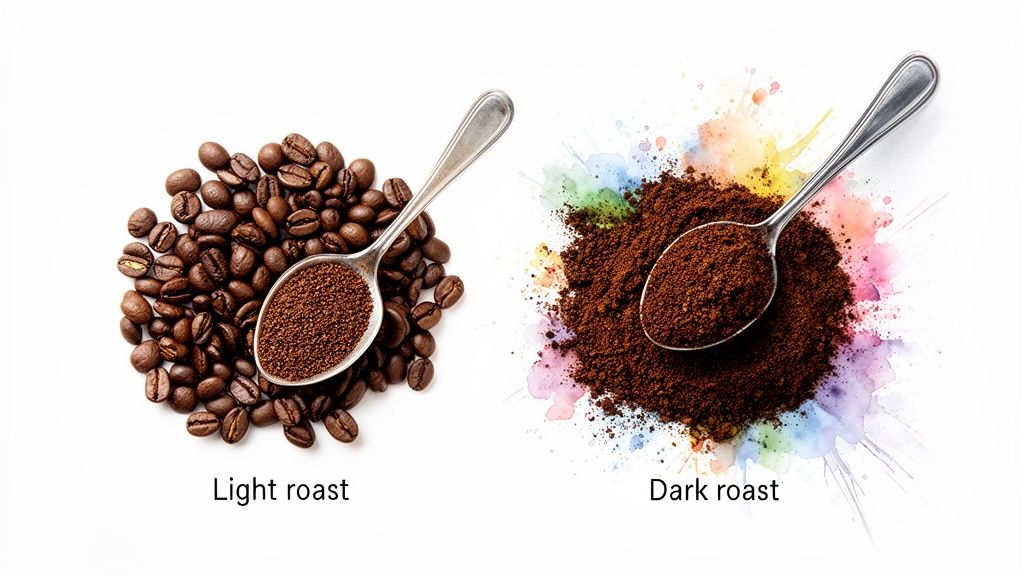
- Light Roasts: These beans are denser and less porous. A level teaspoon of a light roast will actually be heavier than the same scoop of a dark roast. They often bring out brighter, more acidic flavour notes.
- Dark Roasts: During a longer roast, beans expand, lose moisture, and become much lighter and more voluminous. So, a level teaspoon of a dark roast weighs less, meaning you might need a bit more to achieve the same strength.
Realising that a teaspoon of dark roast coffee contains less actual coffee by weight than a light roast is a real game-changer. It explains why you might need to adjust your recipe when switching between roasts to get that consistent flavour you love.
Brewing for a Better Future
Choosing high-quality, freshly roasted beans isn't just about getting a better-tasting cup; it can also be about making a positive impact. Every brew you make with Seven Sisters Coffee Co. beans supports a more sustainable future for the entire coffee industry. We donate a portion of every order to World Coffee Research, an organisation dedicated to protecting and improving the livelihoods of coffee farmers worldwide.
By paying attention to the details—from the freshness of your beans to the roast profile—you're not just answering "how many tsp of coffee per cup". You’re taking full control of your brewing ritual, ensuring every cup is delicious, consistent, and part of a bigger story. Find your perfect roast among our expertly crafted single origins and blends at ADS Coffee Supplies and taste the difference for yourself.
Common Questions About Measuring Coffee
Even with the best guides in hand, questions always pop up when you're trying to nail that perfect daily brew. That's completely normal—fine-tuning your coffee is a journey, not a destination. This final section tackles some of the most frequent queries we hear, giving you clear, practical answers to help you troubleshoot and refine your technique.
Think of this as your personal troubleshooting guide. We want to clear up any lingering doubts so you feel empowered to make consistently delicious coffee, every single time.
Does a Heaped Teaspoon Make a Big Difference?
Yes, it makes a massive difference, and it’s often the secret culprit behind an inconsistent brew. A level teaspoon of ground coffee typically weighs around 2.5 to 3 grams. A heaped teaspoon, however, can easily be double that, sometimes weighing as much as 5 or 6 grams.
This huge variation is the number one reason your coffee might taste perfect one day and disappointingly weak or bitter the next. When a recipe calls for a teaspoon, it almost always means a level one. For consistent results, always, always level off your spoon.
Should I Use a Different Amount for Decaf Coffee?
Nope, you can stick to the exact same measurements for your decaf as you would for your regular coffee. The decaffeination process is incredibly gentle these days and doesn't change the bean's density or size enough to need a different brew ratio. You don’t need to change a thing.
Our Seven Sisters Coffee Co. decaf blends are roasted with the same care and attention as all our other coffees to maximise their rich, satisfying flavour. Just stick to the 1-2 level teaspoons per cup rule, and you can expect a full-bodied brew, just without the caffeine. Browse our decaf coffee beans at ADS Coffee Supplies for a flavourful, caffeine-free experience.
How Do I Fix Coffee That Tastes Too Bitter or Weak?
This is where you truly become your own home barista! Learning to diagnose and fix your brew is a seriously rewarding skill. Let's break down the two most common problems.
- If your coffee tastes weak or watery: The fix is usually straightforward—you likely need more coffee. Next time, just increase your dose slightly. For example, if you used one and a half level teaspoons for your mug, try a full two teaspoons and see how that changes the flavour.
- If your coffee tastes too bitter or harsh: This is a classic sign of over-extraction, meaning the hot water has pulled too many harsh compounds from the grounds. Before you reduce the amount of coffee (which can sometimes make it taste sour), try a different fix first. A slightly coarser grind or a shorter brew time often solves the problem beautifully. For instance, if you steep your French press for four minutes, try knocking it back to three.
Mastering these small adjustments is the key to dialling in your perfect cup. It transforms brewing from a routine into a craft, allowing you to tailor every single cup to your exact preference.
If you're curious about measurements beyond teaspoons, our guide on how many tablespoons per cup of coffee is a great next step. Experimentation is part of the fun, and with these tips, you're well-equipped to brew coffee you'll absolutely love.
At Seven Sisters Coffee Co, we believe that amazing coffee starts with exceptional beans. From bright single origins to rich, comforting blends, our oxygen-free roasting process ensures every bag is packed with flavour. Find your new favourite coffee today.