How Many Spoons of Coffee Per Cup A UK Brewer’s Guide

For a standard UK mug of around 250ml, the simplest answer is to start with two level tablespoons of ground coffee. This is a brilliant starting point, but the real secret behind a truly perfect cup is something baristas call the 'golden ratio'.
Finding the UK's Golden Ratio for Coffee
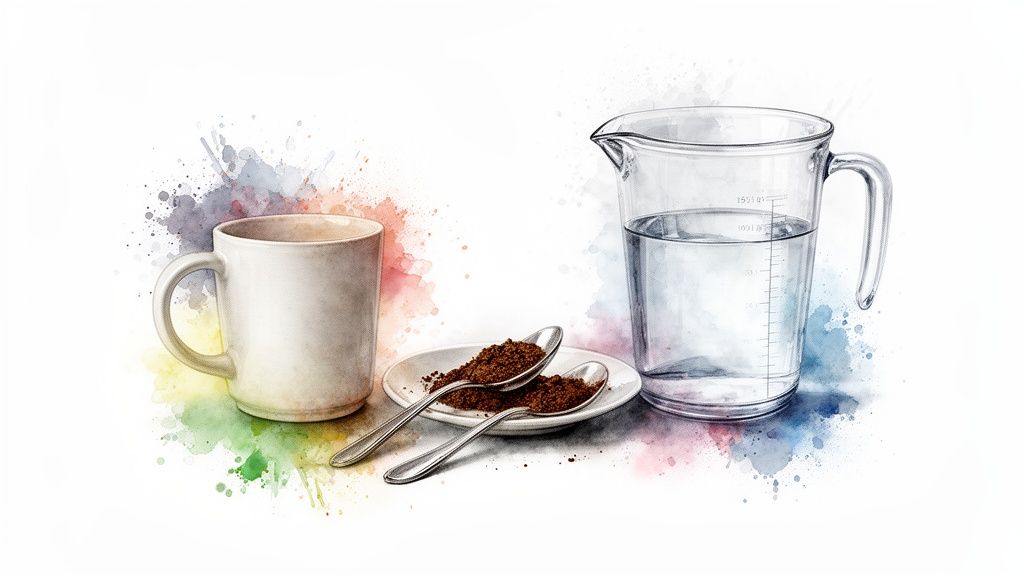
Ever wonder why coffee from a speciality shop tastes so consistently balanced? Baristas from Bristol to Belfast aren't just winging it; they're following a well-established formula. This 'golden ratio' is the universally accepted starting point for brewing fantastic coffee, and it’s surprisingly easy to replicate at home.
The principle is simple: use one part coffee to somewhere between 15 and 18 parts water. Most people find a 1:16 ratio hits the sweet spot, delivering a brew that’s neither too weak nor overwhelmingly strong. It’s the foundation for achieving what we call optimal extraction—just a fancy way of saying you’re pulling all the desirable flavours from the coffee grounds without any of the bitterness.
Translating the Ratio to Spoons
While weighing your coffee in grams offers ultimate precision, you can absolutely get great results with a humble spoon. The trick is knowing how the golden ratio translates into household measurements.
Across the UK coffee scene, this ratio has become the standard for quality. It works out to roughly 1 gram of coffee for every 15 to 18 grams of water, a guideline that ensures a well-extracted, flavourful result. For the common 250ml mug found in most UK kitchens, this means you’ll need approximately 15 grams of ground coffee.
So, how does that convert to spoons? It's about two level tablespoons. This gives you a reliable baseline for making café-quality coffee right in your own kitchen.
Quick Guide Spoons of Coffee for a Standard 250ml Mug
To help you get started without any fuss, here’s a quick reference table. It breaks down how many spoons you'll need for a standard 250ml mug, depending on your preferred strength.
| Strength Preference | Tablespoons (Level) | Teaspoons (Level) | Approx. Grams |
|---|---|---|---|
| Milder | 1.5 | 4.5 | 11g |
| Standard | 2 | 6 | 15g |
| Stronger | 2.5 | 7.5 | 18g |
This table is a fantastic starting point for experimentation. Remember, the best cup of coffee is the one that tastes best to you.
Pro Tip: Always use a level scoop. A heaped spoon can hold almost double the amount of coffee, which will throw off your ratio and result in a bitter, over-extracted brew. Use the back of a knife to level off the grounds for consistency.
If you're new to home brewing and want to dive deeper, our guide on how to brew coffee perfectly at home is packed with more useful tips. Start with these recommendations, and don’t be afraid to adjust by half a spoon here or there until you find your personal perfect brew.
Why Not All Spoons Are Created Equal
Ever followed a recipe down to the last spoonful, only to find the results taste completely different from one day to the next? When you’re figuring out how many spoons of coffee to use per cup, that frustrating inconsistency often comes down to one simple thing: the spoon itself.
The tablespoon you grab from your cutlery drawer is almost certainly not the same as a proper, standardised measuring spoon. This tiny difference is enough to throw your entire brew off-kilter.
A standard UK measuring tablespoon is designed to hold 15ml. In contrast, a random cutlery tablespoon can hold anything from a measly 10ml to a whopping 20ml. Without realising it, you could be using nearly double the amount of coffee you intended. It’s a classic mistake that leaves so many people wondering why their coffee is either weak and watery or harsh and bitter.
The Problem with Volume
Here’s the thing: measuring coffee with a spoon—by volume—is just not as reliable as measuring it by weight. Coffee's density shifts depending on a few key factors, which means that even if you use the exact same spoon every time, you’re not guaranteed a consistent dose.
Your scoop might be letting you down for a few reasons:
- Roast Level: Darker roasts are less dense than lighter ones. As beans roast, they expand and lose mass. This means a spoonful of a dark roast coffee actually weighs less than the same spoonful of a light roast.
- Grind Size: Finely ground coffee packs together much more tightly than a coarse grind. A tablespoon of fine espresso grounds will hold significantly more coffee by weight than a tablespoon of coarse cafetière grounds.
- Heaped vs Level: This is probably the biggest culprit. The difference between a ‘level’ and a ‘heaped’ spoonful is huge. A heaped spoon can easily hold twice as much coffee as a level one, completely wrecking your coffee-to-water ratio.
The Key to Consistency: While spoons are handy in a pinch, weighing your coffee is the single best thing you can do to guarantee a delicious, repeatable brew every single time. It completely removes the guesswork.
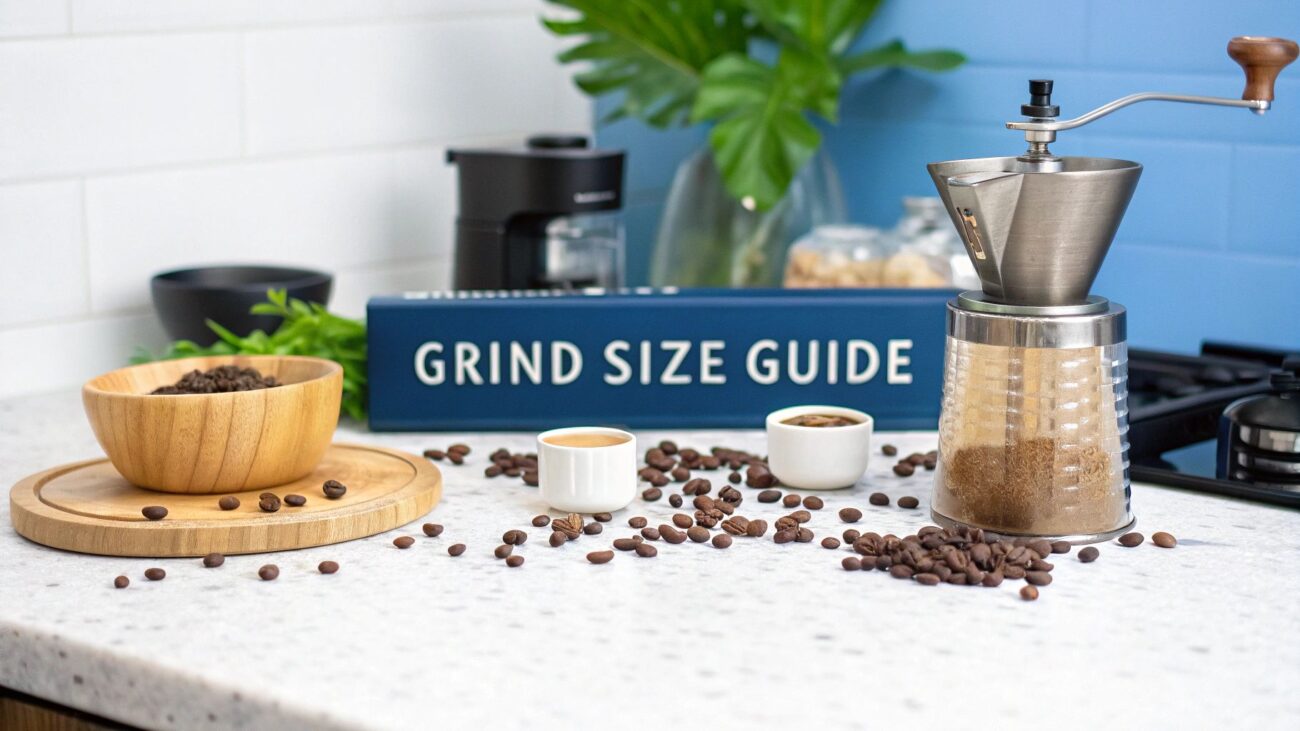
For anyone ready to nail that perfect cup, weighing your beans is a game-changer. It takes all those tricky variables like bean density and grind size out of the equation. Understanding these factors, like those covered in this helpful coffee grind size guide, is the first real step towards mastering your morning ritual and getting fantastic, predictable results.
Matching Your Spoons to Your Brewing Method
The perfect number of spoons isn’t some universal constant; it’s something that changes depending on the brewing kit you have on your counter. A cafetière, with its long, lazy immersion time, demands a completely different approach to a quick, clean V60 pour-over. Getting this part right is absolutely fundamental to unlocking the best flavour from your beans.
Every brewing method has its own personality, really. It's defined by things like water temperature, how long the water and coffee are in contact, and of course, the grind size. All these variables directly influence how much coffee you should be using. What works brilliantly for one method might just give you a disappointingly weak, under-extracted cup with another.
Let's break down the ideal spoon measurements for the most popular brewing methods we see in UK homes.
As this graphic neatly shows, just grabbing any old spoon from the cutlery drawer can lead to wildly different results. This is precisely why matching your measurements to your specific brewer is so important for a consistent cup.
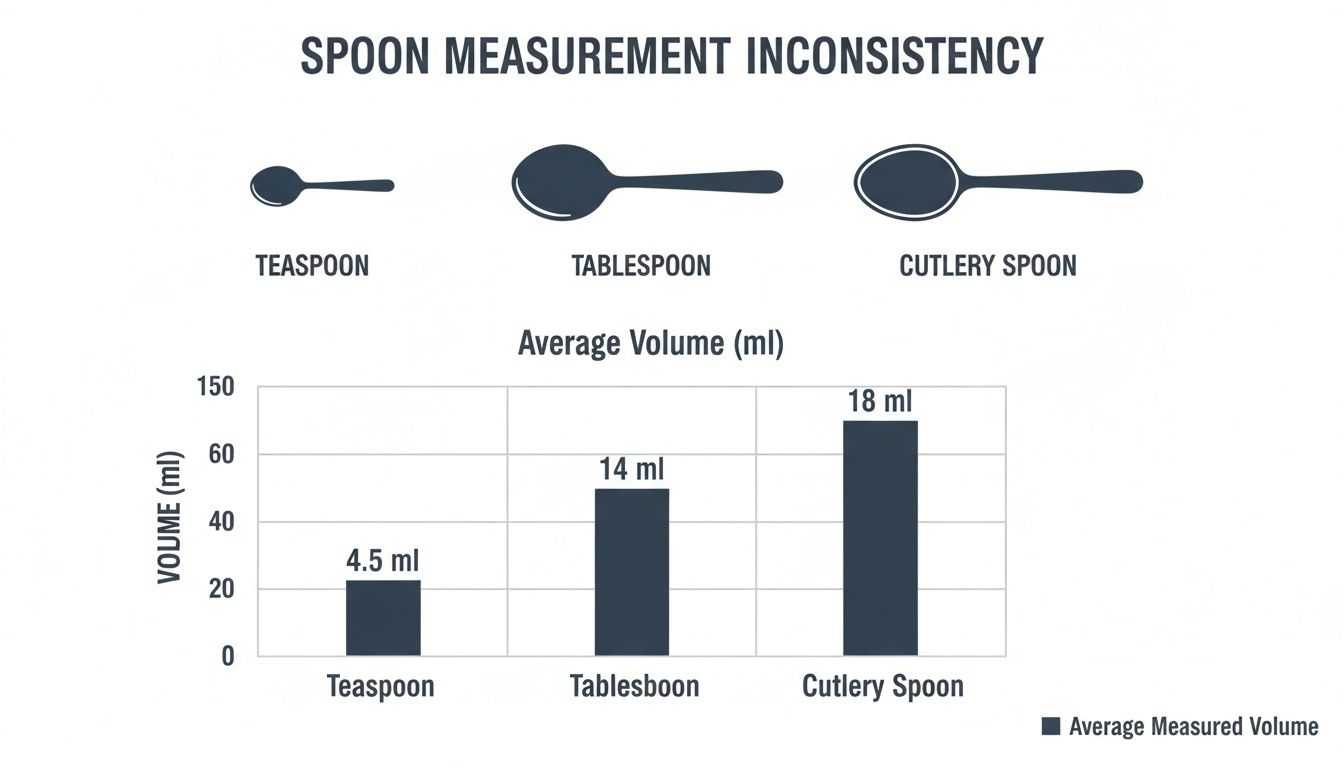
The key takeaway here is simple: a standard measuring spoon gives you far more consistency than a soup spoon ever could. It’s all about keeping your ratios stable, brew after brew.
For the Classic French Press
The French press, or cafetière as we often call it, is a UK favourite for good reason. Its immersion brewing style and metal filter create that full-bodied, rich cup many of us crave. To achieve this signature texture, you’ll want a slightly higher coffee-to-water ratio and a nice, coarse grind.
- How many spoons: Use 2.5 level tablespoons (around 18g) for a standard 250ml mug.
- Why it works: The coarse grind has less surface area, so this slightly stronger ratio ensures you extract enough flavour during the four-minute brew without tipping over into bitterness.
For the Versatile AeroPress
The AeroPress is loved for its incredible speed and versatility, producing a clean yet surprisingly concentrated brew. It uses pressure to speed everything up, so your measurements need to be pretty precise. A medium-fine grind is the sweet spot here.
- How many spoons: Start with 2 level tablespoons (around 15g) for a 250ml mug.
- Why it works: This dose is perfect for the AeroPress’s quick brew time, which is usually just one to two minutes. It creates a concentrated shot that you can then top up with hot water, almost like making an Americano.
For the Delicate Pour-Over
Methods like the Hario V60 or a Chemex give you complete control over the whole process, rewarding you with a bright, clean, and nuanced cup. This technique really demands a medium grind to allow water to flow through at just the right pace.
- How many spoons: Aim for 2 level tablespoons (around 15-16g) per 250ml of water.
- Why it works: The pour-over is all about a steady, controlled flow of water over the grounds. A 1:16 ratio is the ideal starting point to pull out those delicate, complex notes without any harshness. If you're keen to perfect this beautiful technique, you might be interested in our detailed guide on the Hario V-60 pour-over.
A Quick Tip: For any method, start with these recommendations and then just tweak it by half a spoon on your next go. If it's too weak, add a little more coffee. Too strong? Use slightly less. Your own taste is always the final judge.
Before we dive deeper, here’s a quick reference table to pull all that information together. Think of it as your go-to guide when you’re standing bleary-eyed in front of your coffee station in the morning.
Spoons Per Cup A Brewer's Cheat Sheet
| Brewing Method | Recommended Ratio (Coffee:Water) | Spoons per 250ml Cup | Recommended Grind Size |
|---|---|---|---|
| Drip Coffee Machine | 1:17 | 2 level tablespoons | Medium |
| French Press | 1:15 | 2.5 level tablespoons | Coarse |
| Espresso | 1:2 | 1-1.5 level tablespoons | Fine |
| AeroPress | 1:16 | 2 level tablespoons | Medium-Fine |
| Pour-Over (V60) | 1:16 | 2 level tablespoons | Medium |
This table should give you a solid foundation, but remember that the "right" amount is what tastes best to you. Don't be afraid to experiment a little to find your perfect cup.
How to Dial In Your Perfect Cup
Think of the golden ratio we’ve been talking about as a reliable starting point—not a strict, unbreakable law. The real magic happens when you start tweaking your measurements to perfectly match your own taste. Your ideal brew is a deeply personal thing, and learning how to adjust it is the final step toward becoming a truly confident home barista.
Many people’s first instinct when they want stronger coffee is to simply brew it for longer. This is a classic mistake that almost always leads to a bitter, unpleasant cup. Extending the brew time doesn’t just make the coffee stronger; it over-extracts the grounds, pulling out all sorts of harsh, undesirable compounds you don’t want anywhere near your mug.
The real fix is much simpler: add more coffee. If your standard two tablespoons per cup tastes a little weak, try using two and a half next time. This increases the coffee dose without messing with the extraction time, giving you a richer, more robust flavour instead of a bitter one.
Fine-Tuning Your Flavour Profile
On the flip side, if you prefer a milder, more delicate brew, the answer is to reduce your coffee dose slightly. Instead of two level tablespoons, maybe try one and a half. This simple adjustment helps you achieve a lighter body without ending up with a cup that tastes thin, watery, or just plain unsatisfying.
Experimentation is your best friend here. Small, half-spoon tweaks can make a massive difference to the final taste. Keep a mental note of how each change affects the flavour, and you'll quickly figure out how to produce your perfect coffee on demand. This process is a lot like how professionals fine-tune their machines. For a deeper look into this precision-focused approach, our guide on how to dial in an espresso ratio offers some brilliant insights.
A Simple Troubleshooting Guide
Sometimes your coffee just doesn't taste right, and the problem can often be traced directly back to your measurements. Here’s a quick guide to fixing common taste issues by adjusting how many spoons of coffee you use per cup.
- If it tastes weak or watery: This is the most straightforward problem to solve. Your coffee is under-extracted, which means you need to increase your coffee-to-water ratio. Add an extra half-tablespoon of grounds to your next brew.
- If it tastes bitter or harsh: Your coffee is over-extracted. This can happen if your brew time is too long, but it’s often because you've used too much coffee for the amount of water. Reduce your dose by a half-tablespoon.
- If it tastes sour or acidic: This sharp, unpleasant taste is another sign of under-extraction. It's often caused by water that isn't hot enough or a brew time that's too short. Before you touch your spoons, make sure your water is just off the boil (around 93°C) and you’re brewing for the correct time for your chosen method.
Key Takeaway: Always adjust one variable at a time. Change your coffee dose or your brew time, but never both at once. This way, you’ll know exactly what change made the difference, helping you repeat your successes.
Moving Beyond Spoons to Grams for Ultimate Control
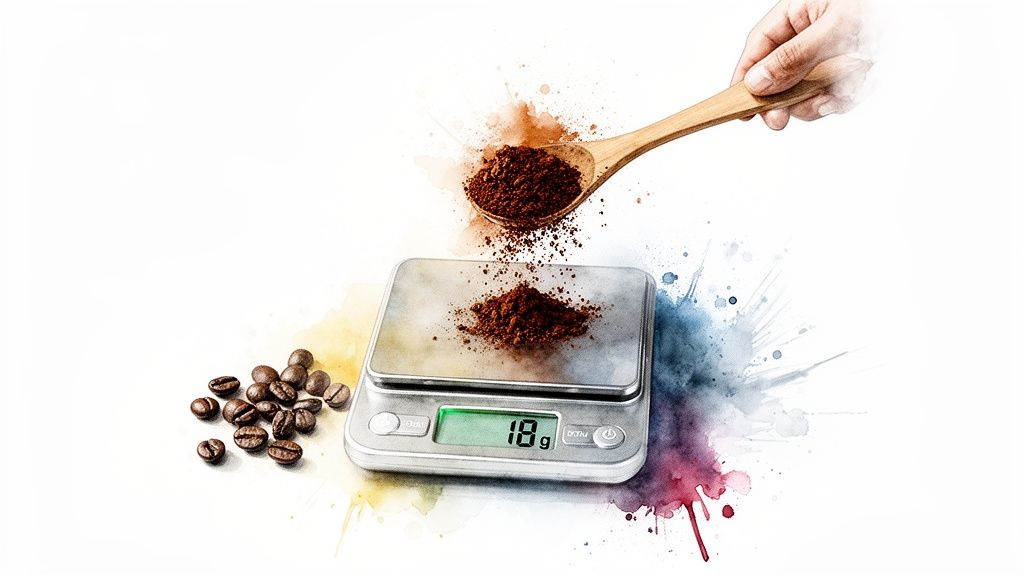
While spoons are a brilliant starting point for any home brewer, there's a moment when you realise you want more. You want that perfect cup you made last week to be repeatable, not just a happy accident. If you're ready to take your coffee seriously and achieve genuine café-quality results, swapping your spoon for a digital scale is the single biggest upgrade you can make. It’s a complete game-changer.
The problem with spoons is that they measure volume, not weight. Imagine you have a light, airy Ethiopian bean. Now, picture a dense, dark-roasted Sumatran bean. A level tablespoon of each might look the same, but their actual weight could be quite different. A spoon has no way of telling you that, but a scale does.
Why Grams Guarantee Consistency
Weighing your coffee in grams simply eliminates the guesswork. It cuts through all the variables that can throw off your brew, like the density of the bean, the size of your grind, or how level your scoop was. This precision is what lets you lock in a recipe and replicate that perfect brew time and time again.
It’s this level of accuracy that unlocks the subtle, complex tasting notes our roasters work so hard to develop in the first place. When you dial in your recipe by weight, you're guaranteeing that your coffee-to-water ratio is exact, every single time. If you're looking to make the switch, we have a great selection of digital coffee scales ready to go.
For anyone thinking bigger, maybe even setting up their own coffee spot, a professional commercial kitchen equipment checklist is invaluable. It helps ensure essentials like high-precision scales and brewers aren't overlooked, which is crucial for scaling up quality.
By measuring in grams, you are no longer just following a recipe; you are controlling the science behind extraction. It’s the single most effective way to improve your home brewing.
To help you get started, it’s useful to understand the relationship between volume and weight. While it always varies slightly, you can use a general conversion as a starting point. And if you really want to get into the details, understanding the nuances between an espresso scale vs a timer will help you refine your process even further.
Grams to Spoons A Quick Conversion Guide
This chart gives you a rough idea of how to translate your current spoon measurements into grams. Just remember, these are estimates and will change depending on the specific coffee you're using.
| Grams | Approx. Tablespoons (Level) | Ideal For |
|---|---|---|
| 11-12g | 1.5 | A milder 250ml cup |
| 15-16g | 2 | The standard "golden ratio" for a 250ml cup |
| 18-20g | 2.5 | A stronger 250ml cup or French press |
| 24-26g | 3-3.5 | A larger 400ml mug |
Use this as your starting point. Next time you make a coffee, weigh out your usual two tablespoons and see what you’re really working with. You might be surprised, and it’ll be your first step towards brewing with brilliant consistency, every single day.
Got Questions About Brewing? We’ve Got Answers.
We get asked all the time about the little details that make or break a good cup of coffee. To save you the guesswork, we've put together some answers to the most common questions that come up when you're trying to perfect your daily brew.
It's no surprise so many people are curious. The UK downs a staggering 98 million cups of coffee every single day—that works out to about 528 cups for every person, every year. Coffee is clearly a massive part of our routine, especially at work. A whopping 81% of professionals have more than one coffee during their shift, and 41% are brewing up at least three cups a day. If you're interested in diving deeper into these national coffee habits, you can read the full research on UK coffee consumption.
Does Roast Level Affect How Many Spoons I Should Use?
Yes, it absolutely does, and it’s a great example of why measuring by volume can be a bit tricky. Darker roasts expand more during the roasting process, making them physically larger but less dense than lighter roasts. Think of it like a loaf of bread versus a dense fruitcake—a slice of each might be the same size, but they weigh very different amounts.
This means a level tablespoon of a dark, oily bean will actually weigh less than the same spoonful of a light, dense one. If you're using a spoon, you might find you need to add a little extra of a dark roast to get the same kick. This is exactly why we always recommend a digital scale for true consistency.
Should I Use More Coffee for a Larger Mug?
You bet. The secret to a consistently delicious cup is maintaining the right coffee-to-water ratio. If you've dialled in your recipe for a standard 250ml mug using two tablespoons, a bigger 400ml mug isn't going to taste right with the same amount of coffee. To get that same strength, you’ll need to scale up to just over three tablespoons.
A Practical Tip: Not sure how big your favourite mug actually is? Grab your kitchen scales or a measuring jug and fill it with water. Once you know its total capacity, you can work out the perfect amount of coffee using the golden ratio (for a 400ml mug, that’s roughly 24-26 grams of coffee).
And when you're not busy perfecting your own brew, you might be thinking of what to get for a fellow coffee lover. For some brilliant ideas, check out this guide on gifts for the coffee aficionado in your life.
What's the Difference Between a Level and a Heaped Spoon?
The difference is huge—easily enough to turn a balanced brew into a bitter mess. A heaped spoon can hold almost double the coffee of a level one.
To put it in numbers:
- A level tablespoon is around 6-8 grams.
- A heaped tablespoon can be anywhere from 12-15 grams.
That’s a massive variable to introduce into your morning routine. All professional advice, including ours, is always based on level spoons for this very reason. Get into the habit of using the back of a knife to sweep across the top of the spoon—it’s a simple trick that guarantees consistency.
Do I Measure Whole Beans or Ground Coffee?
Always, always measure your coffee after grinding it. Whole beans are clunky and create large air pockets when you scoop them. A scoop of whole beans contains far less actual coffee by weight than the same scoop filled with grounds.
For the most accurate dose and the best possible flavour, grind your beans right before you brew. It ensures you’re measuring precisely what you need, and it delivers that fresh, vibrant taste we’re all chasing.
At Seven Sisters Coffee Co, we believe everyone has the right to make brilliant coffee at home. If you want to take full control of your grind and unlock the freshest flavours, have a look at our range of high-quality coffee grinders available at ADS Coffee Supplies.