How Many Spoons of Coffee for One Cup: a UK Brewer’s Guide

For a standard mug of coffee, the simplest starting point is one level tablespoon of ground coffee, which is roughly two level teaspoons. This is a great baseline for popular methods like a French press or filter machine and gets you a balanced, flavourful brew without any fuss.
How Many Spoons of Coffee Per Cup? A Quick Guide
Figuring out how many spoons of coffee you need is the first step to saying goodbye to inconsistent, disappointing brews. While coffee pros often talk in grams and ratios, you don't actually need a scale to make a great cup at home. A simple spoon works wonders, as long as you're consistent.

The trick is to find a reliable baseline and stick to it. Here in the UK, the golden rule for most home brewers is 2 level teaspoons (about 10 grams) of freshly ground coffee for every 180-240ml of water. This ratio ensures a well-rounded extraction for common methods like filter or French press, which you can read more about in our Seven Sisters brewing guides.
Quick Guide: Coffee Spoons per Cup
Think of this as your daily cheat sheet. The right amount of coffee really depends on two things: how strong you like it and the size of your mug. A standard "cup" in coffee circles is usually a bit smaller than the big mugs most of us reach for in the morning.
A common mistake we see is using a heaped spoon instead of a level one. This can easily double the amount of coffee, which often leads to a bitter, over-extracted taste. For consistency, always aim for a level spoonful.
To make things even easier, here’s a simple table to help you nail that perfect ratio every time.
| Cup Size (ml) | Standard Strength (Teaspoons) | Strong Strength (Teaspoons) |
|---|---|---|
| 180ml | 2 level | 2.5 level |
| 240ml | 2.5 level | 3 level |
| 350ml | 3.5 level | 4 level |
Use this table as your starting point. Don't be afraid to adjust by half a teaspoon here or there to find what works perfectly for you. After all, the best cup of coffee is always the one you enjoy the most.
Why Not All Spoons Are Created Equal
Have you ever wondered why your coffee tastes incredible one day and disappointingly weak the next, even when you swear you used the same spoon? The culprit is likely lurking in your cutlery drawer. That teaspoon you use for your morning cuppa and the one you stir your soup with aren't standardised, which is a recipe for a frustratingly inconsistent brew.
Just take a look. One might be deeper, another wider. This tiny variation might seem insignificant, but it makes a massive difference in your final cup. A typical kitchen teaspoon can hold anywhere from 3 to 7 grams of ground coffee—a huge gap in brewing terms. If you use a heaped spoonful instead of a level one, that number climbs even higher, often leading to a bitter, over-extracted taste that completely masks your coffee's beautiful, nuanced flavours.
From Cutlery Drawer to Coffee Scoop
To get a consistently delicious cup of coffee, you need to know the difference between the tools you’ve got at home. Each one holds a different amount, which directly impacts the strength and balance in your mug.
- Teaspoon: The most common offender. It's a handy starting point, but its size varies so much it's unreliable. A level teaspoon is roughly 5 grams.
- Tablespoon: A much safer bet. A standard level tablespoon holds about 10-12 grams of coffee, making it a solid choice for measuring. If you want to get into the nitty-gritty, we've got a full guide on how many tablespoons per cup of coffee.
- Coffee Scoop: This is your best bet if you don't have a scale. Most dedicated coffee scoops are designed to hold a specific amount—usually around 10 grams—which is just right for a single strong cup. You can find excellent quality coffee scoops to improve your daily brew.
The real secret here is consistency. Whatever you choose to measure with, stick with it. And always measure it the same way, preferably level. This one small habit will do more to improve your daily coffee than almost anything else.
If you really want to lock in your measurements, a proper set of Silver Stainless Steel Measuring Cups 4 Cups 4 Spoons can be a game-changer. But for the ultimate precision, nothing beats a dedicated coffee scoop or a simple digital kitchen scale. It’s the only way to guarantee you’re getting the perfect amount of coffee, every single time.
Matching Your Spoons to Your Brewing Method
There’s no single, perfect answer to "how many spoons of coffee for one cup" because it all comes down to your coffee maker. Each brewing method is a world of its own, extracting flavour in a completely different way. This means your measurements need to adapt to get the taste you're after. A long, lazy immersion in a French press is miles away from a quick, high-pressure espresso shot.
Take the classic drip filter machine, a reliable staple in so many UK kitchens. It gets on brilliantly with the standard ratio of two level teaspoons per 240ml cup. This approach gives you a really balanced extraction that lets the coffee's natural sweetness come through. For something more intense like an AeroPress, you might use a similar amount of coffee but with much less water, creating a powerful, espresso-style shot.
French Press and Pour-Over Ratios
The French press, famous for its rich and full-bodied brew, loves a slightly coarser grind and a more generous scoop of coffee. Because the grounds are completely submerged for a few minutes, you get a really deep, satisfying extraction.
- For a French Press: I'd recommend starting with three level teaspoons for a standard 240ml mug. This is what gives you that full-bodied flavour the cafetière is celebrated for. We've got more tips in our detailed guide on how to use a cafetière.
- For a Pour-Over (like a V60): This method is all about a cleaner, crisper cup. Here, you'll want to stick closer to two and a half level teaspoons per mug. This allows the delicate, nuanced notes of the coffee to shine without being drowned out.
This little flowchart shows why picking the right tool for the job is the first step towards a consistently great cup of coffee.
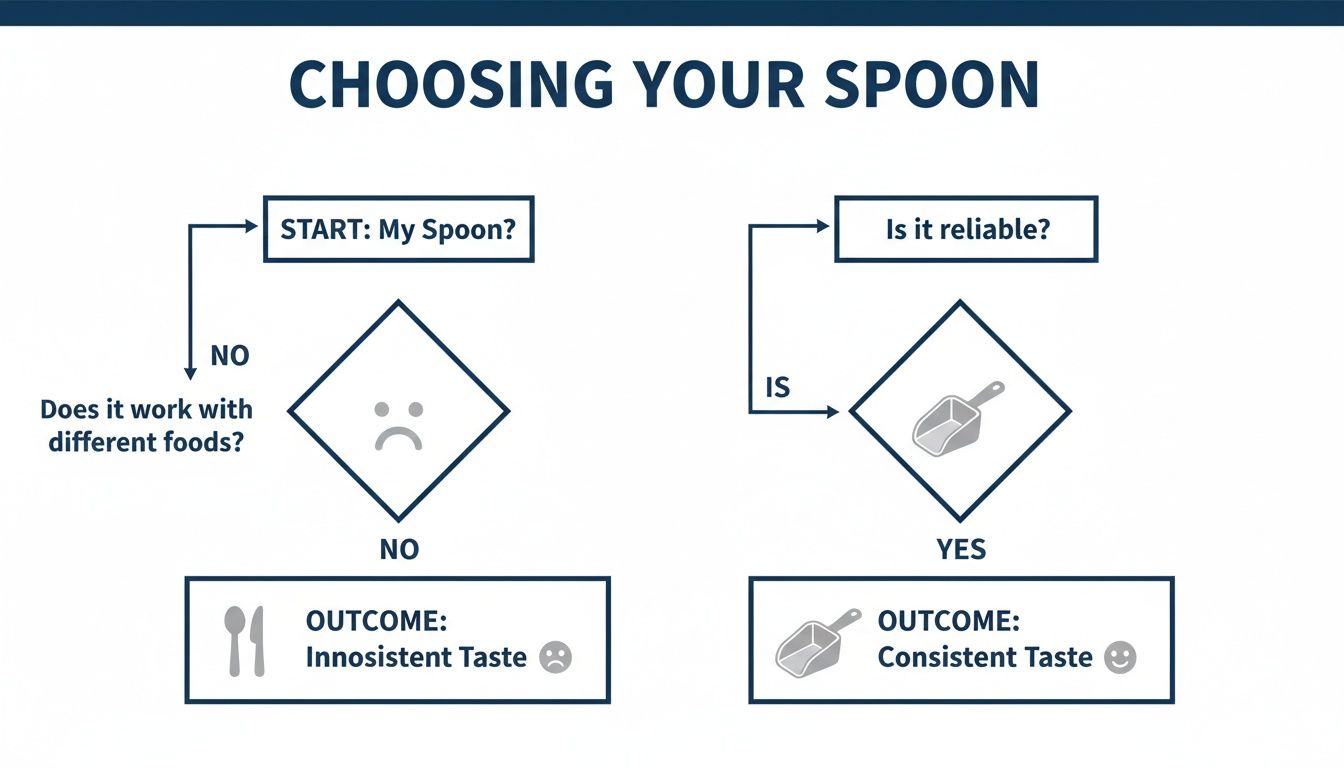
The takeaway here is simple: a dedicated coffee scoop is your best friend. It eliminates all the guesswork that comes from using random cutlery, leading to a much more reliable brew, day in and day out.
The Concentrated World of Espresso
Espresso is a different beast entirely. It’s the powerful heart of all those UK café favourites like lattes and cappuccinos, and the ratios are far more concentrated.
Typically, you're looking at just one level teaspoon (about 5 grams) for a single espresso shot. This tiny measurement is surprisingly crucial, especially as pod machines become more and more common in UK homes. With a market that sips its way through roughly 35 billion cups a year, getting that little shot right matters. If you're aiming to fill a full mug with an espresso-based drink, you'd scale that up to two or three teaspoons, depending on how strong you like it.
How Grind Size and Roast Level Change the Game
Getting your coffee-to-water ratio right is a fantastic start, but two other crucial factors can completely change the flavour in your cup: the grind size and the roast level of your beans. It's not just about how many spoons of coffee you use, but what kind of coffee is in those spoons.
Think of it like this: a fine, almost powdery espresso grind is dense and compact. A spoonful will pack in far more tiny coffee particles than the same spoonful of a coarse, chunky French press grind. Because of this difference in density, a level teaspoon of fine grounds could easily over-extract and turn bitter, while the same spoon of coarse grounds might leave you with a weak, watery brew.
The key takeaway is that finer grinds have more surface area for the water to interact with, so they often need a slightly smaller volume (fewer spoons) to achieve the same strength. Coarser grinds usually need a bit more coffee to compensate.
Adjusting for Your Bean's Roast Profile
The roast level also changes the physical properties of the beans. A dark, oily roast is actually less dense than a light roast. This is because the beans expand and lose mass during the extended roasting process, meaning a spoonful of dark roast coffee genuinely weighs less than the same spoonful of a light roast.
- For light to medium roasts: These beans are denser. You can stick to the standard ratio or even be a little less generous with your scoop. This helps their delicate, often fruity or floral, notes really shine through.
- For dark, oily roasts: Because these beans are lighter and more porous, you might find you need to add an extra half-teaspoon to get that rich, bold flavour without it tasting thin.
Once you master this relationship, you can make small, confident adjustments on the fly. If you're keen to explore how different beans and brew methods work together, our complete coffee grind size guide is the perfect next step to help you dial in your settings.
Putting It All into Practice for a Flawless Brew
Alright, let's bring all this theory into the kitchen and brew a genuinely fantastic cup of coffee. This is where the talk about spoons, grams, and ratios turns into that perfect first sip of the day.
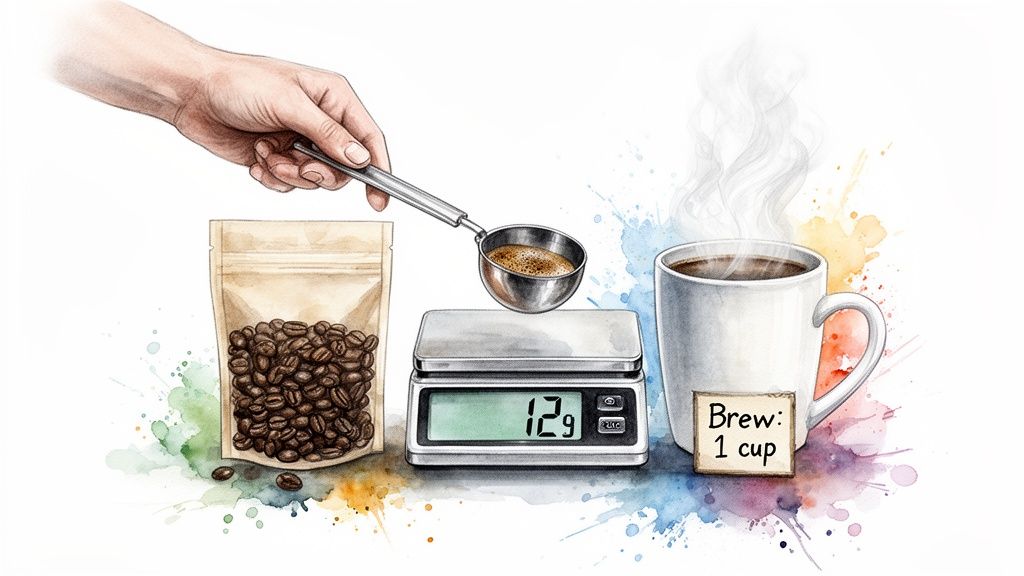
Before we do anything else, let's talk beans. The quality of your coffee is the absolute foundation of your brew—no amount of precise measuring can rescue stale, low-grade coffee. Freshly roasted beans are packed with complex aromatic compounds that fade over time, which is why they deliver a much more vibrant and nuanced flavour.
Choosing and Measuring Your Coffee
When you're picking out your beans, think about the flavours you naturally gravitate towards. Are you a fan of bright, fruity notes, or do you prefer something deep and chocolatey? Exploring different single-origin beans and expertly crafted blends is all part of the fun. Our collection of freshly roasted coffee beans is a brilliant place to start, no matter what your taste.
Once you’ve got your beans, follow this simple routine:
- Grind Fresh: I can't stress this enough—always grind your coffee right before you brew. It makes an enormous difference to the final taste. If you need a new one, we have a range of excellent coffee grinders.
- Measure Consistently: Start with our golden ratio: two level teaspoons (or one level tablespoon) for a standard 240ml mug. The key is to use the same spoon every time you brew.
- Adjust to Taste: Brew a cup and give it a proper taste. Is it a bit weak? Try adding an extra half-teaspoon next time. Too strong or bitter? Just dial it back a little.
Remember, these ratios are a starting point, not a strict rule. Your personal preference is what matters most. The goal is to find the perfect number of spoons that creates a cup you genuinely love, turning your daily coffee from a simple routine into a delightful ritual.
Got Questions About Measuring Coffee?
Even the most seasoned coffee lover runs into questions when dialling in their brew. We get asked these all the time, so we’ve put together some straight-talking answers to help you get it right.
Does a Heaped or Level Spoon Really Matter?
Yes, it makes a massive difference. If you want a delicious cup of coffee every single time, consistency is your best friend, and that starts with a level spoon.
Think about it: a heaped spoon can easily hold nearly double the coffee grounds of a level one. That's a one-way ticket to an over-extracted, bitter brew. For the best flavour, always, always level off your spoon.
If you’re ready to take precision to the next level, weighing your coffee is the ultimate game-changer. For a deeper dive, check out our article comparing an espresso scale vs a timer.
How Do I Make My Coffee Stronger?
The obvious answer is to add more coffee, but it’s a delicate balancing act. Tipping in too much can easily overwhelm the brew, leaving you with harshness instead of that rich flavour you're after. A good starting point is to add an extra half-teaspoon and see how that tastes.
Here’s a pro tip for a more intense cup without the bitterness: try a slightly finer grind size first. This increases the coffee's surface area, allowing for a more efficient extraction and a stronger flavour profile from the same amount of grounds.
What's the Gram Equivalent of a Spoon?
As a rule of thumb, a standard level teaspoon holds roughly 5 grams of ground coffee. A level tablespoon is typically closer to 10-12 grams. You'll find many dedicated coffee scoops are designed to hold around 10 grams, which is just about perfect for a single cup.
One last thing: never use the same spoon measurement for whole beans as you would for grounds. Whole beans are much less dense, so a spoonful of beans weighs significantly less than a spoonful of ground coffee. Always measure your coffee after you’ve ground it to keep your ratios accurate.