Frothing milk without a steam wand: Perfect lattes at home

Of course you can. Getting that rich, velvety frothed milk for your favourite coffee is absolutely possible without a steam wand. The secret isn't in some expensive gadget; it's likely already hiding in your kitchen. Simple tools like a French press, a handheld whisk, or even a basic jar with a lid can work wonders.
Great Froth Is Possible Without an Espresso Machine
Let's be honest, the dream of a perfect homemade latte often feels tied to a pricey espresso machine glimmering on the countertop. But what if the key to that luxurious, velvety microfoam is already within reach? It's time to debunk the myth that you need a steam wand to create cafe-quality milk.
The process is much simpler than you might think. It all boils down to the basic science of aeration—incorporating tiny air bubbles into milk to create that silky, textured finish. Forget the intimidating equipment. We’re going to focus on practical, accessible methods for frothing milk that real home baristas across the UK use every single day.
So, Why Ditch the Steam Wand?
While a proper espresso machine is a fantastic piece of kit, it’s not the only route to a brilliant coffee. Lots of people are discovering the freedom and simplicity of manual methods, and for good reason. Frothing milk without a dedicated steam wand has become incredibly popular in UK households.
In fact, the UK milk frother market was valued at USD 17.8 million recently, with experts projecting a compound annual growth rate (CAGR) of 7.4% through 2035. This growth isn't just about convenience; it shows a real shift towards tools that give you great results without the massive investment.
This trend highlights a key point: you don't need complex machinery to enjoy top-tier drinks at home. For many coffee lovers, a dedicated espresso machine just doesn't fit the budget or the kitchen space. If you're weighing your options, it's worth comparing an espresso machine vs bean-to-cup for home use to see what makes sense for you.
The core principle is the same whether you use a £2,000 machine or a £20 French press: introduce air into heated milk to create texture. The tools are different, but the goal is identical.
With the right technique, you can easily elevate your daily coffee into something special. We'll walk through several proven methods, so you can find one that suits you and helps you create delicious, beautifully textured milk every time.
The Secrets to Choosing and Heating Your Milk
Before you even think about whisking, plunging, or shaking, the success of your coffee is already being decided by what's in your milk jug. It sounds dramatic, I know, but creating that perfect, glossy foam without a steam wand really boils down to two things: the type of milk you use and its temperature.
It’s all about the science. The proteins in milk are what build the structure, essentially forming a net that traps air to create bubbles. The fats, on the other hand, deliver the richness and stability, giving the foam its creamy texture and flavour. Nail this balance, and you've laid the groundwork for a truly great latte or cappuccino.
Choosing Your Milk: The Right Foundation
The type of milk you pour into your jug will drastically change the outcome. I’ve frothed them all, and I can tell you that different milks behave in completely unique ways, each with its own quirks when you're frothing by hand.
- Whole Milk: This is, without a doubt, the champion. Its higher fat and protein content creates a stable, rich, and velvety microfoam that's an absolute dream to pour. It’s forgiving for beginners and delivers consistently excellent results.
- Semi-Skimmed Milk: You can get a decent amount of foam with this, but it's often lighter and less stable than what you’d get from whole milk. The texture can sometimes lean a bit more bubbly than creamy.
- Oat Milk (Barista Edition): The star player in the plant-based world. Barista-grade oat milks are specifically formulated with emulsifiers that help them froth beautifully, creating a texture that’s remarkably close to whole dairy milk.
- Almond & Soy Milk: These can be tricky customers. Almond milk often produces a thin, airy foam that disappears in a flash, while soy can create a very dense, almost stiff foam. If you’re using either, always hunt down a 'barista' version if you can.
If you're aiming for that classic, silky mouthfeel, especially when you're learning how to make a flat white at home, starting with whole milk will give you the best chance of success. It provides a reliable canvas to perfect your technique before you start experimenting with alternatives.
The Golden Rule of Temperature
Getting your milk to the right temperature is just as crucial as picking the right type. The ideal range for frothing is between 60-65°C. This is the sweet spot where the milk’s natural sugars are caramelised just enough to taste sweet, and the proteins are primed to create a stable, luscious foam.
Go any hotter than 65°C and you risk scalding the milk. This process, known as denaturing, breaks down the proteins, killing their ability to hold air. The result? A flat, burnt-tasting addition to your lovely coffee.
But what if you don’t have a thermometer? No problem at all. A simple, practical trick I use all the time is the 'hand-touch' method. Heat your milk in a pan or microwave, and place your hand on the side of the jug. The second it becomes just a little too hot to comfortably keep your hand there is the moment it's ready. With a bit of practice, this technique becomes surprisingly accurate, helping you hit that perfect temperature every single time.
Five Proven Methods for Frothing Milk at Home
Now that you’ve got your milk perfectly heated, it’s time to whip up that beautiful, velvety texture. You might think creating café-quality foam without a steam wand is a tall order, but it’s surprisingly straightforward once you know the tricks of the trade.
Let’s get hands-on. We’ll walk through five reliable methods, from zero-cost kitchen hacks to nifty gadgets. Each one has its own personality, so you can find the perfect fit for your morning coffee ritual.
The French Press Plunge
Who knew? Your trusty French press is a secret weapon for creating seriously dense, luxurious foam. This method is brilliant for its simplicity and the impressive texture it produces—absolutely ideal for a classic, frothy cappuccino.
Just pour your heated milk into the press, filling it no more than a third of the way up. Pop the lid on and start plunging the filter rapidly up and down. I find the sweet spot is around 50-60 plunges in about 30 seconds. You’re looking for the milk to roughly double in volume and take on a gorgeous, glossy sheen.
The real trick here is to keep the mesh filter just below the surface of the milk on the up-stroke and push it all the way down on the down-stroke. This motion is what folds air into the milk, creating a wonderfully stable and thick foam.
The Handheld Electric Whisk
For pure speed and convenience, nothing beats a handheld electric whisk. These little battery-powered gadgets are cheap, a breeze to clean, and incredibly good at whipping up silky microfoam in seconds. They’re a fantastic all-rounder for everything from lattes to hot chocolates.
Submerge the whisk head near the surface of your warm milk for just a couple of seconds to get some air in—you'll hear a slight hissing sound. Then, dip the whisk deeper and tilt the jug to create a swirling vortex. This is what breaks down the big bubbles into a smooth, integrated microfoam. Keep going for about 20-30 seconds until you see that perfect velvety texture form.
If you’re curious how this foam stacks up against the real deal, our guide on how to make a cappuccino breaks down the exact texture you’re aiming for.
Deciding which milk to use can sometimes feel like a minefield, but this flowchart makes it easy to choose based on your preferences.
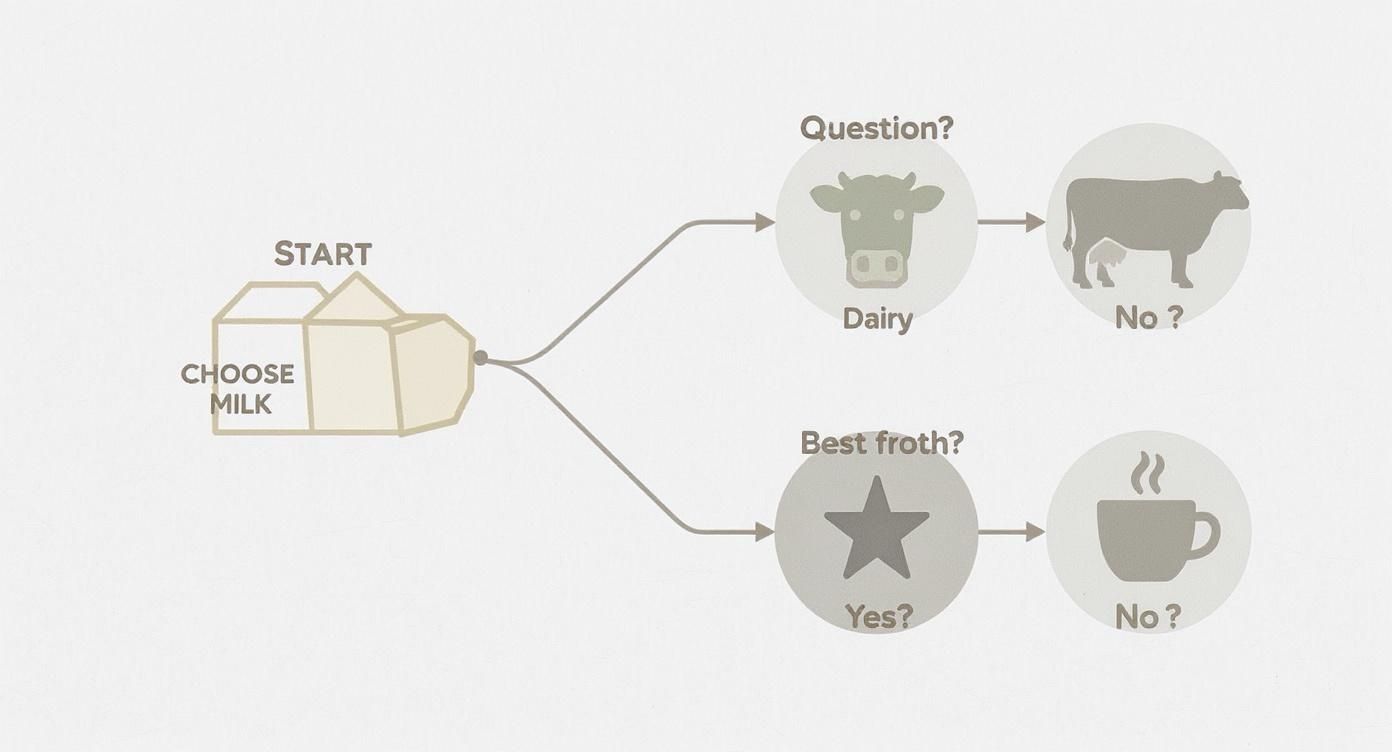
As you can see, the choice between dairy and non-dairy often comes down to balancing froth stability against your dietary needs.
The Mason Jar Shake
This is the ultimate no-gadget, no-cost method. All you need is a clean jar with a tight-fitting lid—a mason jar or even a protein shaker will do the job. It’s a beautifully simple technique that runs on pure elbow grease.
Pour your warm milk into the jar, making sure to fill it no more than halfway to give it room to expand. Screw the lid on tight and shake it like you mean it for about 45-60 seconds. You’ll feel and see the milk thicken and grow in volume right before your eyes.
The foam you get is lighter and a bit more bubbly than with other methods, but it’s perfect for a rustic-style latte or just adding a foamy cap to your morning filter coffee. Just be careful when you open the lid, as the hot milk can build up a bit of pressure.
The Blender Method
Making coffee for a few friends? Your blender can step in to froth a larger batch of milk all at once. This method is fast and efficient, producing a surprisingly uniform foam, though it’s definitely the loudest option on the list.
Carefully pour the heated milk into your blender. Start on a low speed for a few seconds just to get things moving, then crank it up to medium-high. Let it go for around 30-45 seconds, or until the milk has doubled in volume and looks consistently frothy.
- Pro Tip: If your blender has a vented lid, use it. This allows steam to escape safely.
- Best For: When you need a big batch of frothed milk for multiple drinks at the same time.
- Texture: Expect a light-to-medium-bodied foam with a good balance of froth and liquid milk.
The Automatic Milk Frother
For anyone who values consistency and wants a completely hands-off approach, an automatic milk frother is the dream machine. These countertop gadgets heat and froth your milk perfectly at the touch of a button. No guesswork, just great results every time.
They’re a brilliant investment if you make milky coffees on the regular. Many models even have different settings for thick cappuccino foam, silky latte milk, or even cold foam for your iced drinks. It’s without a doubt the most foolproof way to get the job done.
How to Pour Like a Pro for Classic Coffee Drinks
So, you’ve done the hard part and whipped up a jug of beautifully textured milk without a fancy steam wand. Brilliant. But don't let all that effort go to waste with a clumsy pour.
The final step—marrying the milk and coffee—is what separates a good homemade coffee from a truly exceptional one. This is your moment.

Before a single drop hits the cup, you need to groom your milk. After frothing, just let it sit for about 30 seconds. You'll probably see a few bigger, rogue bubbles on the surface; a firm tap of the jug on your worktop will pop them right away.
Next, give the jug a smooth, circular swirl. This is a non-negotiable step. It folds the light microfoam back into the liquid milk underneath, creating a single, uniform texture that looks like glossy, wet paint. Get this right, and your pour will be consistent from the first drop to the last.
Matching Foam to Your Favourite Drink
Not all frothy coffees are created equal, and the foam you need can vary wildly from one drink to the next. That lovely, airy foam you just made might be perfect for a cappuccino but completely wrong for a flat white.
- For a Classic Cappuccino: You're aiming for a thick, luxurious cap of foam. After grooming the milk, pour it confidently right into the centre of your espresso, letting that dense foam pile high.
- For a Velvety Latte: This calls for a thinner layer of silky microfoam. After swirling, start pouring from a bit higher up to let the liquid milk dive under the crema. Then, bring the jug closer to the surface to let the foam float on top.
- For a Perfect Flat White: This one is all about that barely-there, silky microfoam. Your milk should be exceptionally glossy and pourable. The goal is a delicate, paper-thin layer of foam that melts seamlessly into the coffee.
The real secret is controlling how the liquid and foam separate. If you pour too slowly or hesitate, you’ll end up with a disappointing blob of stiff foam at the end. A confident, steady hand is your best friend here.
Your First Step into Latte Art
Feeling brave enough to try some simple art? Pouring a heart is the perfect place to start, and it’s genuinely much easier than it looks. It's a fantastic entry point, and we've got a more detailed guide covering latte art basics you can try at home when you're ready for more.
Start by tilting your cup and pouring into the deepest part until it's about two-thirds full. This initial pour is all about mixing the milk and coffee.
Now for the magic. Bring the spout of your jug as close as you can to the surface of the coffee. As you keep pouring into the centre, a white dot will appear and grow. Once the cup is nearly full, slow your pour to a thin stream, lift the jug slightly, and pull it straight through the middle of the circle.
And just like that, you've made a heart.
Fixing Common Milk Frothing Frustrations
We’ve all been there. You’ve followed every step, dreaming of that perfect silky microfoam, only to be left staring at a jug of flat, sad milk or a sea of big, airy bubbles. It’s a common hurdle, but don't worry, most of these issues have a surprisingly simple fix.
Think of this as your frothing first-aid kit. Once you understand what’s going wrong—whether it's over-aerating or just using the wrong type of milk—you’ll have the confidence to diagnose and fix any problem that comes your way. Your next cup is going to be perfect.
My Milk Isn’t Getting Thick Enough
This is easily the most frequent frustration I hear about. If your milk stubbornly refuses to thicken, the culprit is almost always either temperature or freshness.
Milk that’s a bit old starts to lose the protein structure it needs to build a stable foam. For the best results, always try to use the freshest milk you possibly can.
The other massive factor is heat. If your milk gets too hot (anything over 65°C), the proteins break down and simply can’t hold the air you’re trying to introduce. On the flip side, if it’s not warm enough, it just won’t have the energy to create that velvety texture we're after. Your target is that sweet spot where the jug is just too hot to hold comfortably.
A common mistake is not introducing enough air right at the beginning. Whether you're plunging with a French press or buzzing with a handheld whisk, those first few seconds of aeration are absolutely critical for building the foundation of your foam.
My Foam is Just Big Bubbles
Ah, the classic 'bubble bath' effect. Seeing a stiff, bubbly layer sitting on top of thin, watery milk is a dead giveaway for over-aeration. This happens when you introduce way too much air, or you do it too aggressively, creating large, unstable bubbles instead of that tight, fine microfoam.
To fix this, the key is to create a whirlpool or vortex after that initial aeration phase. For example, with a handheld whisk like the popular Aerolatte Original Steam-Free Milk Frother, you’ll want to submerge the whisk deeper into the milk after the first few seconds. This simple motion breaks down those big bubbles and folds them back into the liquid, creating a gorgeous, uniform, and glossy texture.
Don't forget to give the jug a firm tap on the worktop when you're done—this will pop any last-minute large bubbles before you pour.
My Plant-Based Milk is Separating
Frothing alternative milks can feel like a completely different ball game. If your oat or almond milk is separating or creating a weak, disappointing foam, here are a few things to check:
- Use a Barista Edition: This is non-negotiable. Always opt for a 'barista' version of your favourite plant-based milk. They’re specifically formulated with added proteins and stabilisers to help them foam up beautifully.
- Don't Overheat: Plant milks are often far more sensitive to heat than dairy. Keep a close eye on the temperature and whatever you do, don't let it get anywhere close to boiling.
- Shake Well: Give the carton a really vigorous shake before you pour. The ingredients that are key for foaming can easily settle at the bottom.
With these troubleshooting tips in your back pocket, you'll be well-equipped to handle any frothing challenge, turning frustration into consistently brilliant coffee.
Your Milk Frothing Questions Answered
To wrap things up, let's get into some of the questions that always pop up when you're trying to froth milk at home without the fancy gear. Think of this as a quick-fire round to help you nail your technique.
What Is The Best Non-Dairy Milk For Frothing?
From my own experience, I’ve found that a good barista-grade oat milk is the undisputed champion here. It’s specifically formulated to create a creamy, stable microfoam that honestly behaves a lot like whole dairy milk.
Almond milk is another decent shout, but you’ll find it produces a much lighter, more delicate foam. Soy is also a solid option if you’re after a dense foam, though its distinct flavour can be a bit love-it-or-hate-it. If you want reliable results from the get-go, always start with a "barista edition" plant milk—they’re designed for exactly this.
Can I Froth Cold Milk For Iced Coffees?
Absolutely! This is where the French press and handheld whisk methods really shine. They're both fantastic for creating that silky cold foam that’s all over your favourite coffee shop’s menu. Just use your milk chilled, straight from the fridge, and use the exact same technique you would for hot milk.
Interestingly, skimmed milk often whips up into the most voluminous cold foam because of its high protein-to-fat ratio. It’s a brilliant way to top an iced latte or cold brew without watering it down. Once you’ve got the hang of it, you can start exploring all the different types of coffee drinks you can make.
The goal with cold foam is a dense, pourable texture that sits neatly on top of your drink. You want it to slowly cascade into the coffee below—it’s a real game-changer for summer drinks.
How Should I Clean My Frothing Equipment?
A quick and proper clean is the secret to keeping your gear in top shape and your coffee tasting fresh. For French presses or any frothing jars, the trick is to rinse them with hot water the moment you’re done, even before you wash them properly with soap.
If you've used a handheld whisk, just give the whisk head a quick run under a hot tap for a few seconds. For most automatic frothers, a wipe with a soft, damp cloth is all it takes. The golden rule is simple: never submerge any electronic parts in water, and always give the manufacturer's instructions a quick look.
At Seven Sisters Coffee Co, we believe great coffee starts with great beans. Pair your perfectly frothed milk with our freshly roasted blends for a café experience in your own home. Explore our full range of coffee today.