Your Guide to Perfect Cup Filter Coffee at Home

Cup filter coffee is a hands-on way to brew that puts you in complete control of the final flavour. By manually pouring hot water over ground coffee in a filter, you can draw out a clean, nuanced cup that’s exceptionally tasty—something brewing machines often struggle to replicate.
Why Pour-Over Is the Ultimate Home Coffee Ritual
There’s a quiet satisfaction that comes from making your coffee by hand. In a world of instant gratification and automated everything, the pour-over method is a chance to slow down and really connect with the process. It's more than just a caffeine fix; it's a mindful ritual that can turn a daily routine into a genuine sensory experience.
The magic lies in its simplicity and precision. Unlike an automatic brewer, you are in charge of every single variable: the water temperature, the speed of your pour, and how evenly you saturate the coffee grounds. This direct involvement is what unlocks the intricate flavours hidden away inside high-quality beans.
A Connection to Your Coffee
Here at Seven Sisters Coffee, we believe this hands-on approach is the very best way to appreciate the journey our coffee has been on. From our roastery in East Sussex, we pour our passion into sourcing and roasting exceptional beans. Our unique oxygen-free roasting process protects delicate flavour compounds, making sure every bag is packed with character. When you brew our coffee using the cup filter method, you’re completing that journey yourself.
This method empowers you to be your own barista. You’re not just pressing a button; you are actively crafting your perfect cup, tailored exactly to what you love.
The UK's love for quality coffee is stronger than ever. Brits now drink a staggering 98 million cups of coffee daily, a huge jump from 70 million back in 2008. This surge is driven partly by filter methods like pour-over, which appeal to the 77% of UK adults who drink coffee every day.
This shift toward quality brewing at home is what inspires us. By choosing the right beans and mastering a simple technique, you really can produce café-quality coffee right in your own kitchen. For those curious about other morning rituals, it can be interesting to explore the comparison of matcha vs coffee for your morning routine. We'll guide you through making the perfect cup filter coffee, helping you get the most out of every single brew.
Choosing Your Essential Brewing Equipment
To really get the best out of your coffee, you need a few key pieces of kit. You don’t need a full-blown café setup on your kitchen counter, but investing in the right tools is the single best way to guarantee a delicious, consistent brew every single time. Think of it as putting together your personal coffee toolkit—each item has a massive impact on the final flavour in your cup.
The journey starts with the dripper itself, the cone-shaped gadget that holds your filter paper and coffee grounds. Models like the iconic Hario V60 are legendary for a reason; their design encourages a really even extraction, giving you a clean, vibrant cup. Paired with good-quality filter papers, the dripper becomes the heart of your whole pour-over operation.
The Tools for Precision and Consistency
Next up, let's talk about water. Sure, a standard kettle gets water hot, but a gooseneck kettle is an absolute game-changer for pour-over. That long, slender spout gives you pinpoint control over where your water goes and how fast it flows, making sure all the coffee grounds get saturated evenly. This precision is what stops little channels from forming in the coffee, which can lead to a weak, disappointing brew.
Just as important are a good set of digital scales. Honestly, just guessing your coffee and water measurements is a recipe for disaster—or at least, for wild inconsistency. A scale lets you lock in precise ratios, which is non-negotiable if you want to recreate that perfect cup day after day. Try to find one with a built-in timer to help you keep an eye on your brew time.
Without a scale, you're essentially brewing blind. It's the one piece of kit that moves you from guesswork to deliberate, repeatable brewing excellence, making every cup as good as the last.
Finally, we come to what is arguably the most important investment you'll make: the grinder. Freshly ground beans are packed with aromatic oils and delicate compounds that start to disappear almost the second they’re ground. A quality burr grinder is vital because it produces uniform coffee particles, which is the secret to a balanced extraction. Blade grinders, on the other hand, just smash the beans into a chaotic mix of dust and chunks, which can leave your coffee tasting both bitter and sour at the same time.
If you want to dive deeper into the differences, you might find our guide on choosing between a hand grinder and an electric coffee grinder helpful.
To make things simple, here’s a quick rundown of the essential gear.
Your Pour-Over Coffee Brewing Toolkit
This table is a quick reference to the gear you'll need and, more importantly, why each piece is so crucial for making a quality brew.
| Equipment | Why It's Essential | Recommended Link |
|---|---|---|
| Coffee Dripper | Shapes the flow of water through the coffee for optimal extraction. | Shop for Drippers at ADS Coffee Supplies |
| Filter Papers | Remove fine particles and oils for a clean, sediment-free cup. | Browse Filter Papers at ADS Coffee Supplies |
| Gooseneck Kettle | Provides complete control over pouring speed and precision. | Find Gooseneck Kettles at ADS Coffee Supplies |
| Digital Scale | Ensures consistent coffee-to-water ratios for repeatable results. | View Digital Scales at ADS Coffee Supplies |
| Burr Grinder | Creates uniform coffee grounds for a balanced extraction. | Buy Burr Grinders at ADS Coffee Supplies |
We've linked to our trusted friends at ADS Coffee Supplies, where you can find everything you need to get started on your pour-over journey.
Our Seven Sisters Pour-Over Brewing Method
With your gear sorted, it’s time to get brewing. This is the moment you turn those carefully roasted beans into an exceptional cup of filter coffee, and honestly, the process itself is a rewarding ritual. We'll walk you through our tried-and-tested method, using our popular Seven Sisters House Blend as the perfect coffee to start with.
First things first, let’s get our recipe locked in. Our go-to for a single, generous mug is a 1:16.6 ratio. That breaks down to 15g of coffee to 250g of water. We find this ratio hits the sweet spot, giving you a brilliant balance of body and clarity. Of course, feel free to tweak it later to match your personal taste.
Preparing Your Brewing Station
A little bit of prep work before any water hits the coffee makes all the difference. Get your kettle on to boil – you’ll need a bit more than the 250g for brewing, as some will be used for preheating. Try to get your water temperature somewhere between 92-96°C. If you don’t have a fancy temperature-controlled kettle, no worries. Just let it cool down for about 30-45 seconds after it boils.
While the water is settling, place your dripper on your mug, pop a filter paper inside, and get the whole lot onto your digital scales. Tare them to zero. Now, pour some of that hot water into the filter, wetting the paper thoroughly in a gentle swirl. This rinse is super important for two reasons: it gets rid of any papery taste and it preheats your dripper and mug, helping keep the temperature stable while you brew.
Once the water has drained through, carefully tip it out of the mug and put your setup back on the scales. Now you can add your freshly ground coffee. For our 15g dose, give the dripper a gentle shake to level the coffee bed, then hit the tare button again so your scale reads zero. You're now perfectly set up for the pour.
The Critical Bloom Phase
The first pour is arguably the most important part. It’s called the bloom, and it’s where all that incredible flavour begins to wake up. Start your timer and pour just enough water to saturate all the grounds—somewhere around 30-45g should do the trick.
You’ll see the coffee bed puff up and bubble. That’s just carbon dioxide, a gas trapped in the beans during roasting, making its escape. Letting the coffee 'bloom' for about 30 seconds ensures this gas gets out of the way. If it doesn't, it can repel water during the main pour, leading to an uneven, less flavourful extraction.
Think of the bloom as giving your coffee grounds a moment to breathe. Skipping this step is like trying to have a conversation with someone who isn't listening—you won't get the best results. A proper bloom paves the way for a much sweeter and more balanced cup.
This infographic shows the simple, essential gear that makes this entire process possible.
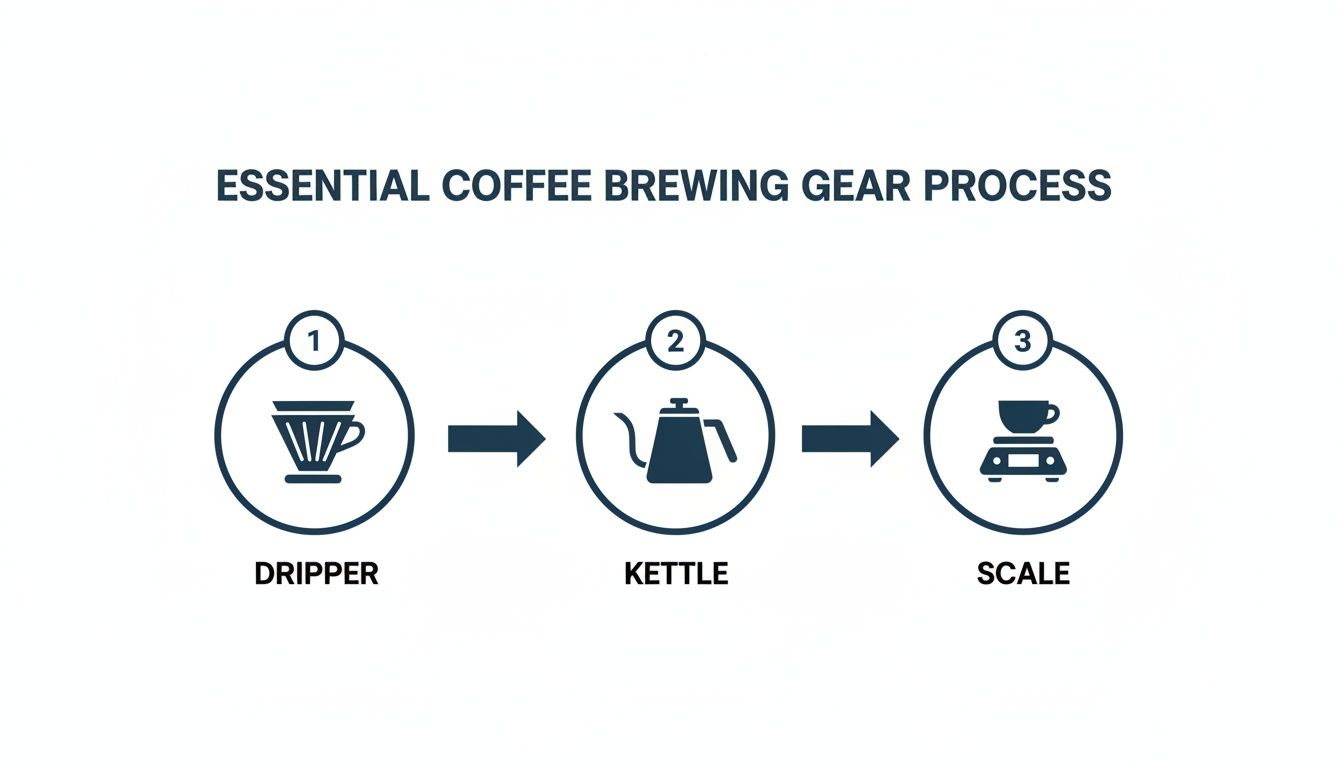
From the dripper that shapes the brew to the kettle that controls the flow, each tool plays a specific, vital role in achieving a great cup.
Mastering The Main Pour
After the bloom, it’s time for the main event. Your goal is to pour the rest of the water steadily and gently until the scale hits 250g. Using your gooseneck kettle, start pouring in a continuous, gentle circle, working from the centre outwards and then back in again. Just try to avoid pouring directly onto the filter paper itself.
A good tip is to maintain a consistent water level in the dripper as you pour, keeping it about halfway full. This really helps with an even extraction. Your total brew time, including the 30-second bloom, should land somewhere between 2 minutes 30 seconds and 3 minutes. If it’s much faster, your grind is probably too coarse; if it’s dragging on for much longer, it’s likely too fine.
Once the water has fully drained through, your delicious cup of filter coffee is ready. If you're using a V60, its unique design really encourages this precise technique. You can dive deeper into this popular brewer in our guide to the Hario V-60 pour-over. Now, take a moment to enjoy the incredible aroma before that first sip.
How to Dial In Your Perfect Brew
Now that you've got the basic pouring technique down, it's time for the fun part: refining your brew. This is where you graduate from simply following a recipe to really understanding your coffee. It's the small, deliberate tweaks that take a brew from being just 'good' to something truly special, and it all begins with the grind.
Think of your coffee grind size as the gatekeeper to all the flavour locked inside the bean. If your grind is too coarse, the gate is wide open. Water rushes through too quickly, barely picking up any of the good stuff. The result? A thin, sour, and frankly disappointing cup. We call this under-extraction.
On the other hand, a grind that's too fine makes the gate too narrow. Water struggles to get through, lingering too long and pulling out all sorts of bitter, unwanted compounds. This is over-extraction, and it’s the culprit behind that harsh, astringent taste that makes you wince. Your mission is to find that perfect sweet spot right in the middle.
Finding the Sweet Spot with Grind Size
Every time you open a fresh bag of beans, you need to ‘dial it in’. This is just a fancy way of saying you’ll make tiny, methodical adjustments to your grinder until you hit that perfect extraction. For pour-over, a medium-fine grind—something with the texture of table salt—is a brilliant place to start.
Treat your first brew as a baseline test. Taste it, and be honest with yourself about what you're picking up.
- Does it taste sour, overly acidic, or watery? Your grind is too coarse. Nudge your grinder setting one or two clicks finer for your next attempt.
- Is it bitter, harsh, or does it leave a dry feeling in your mouth? Your grind is too fine. Go one or two clicks coarser next time.
This simple principle—sour means go finer, bitter means go coarser—is the single most effective tool you have for improving your brew. If you want to dive deeper, our comprehensive coffee grind size guide has everything you need.
This dedication to getting it just right is becoming more and more common across the UK. It turns out we're becoming a nation of coffee aficionados. A recent De’Longhi survey found that a massive 56% of Brits now favour coffee over tea. It also shone a light on a younger generation of coffee lovers, with a staggering 87% of 18-27-year-olds calling themselves ‘coffee connoisseurs’. It's this growing appreciation for flavour and nuance that makes methods like the cup filter so rewarding.
How Roast Profile Affects Your Brew
The way the beans have been roasted plays a huge part in how you should brew them. Lighter roasts, which are very common for single-origin coffees, are physically denser and less soluble. To properly extract their bright, delicate, and often fruity notes, they usually need a slightly finer grind or hotter water—think around 96°C.
Trust your palate above all else. Recipes and guides are fantastic starting points, but the 'perfect' cup is the one that tastes best to you. Don't be afraid to experiment and break the rules once you understand them.
Darker roasts, like our very own Seven Sisters House Blend, are more porous and extract much more readily. For these, you’ll want to use a slightly coarser grind and cooler water—around 92°C is a good target. This helps you avoid pulling out any of those harsh, overly roasty bitter notes, letting the deep, chocolatey, and nutty flavours shine. Trying different beans and tweaking your technique to match is what this is all about.
Troubleshooting Common Brewing Mistakes
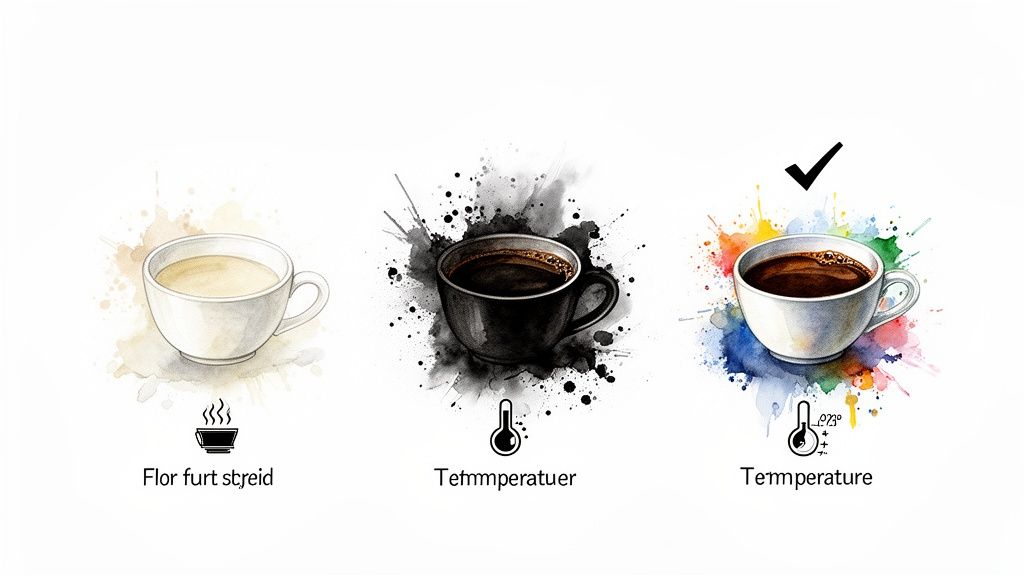
Even the most experienced home brewers have off days. Don’t worry, a disappointing cup isn’t a failure—it's feedback. Think of it as your coffee telling you exactly what it needs next time.
When your filter coffee tastes off, it almost always comes down to two culprits: under-extraction or over-extraction. Once you learn to recognise the distinct taste of each, you'll have the power to fix almost any brew.
Is Your Coffee Weak and Sour?
If you take a sip and your coffee tastes thin, disappointingly watery, or has a sharp, sour tang, you’re dealing with under-extraction.
This is a classic sign that the water rushed through the grounds too quickly, failing to pull out enough of the good stuff—the sugars and flavour compounds that give coffee its depth. It’s a very common hurdle when you're just starting.
The usual suspect here is a grind that's too coarse. The large coffee particles leave big gaps for water to flow through, meaning there just isn’t enough contact time.
To get it right, you have a few options:
- Go finer on the grind. This is your best bet. Tweak your grinder setting a couple of notches finer to slow the water down and increase extraction.
- Turn up the heat. If your water is on the cooler side (below 92°C), it might not have enough energy to extract efficiently. Aim for slightly hotter water.
- Slow down your pour. Rushing the pour can mimic the effect of a coarse grind. Focus on a slower, more controlled spiral to give the water more time to do its job.
Does Your Coffee Taste Harsh and Bitter?
On the flip side, if your coffee is unpleasantly bitter, harsh, or leaves a dry, almost chalky feeling in your mouth, you’ve swung too far into over-extraction.
This happens when the water hangs around for too long, pulling out bitter compounds that are best left in the grounds. The number one cause is a grind that is simply too fine, which clogs up the filter and slows the flow to a crawl.
Think of troubleshooting as a simple balancing act. A sour taste means you need more extraction (finer grind, hotter water), while a bitter taste means you need less extraction (coarser grind, cooler water).
Here’s how to dial it back from an over-extracted brew:
- Coarsen your grind. The quickest and most effective fix is to adjust your grinder to a coarser setting. This will let the water flow more freely and shorten the total brew time.
- Lower the water temperature. Water that’s too hot (above 96°C) can easily scald the grounds and fast-track the extraction of bitter elements. Let your kettle rest for a minute after it boils.
- Use reliable equipment. Inconsistent results can sometimes come from worn-out kit. Using fresh, high-quality filter papers from a trusted supplier like ADS Coffee Supplies ensures you get a clean and predictable flow rate every single time.
Quick Fixes for Your Filter Coffee
Don't let a bad cup ruin your morning. This table breaks down the most common taste issues and gives you simple, actionable adjustments to perfect your next brew.
| If Your Coffee Tastes… | The Likely Cause | How to Fix It |
|---|---|---|
| Weak, Sour, Salty | Under-extraction (water moved too fast) | Use a finer grind, increase water temperature, or pour slower. |
| Bitter, Harsh, Dry | Over-extraction (water moved too slow) | Use a coarser grind, decrease water temperature, or pour faster. |
| Muddy, Unclear | Inconsistent grind or poor filter | Ensure your grinder produces uniform particles. Use quality filter papers. |
| Hollow, Empty | Incorrect coffee-to-water ratio | Double-check your recipe. A 1:16 ratio (15g coffee to 240ml water) is a great start. |
With these simple diagnostics, you're no longer just guessing. You're actively tasting, learning, and refining your technique with every single cup you make.
Your Cup Filter Coffee Questions Answered
To round things off, let's dive into some of the most common questions that pop up when you're getting to grips with cup filter coffee. Nailing these little details can make a massive difference to what ends up in your mug.
Can I Use Pre-Ground Coffee for Pour-Over?
You can, but honestly, we’d really advise against it if you're chasing the best possible flavour. The moment coffee is ground, it starts to lose its incredible aromatic compounds. Freshly ground beans are the key to capturing that full spectrum of taste that makes pour-over so special.
Think of it this way: pre-ground coffee almost always leads to a flatter, less exciting cup because all those delicate, vibrant notes have simply vanished into thin air. Grinding your beans just before you brew is probably the single biggest upgrade you can make to your coffee at home.
What Is the Difference Between Bleached and Unbleached Filters?
This is a great question, and the answer often boils down to personal taste.
- Bleached Filters: These are the white ones. They're typically whitened using an oxygen-bleaching process, which is perfectly safe for the environment. The big advantage is that they have a neutral impact on flavour, which is why so many coffee lovers prefer them.
- Unbleached Filters: These are the natural brown filters. The only catch is they can sometimes add a subtle papery or woody taste to your brew if you don't give them a really good rinse before you start.
For the cleanest possible taste, we recommend using bleached papers. They let the coffee's true character shine through without any interference. You can find some excellent bleached filter papers at ADS Coffee Supplies that are perfect for getting a pristine brew.
How Do I Brew for More Than One Person?
Making a bigger batch is straightforward. The trick is to simply keep your coffee-to-water ratio consistent. If your go-to recipe for one cup is 15g of coffee to 250g of water, just double everything for two people: 30g of coffee to 500g of water.
If you're scaling up and want to be sure you're getting the measurements spot-on, you might want to check out our guide on how many tablespoons per cup of coffee for some extra tips on consistency.
Ready to put it all into practice? Explore our range of freshly roasted beans at Seven Sisters Coffee Co and discover the incredible difference that quality makes. Pop over to https://sevensisterscoffee.co.uk to find your new favourite brew.