Coffee Producing Countries: Discover Top Origins & Flavours

Every sip of coffee tells a story. It’s a story of where it grew, the soil that nourished it, the altitude, and the climate. You’ll find all the world’s major coffee producing countries nestled within the ‘Bean Belt’, a band around the equator with the perfect conditions for growing these incredible plants. This guide is your passport to exploring them.
Your Global Coffee Journey Starts Here
Think of this as a world tour in a coffee cup. Getting to grips with where your coffee comes from can completely change how you see your daily brew, turning it from a simple routine into a rich, sensory experience.
Ever wondered why a coffee from Ethiopia tastes wildly different from a Brazilian one? It all comes down to its terroir—the unique combination of environmental factors where it was grown. We’re here to connect your morning ritual to the hardworking farmers and stunning landscapes behind every single bean.
Here at ADS Coffee Supplies, our passion is hunting down exceptional single-origin beans. We genuinely believe that understanding a coffee's origin is the first step to truly appreciating its incredible quality and flavour. As you read on, you'll discover what makes each region so special. To go a bit deeper, you can also explore our guide on what is specialty coffee.
Understanding Coffee Terroir
The idea of terroir is simple but profound: it's how a specific place tastes. Just as a vineyard's location shapes the flavour of wine, a coffee's character is defined by three key environmental factors.
This diagram helps visualise how soil, altitude, and climate work together to create the distinct coffee profiles we know and love from around the world.
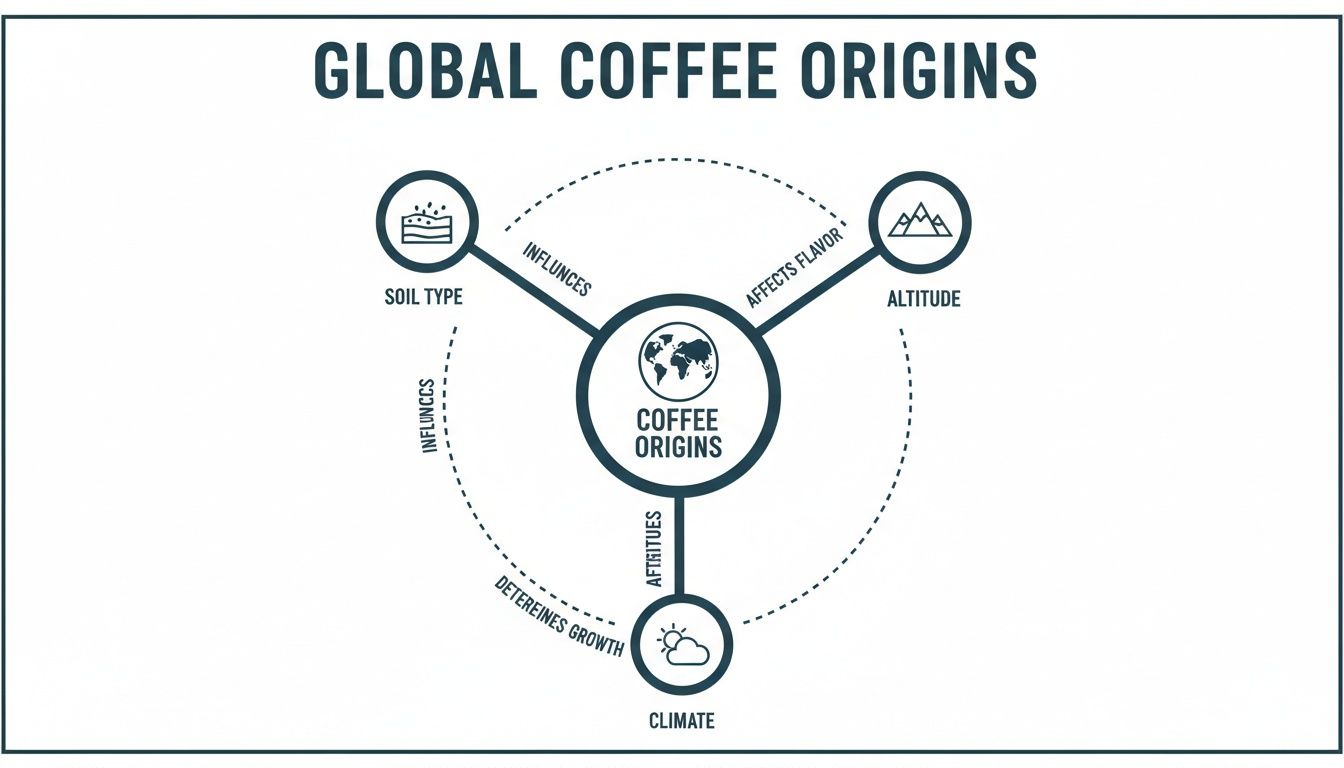
As you can see, no single element works alone. It's the interplay between these three factors that gives each coffee-producing country its signature taste.
The 'Bean Belt' is more than just a line on a map; it's a collection of thousands of microclimates, each one capable of producing a coffee with a completely distinct personality. This incredible diversity is what makes exploring single-origin coffee so exciting.
For UK coffee lovers, this global exploration has never been more relevant. Coffee is a daily essential here, with Brits getting through an astonishing 98 million cups every single day. Our love affair with the bean has grown so much that 63% of UK adults are now regular coffee drinkers, putting it ahead of tea.
For home brewers, this boom means fantastic access to premium beans from all corners of the globe, making it the perfect time to start discovering the world's finest flavours right from your own kitchen.
Exploring the Coffee Powerhouses of the Americas
Our global journey kicks off in the Americas, a continent that truly forms the backbone of the world's coffee supply. This is a region of incredible diversity, from sprawling, sun-drenched plantations to tiny, high-altitude farms tucked away on the slopes of volcanic mountains. Each country here serves up a unique personality in the cup.
We'll start with the titans before moving to the smaller, but no less impressive, producers. Getting to grips with the Americas is fundamental to understanding the global coffee market. The flavours born here often set the standard for what many of us think of as a classic, satisfying cup of coffee.
Brazil: The Undisputed Giant
When you think of coffee-producing countries, Brazil should be the first name that springs to mind. It is, by a massive margin, the world's largest producer, responsible for roughly a third of all coffee grown globally. This sheer scale means Brazilian beans form the foundation of countless espresso blends you’ll find worldwide.
The country's relatively low altitudes and stable climate create coffees known for their low acidity, heavy body, and deeply comforting flavour profiles. Think rich notes of chocolate, toasted nuts, and sweet caramel. These aren't coffees that shout with bright, fruity notes; instead, they offer a smooth, mellow, and consistently satisfying experience.
Because of this dependable profile, Brazilian coffee is the perfect entry point for anyone new to single-origin brewing.
Colombia: A Profile of Balance and Sweetness
Just north of Brazil lies Colombia, a country whose coffee is synonymous with quality. While Brazil is all about volume, Colombia is about carefully cultivated character. The iconic Andes mountains snake through the country, creating thousands of unique microclimates where farmers grow some of the world's most beloved Arabica beans.
Colombian coffees are celebrated for their remarkable balance. They typically feature a medium body, bright but gentle acidity, and a pronounced caramel sweetness. You'll often find delightful hints of citrus, red fruits, and a clean, crisp finish that keeps you coming back for another sip.
This well-rounded nature makes Colombian coffee incredibly versatile, shining in everything from a morning filter brew to a sophisticated espresso. It’s the kind of coffee that pleases just about every palate, offering complexity without ever being overwhelming.
The meticulous 'washed' processing method, common throughout Colombia, is a key reason for its coffee's clean and bright flavour. By removing the fruit cherry before drying the bean, farmers can highlight the bean's inherent sweetness and vibrant acidity, resulting in a consistently high-quality cup.
Central America: The Treasures of High Altitude
As we move into Central America, the landscape changes, and so does the coffee. Countries like Honduras, Guatemala, and Costa Rica leverage their volcanic soils and high altitudes to produce beans with a distinctly different character from their South American neighbours.
These coffees are often brighter, more acidic, and bursting with complex fruit and floral notes.
- Honduras: As the largest producer in Central America, Honduras offers a wide spectrum of flavours. You can find everything from soft, caramel-forward beans to vibrant coffees with notes of apricot and tropical fruit. Its potential for exceptional quality is massive.
- Guatemala: Coffees from regions like Antigua and Huehuetenango are world-renowned. They often possess a bright, sparkling acidity akin to a crisp apple or citrus fruit, complemented by rich notes of dark chocolate, toffee, and spice.
- Costa Rica: This country is a pioneer in processing methods, particularly the 'honey' process. If you want to learn more, you can read our deep dive into what makes Costa Rican coffee special. This method gives the beans a remarkable sweetness and a syrupy body.
A Quick Guide to Coffee Flavours from the Americas
To make sense of these differences, the table below gives you a quick reference for the typical profiles you can expect from these key American coffee origins. Think of it as your cheat sheet for your next coffee purchase.
| Country | Common Flavour Notes | Acidity | Body | Best Brew Method |
|---|---|---|---|---|
| Brazil | Chocolate, Toasted Nuts, Caramel | Low | Full | Espresso, French Press |
| Colombia | Caramel, Citrus, Red Fruits, Nutty | Medium | Medium | Filter, Pour-Over |
| Guatemala | Dark Chocolate, Toffee, Apple | Bright | Medium | Pour-Over, Aeropress |
| Honduras | Apricot, Caramel, Tropical Fruit | Bright | Medium | Filter, French Press |
This comparison really highlights how geography directly shapes your drinking experience. The low-lying plains of Brazil create a mellow, comforting brew, while the high volcanic slopes of Guatemala produce a cup that is lively and complex. Exploring coffees from the Americas is a fantastic way to train your palate and discover the foundational flavours of the coffee world.
Right, so we've left the Americas with their classic chocolatey, nutty profiles behind. Now we're heading to the big one: Africa, the very birthplace of coffee itself.
This is where it all started. Africa is the ancestral home of the Arabica bean, and honestly, it’s where you'll find some of the most dazzling, complex, and aromatic coffees on the planet. Forget what you think you know about coffee; African beans are famous for their bright, sparkling acidity, vibrant fruit notes, and delicate floral hints. It's a completely different world in the cup.
If Brazilian coffee is like a warm, comforting hug, then African coffee is the life of the party. It's expressive and unforgettable. Our journey across this incredible continent will take us from the legendary highlands where coffee was first discovered to the rising stars making a name for themselves today.
Ethiopia: The Legendary Birthplace
You can't talk about coffee origins without bowing down to Ethiopia. Legend has it that centuries ago, a goat herder named Kaldi noticed his flock getting suspiciously energetic after munching on some red berries. The rest, as they say, is history.
What makes Ethiopia truly unique is its mind-boggling genetic diversity. Thousands of heirloom coffee varieties grow here, many still wild and uncatalogued. You just don't find that anywhere else. This translates into an incredible spectrum of flavours in the cup—think of it like a vast, well-stocked wine cellar where every single bottle is distinct.
- Yirgacheffe: Coffees from this southern region are famously delicate and almost tea-like. They’re light on the palate, with elegant notes of bergamot, jasmine, and bright citrus.
- Harrar: Head over to the east, and you get a totally different experience. Harrar beans are usually naturally processed (sun-dried with the fruit left on), which gives them a heavy, syrupy body and huge, jammy fruit flavours like blueberry and strawberry.
The deep cultural significance of coffee in Ethiopia is profound; you can learn more about its roots by exploring the traditional Ethiopian ceremony coffee ritual.
Kenya: A Symphony of Brightness and Body
Just south of Ethiopia, you’ll find Kenya, a country that produces some of the boldest and brightest coffees in the world. Kenyan coffee is instantly recognisable for its powerful, wine-like acidity and a signature tasting note of blackcurrant.
This isn't a subtle flavour, either. It’s a full-on burst of tart fruit, often backed up by notes of grapefruit or rhubarb. The result is a cup that’s incredibly complex, crisp, and refreshing. So, what’s their secret? It’s a perfect storm of high altitudes, rich volcanic soils, and a national obsession with quality. The country’s well-organised auction system rewards farmers for better beans, pushing standards higher year after year.
Kenyan coffees are often graded by bean size, with 'AA' being the largest and most sought-after. While bigger isn't always better, in Kenya it often points to a more developed and intense flavour. For many speciality coffee lovers, Kenyan AA is the gold standard.
Rwanda and Burundi: The Rising Stars
While Ethiopia and Kenya are the established giants, Rwanda and Burundi are the exciting future of African coffee. Both nations have overcome immense historical challenges to emerge as producers of exceptionally sweet, juicy, and clean coffees.
Sharing similar high altitudes, volcanic soil, and a preference for the Bourbon varietal, their coffees have a character all their own. You’ll often find notes of red apple, orange, and sweet baking spices, all wrapped up in a silky body with a clean, satisfying finish. Much of this quality boom is thanks to a network of communal washing stations, which give smallholder farmers the tools and expertise to produce coffee that can compete on the world stage.
This passion for quality isn't just happening at origin—it's right here in the UK, too. A staggering 80% of us visit a coffee shop at least once a week. This growing appreciation for a truly great cup is driving demand for traceable, high-quality beans, especially from Africa's rising stars. It signals a clear shift away from commodity coffee and towards the premium world these origins represent.
Uncovering the Bold and Earthy Tastes of Asia
Right, let’s hop over to Asia, a continent that flips the script on what many people expect from their coffee. If African coffees are all about bright, zesty notes and American coffees bring that comforting nutty sweetness, then Asian coffees are the bold, earthy older sibling. We're talking deep, powerful, and often complex profiles that stick with you long after the last sip.
This part of the world is a real powerhouse in the coffee market. It’s dominated by a few key players producing beans with truly memorable personalities. From the sheer force of Vietnam's Robusta to the unique, time-honoured processing methods scattered across Indonesia’s islands, Asia offers a tasting journey for anyone craving a truly robust cup.
Vietnam: A Robusta Powerhouse
You simply can't talk about coffee in Asia without starting with Vietnam. As the world’s second-largest coffee producer, its impact is absolutely massive. The country's entire coffee culture is pretty much built on the Robusta bean—Arabica’s hardier, more caffeinated cousin.
While it's sometimes looked down on in speciality circles, Vietnamese Robusta is prized for its intense, bold character. Think powerful notes of dark chocolate with a smoky, almost bitter finish that really packs a punch. This strength is exactly why it’s the non-negotiable base for a traditional Vietnamese iced coffee, cà phê sữa đá, where its potency stands up perfectly to sweet condensed milk.
The incredible volume grown here—a staggering 20% of the world's coffee is Vietnamese—means Robusta is a vital ingredient in espresso blends everywhere, adding that thick, stable crema and a serious caffeine kick.
Indonesia: Island Hopping for Flavour
Indonesia isn’t just one coffee origin; it's a sprawling archipelago of thousands of islands, each with its own microclimate and coffee identity. The big names you'll hear are Sumatra, Java, and Sulawesi, all celebrated for producing some of the world’s most distinctive full-bodied, low-acidity coffees.
The secret to their unique flavour? A special processing method called ‘Giling Basah’, or wet-hulling. Unlike other methods where the coffee cherry is dried completely before the parchment layer is stripped off, Giling Basah involves hulling the bean while it’s still damp.
This unique Giling Basah process is what creates that classic Indonesian profile: a heavy, almost syrupy body with deep, earthy notes of cedar, tobacco, spice, and dark chocolate. It makes for a cup that feels rustic, complex, and deeply satisfying.
Let's do a quick tour of the main islands:
- Sumatra: Probably the most famous of the lot, Sumatran coffees are the textbook example of that wet-hulled flavour. They’re intensely earthy, full-bodied, and often have these intriguing herbal or spicy undertones.
- Java: With a coffee history stretching back centuries, Javanese beans are often a bit cleaner and sweeter than their Sumatran neighbours, typically with a lingering spicy finish.
- Sulawesi: Coffees from this island are known for a creamy body and complex flavour, often showing off notes of ripe fruit and warm spices alongside that signature earthiness.
If you’re keen to dive deeper into this fascinating region, you can explore the world of coffee from Indonesia in our detailed guide.
India and the Famed Monsooned Malabar
Our final stop in Asia brings us to India, a country that grows both Arabica and Robusta and is home to one of the most unusual coffees out there: Monsooned Malabar. The story behind this coffee is a fantastic mix of happy accident and living history.
Hundreds of years ago, during the long sea voyages from India to Europe, raw coffee beans sat in the holds of wooden sailing ships, exposed to the humid, salty monsoon winds. This exposure made the beans swell up, lose their acidity, and develop a completely new flavour.
Today, that process is intentionally replicated on land. After harvest, high-quality Arabica beans are spread out in airy warehouses along the Malabar Coast, where they’re left to face the moisture-heavy monsoon winds for several months.
This ‘monsooning’ results in a coffee with incredibly low acidity, a heavy body, and a distinctively wild, musty, and spicy flavour. With notes of baker's chocolate, nuts, and wood spice, it is a truly one-of-a-kind brew that offers a taste of history in every cup.
We’ve journeyed across the world’s best coffee-growing regions, from the highlands of the Americas to the volcanic soils of Asia. Now it's time to bring that global expertise back home to your own kitchen. Knowing where your coffee comes from is one thing, but turning that knowledge into a truly delicious cup? That’s where the real magic happens. Let’s get you selecting and brewing single-origin beans with total confidence.
Think of a coffee bag as less of a container and more of a treasure map. It’s covered in clues that, once you learn to read them, will lead you straight to the perfect brew. It’s the first step to moving beyond guesswork and finding a coffee you’ll genuinely love.
Reading a Coffee Bag Like a Pro
When you pick up a bag of speciality coffee, you're holding a story. The details on that label tell you everything about its journey from the farm and give you a solid idea of what to expect in the cup.
Here’s what you should be looking for:
- Origin (Country & Region): This is your biggest clue. As we’ve seen, a coffee from Yirgacheffe, Ethiopia, will be a world away from one grown in Sumatra, Indonesia.
- Processing Method: Washed, natural, or honey? This decision at the farm has a massive impact on the final taste. Washed coffees are clean and bright, while natural coffees lean towards being fruity, funky, and wild.
- Tasting Notes: These aren't added flavours! They're the inherent notes a skilled roaster has identified in the beans. You might see descriptions like "stone fruit, jasmine, and black tea" or "dark chocolate, cedar, and spice."
- Roast Date: Freshness is everything in coffee. Always, always check the roast date and grab the bag that was roasted most recently.
With this information, you can start making seriously informed choices. By paying attention, you'll soon figure out which coffee producing countries and flavour profiles get you excited. To see these labels in action, have a look through our hand-picked single-origin coffee beans.
Matching Brew Method to Bean Profile
You’ve chosen your beans. Great. Now for the brew. Not all methods are created equal; some are brilliant at highlighting certain characteristics while muting others. Matching your brewer to your bean is just like pairing the right wine with a meal—it elevates the entire experience.
A delicate, floral Ethiopian coffee, for example, just sings when brewed with a pour-over like a V60. This method allows its subtle complexities and bright acidity to dance on your palate.
On the other hand, a big, bold, earthy Sumatran bean is a fantastic match for a French press. This immersion method really leans into the coffee's full body and deep flavours, creating a satisfying and robust cup.
The goal of brewing is to do justice to the coffee's origin. Your equipment and technique should work to highlight the unique qualities that the farmers and roasters worked so hard to cultivate and preserve.
Practical Brewing Recommendations
To get you started, here’s a simple guide for matching some common origins with their ideal brew methods. Treat these as a jumping-off point for your own experiments.
For Bright, Floral & Fruity Coffees (e.g., Ethiopia, Kenya, some Central Americans):
- Best Bet: Pour-Over (V60, Chemex) or AeroPress.
- Why: These methods use a paper filter, which gives you a super clean cup. This clarity lets all those delicate acidic and aromatic notes be the star of the show.
For Balanced, Sweet & Nutty Coffees (e.g., Colombia, Brazil):
- Best Bet: Filter Machine, French Press, or Espresso.
- Why: These are wonderfully versatile beans that work well with almost anything. A good filter machine offers brilliant consistency, while a French press will give you a fuller body.
For Bold, Earthy & Full-Bodied Coffees (e.g., Indonesia, India):
- Best Bet: French Press or Moka Pot.
- Why: These methods produce a brew with more oils and fine sediment, which perfectly complements the heavy body and deep, rich flavours of these beans.
This growing obsession with quality at home is part of a much bigger trend in the UK. A staggering 103.4 million kilograms of coffee is bought here every year, with roasted beans making up 54.3% of that total. And with 82% of coffee being enjoyed at home, more and more people are investing in their setup to get cafe-quality results.
Of course, beyond the beans, having the right tools is key. For anyone thinking of going pro, a detailed coffee shop equipment checklist is an absolute must-read. The most important thing is to have fun and experiment with confidence.
Your Coffee Origin Questions Answered
We’ve just zipped around the globe, from the chocolatey, nutty fields of Brazil to the vibrant, fruity highlands of Ethiopia. It's a lot to take in. So, let’s pause and tackle some of the most common questions that pop up when you start digging into the world of coffee origins. Think of this as tying up the loose ends, making sure every piece of the puzzle fits perfectly.
This is where the bigger picture really starts to click into place, helping you feel even more connected to the story behind every cup.
What Is the 'Bean Belt'?
You’ll hear coffee experts throw around the term ‘Bean Belt’ all the time, and it’s a pretty simple but crucial concept. Imagine a wide band wrapped around the equator, tucked neatly between the Tropics of Cancer and Capricorn. That’s it. That’s the sweet spot where nearly all of the world's coffee is grown.
This equatorial region delivers the perfect storm of conditions that coffee trees—especially the notoriously fussy Arabica variety—need to flourish. It’s a delicate balance of:
- Stable Temperatures: Warm, steady climates that never see a harsh frost.
- Plentiful Rain: Just enough rainfall to keep the plants happy, followed by a dry season perfect for harvesting.
- High Altitudes: The best coffees are often found clinging to mountain slopes, where the altitude forces the beans to mature slowly, packing them with complex flavours.
- Rich Soil: Volcanic soil, common in these areas, is like a superfood for coffee plants, loaded with all the right nutrients.
Essentially, the Bean Belt is the geographical magic that makes our global coffee obsession possible.
Why Do Coffees from Different Countries Taste So Different?
Ever wondered why a Kenyan coffee can taste like a zesty glass of blackcurrant juice while a Sumatran is all deep, earthy spice? The secret is a single, beautiful word: terroir. It’s a term borrowed from the wine world, but it fits coffee perfectly.
Terroir is the unique fingerprint of a place. It’s the sum of all the environmental factors that shape a coffee bean’s final flavour—the altitude, the soil, the rainfall, the sunshine, even the other plants growing nearby.
A coffee grown in the high, volcanic mountains of Guatemala is going to taste completely different from one grown in the low, sprawling plains of Brazil because their terroirs are worlds apart. Then, you add in the human touch—processing methods like washed or natural—and you get another distinct layer of flavour. It’s this incredible combination of nature and nurture that creates such a dizzying array of tastes.
Are Single-Origin Coffees Better Than Blends?
This is a classic debate, but the truth is, one isn't better than the other. They just have different goals.
A single-origin coffee is all about celebrating the unique, unadulterated character of one specific place. It’s for those moments when you want to dive headfirst into the bright, wine-like acidity of a Kenyan bean or the heavy, syrupy body of a Sumatran. It's an exploration.
Blends, on the other hand, are all about creating harmony and consistency. A skilled roaster acts like a chef, combining beans to craft a specific, balanced flavour profile. They might take a Brazilian bean for its chocolatey base, add an Ethiopian for a pop of fruity brightness, and weave in a Colombian for a sweet, caramel finish. Blends are designed for balance, reliability, and creating a signature taste.
So, the choice is yours. Are you in the mood for an adventure to a single, distinct place, or the comforting reliability of a perfectly balanced cup?
Ready to put all this new knowledge to the test? Explore our carefully curated selection of single-origin coffees at ADS Coffee Supplies and start your own flavour journey today. Discover your next favourite brew by exploring our single origin collection.