Choosing a Coffee Bean Grinder for the Perfect Brew

If you're looking to make one single upgrade that will completely change your daily coffee, this is it. Long before hot water even thinks about meeting coffee grounds, the real secret to unlocking incredible flavour is hidden inside one essential tool: a quality coffee bean grinder. Making the leap from pre-ground to freshly ground beans is what takes your morning cup from just okay to genuinely magnificent.
Why Your Grinder Is the Most Important Coffee Tool
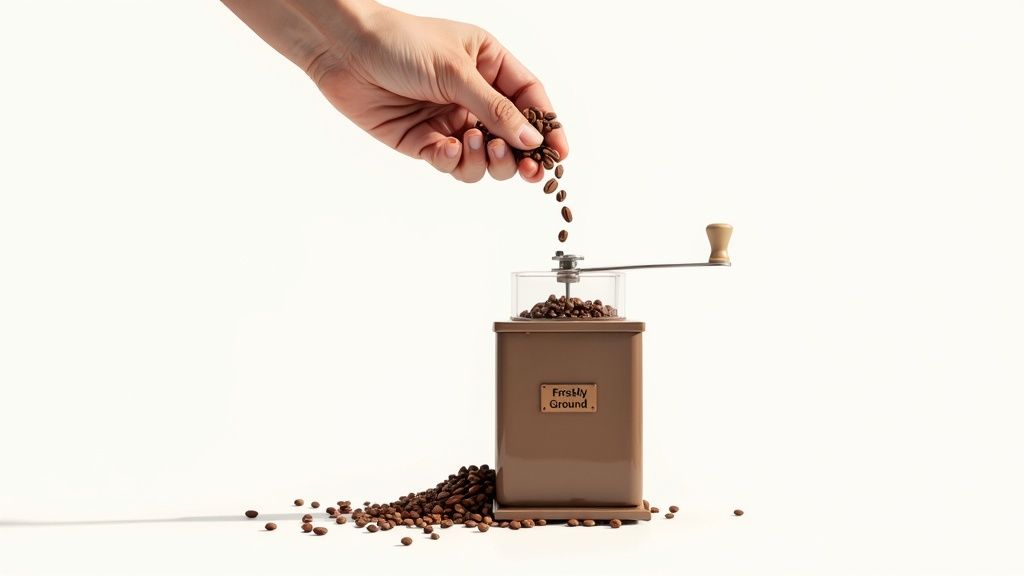
Seriously, if you want to level up your coffee at home, don't start with a new brewer or a fancy kettle. Start with the grinder. Grinding beans just moments before you brew is the only way to preserve all those volatile aromatic compounds that give coffee its captivating smell and complex taste. Pre-ground coffee, on the other hand, starts going stale almost immediately after it's processed.
Think of a whole coffee bean as a tiny, perfectly sealed flavour capsule. A good grinder is the key that unlocks all that potential, consistently, every single time.
The Foundation of Great Flavour
At its core, a grinder’s job is to control extraction—that’s the magic of dissolving all the good stuff from the coffee into the water. The size and, crucially, the uniformity of your coffee grounds dictate how quickly this happens. The right grinder gives you precise control over this, allowing you to dial in your brew for any method you can think of. This is exactly why getting to grips with how to make coffee with beans from scratch is so rewarding.
Of course, once you've got your hands on quality beans, knowing how to store coffee beans properly is just as vital as the grind itself for keeping them at peak freshness.
This move towards better home brewing isn't just a niche hobby anymore. In the UK, the demand for coffee bean grinders has exploded along with the home coffee market, which hit a value of around USD 8.81 billion in 2024. That growth tells a clear story: more and more of us are investing in our equipment to get a better-tasting cup at home.
The grinder is the single most important piece of equipment you can own. It allows you to unlock the full potential locked inside every single bean, turning a simple daily routine into a truly exceptional experience.
Burr Grinders vs Blade Grinders: The Great Divide
When you first dip your toes into making better coffee at home, the single biggest decision you’ll face is your choice of grinder. This isn't just about turning big beans into small ones; it's the foundational step that dictates the quality of every single cup you brew. The two main players in this game are blade grinders and burr grinders, and understanding the difference is everything.
Imagine you're prepping vegetables for a stew. A blade grinder is like throwing everything into a food processor and hitting ‘pulse’. A spinning blade violently smashes and shatters the beans into a chaotic mix of huge chunks, tiny pieces, and fine dust.
That uncontrolled shattering is a recipe for disaster in coffee. It creates a wildly inconsistent grind size, full of large "boulders" and fine "dust." When hot water meets this mess, the fine dust over-extracts almost instantly, turning bitter and harsh. At the same time, the big boulders under-extract, adding sour, acidic notes. The result? A cup that’s somehow both bitter and sour—the worst of all worlds.
Why Burr Grinders Are in a League of Their Own
Now, let's swap that food processor for a sharp, precise knife. Instead of smashing, you're carefully chopping your vegetables into perfectly uniform cubes. That’s exactly what a burr grinder does. It works by milling the coffee beans between two abrasive surfaces, or "burrs"—one stays still while the other rotates.
The beans are gently crushed and ground to a consistent, uniform size as they pass between the burrs. This consistency is the holy grail of coffee brewing.
With uniform grounds, every single particle extracts at roughly the same rate. This is what allows you to unlock a balanced, sweet, and genuinely flavourful cup. It’s why investing in even a basic burr grinder is the most important step you can take toward better coffee.
This appreciation for quality is really changing how we drink coffee at home here in the UK. Recent findings from Allegra’s Coffee At Home Report highlight a big shift away from instant or pod coffee towards freshly prepared filter and espresso—methods that absolutely rely on a good grinder. It shows we're all starting to invest more in quality kit. You can read more about it in the full report from the World Coffee Portal.
Blade Grinder vs Burr Grinder At a Glance
To make it simple, let's break down the key differences between these two grinder types. The table below shows you exactly how they stack up in terms of how they work, the quality of the grind they produce, and what that means for the final flavour in your cup.
| Feature | Blade Grinder | Burr Grinder |
|---|---|---|
| Mechanism | A spinning blade shatters beans like a blender. | Two revolving burrs crush and mill beans. |
| Grind Quality | Produces a mix of dust and boulders (inconsistent). | Creates a highly uniform and consistent particle size. |
| Flavour Result | Often leads to bitter and sour flavours due to uneven extraction. | Allows for a balanced, clear, and rich flavour profile. |
| Control | Offers very little control over the final grind size. | Provides precise, adjustable control over grind settings. |
| Price | Generally very cheap and widely available. | Ranges from affordable entry-level to premium models. |
While a blade grinder is a step up from buying pre-ground coffee, its limits become obvious almost immediately. If you're serious about getting the best flavour out of your beans, a burr grinder is non-negotiable.
Even a brilliant entry-level model like the Fellow Opus Coffee Grinder will deliver a night-and-day improvement over any blade grinder. For those ready to get serious with espresso or dial in the perfect pour-over, premium options like the Eureka Mignon series offer the precision needed to unlock those delicate, hidden flavour notes.
Inside these machines, you'll find either conical or flat burrs, and they each have their own quirks. If you're curious about what sets them apart, have a read of our guide that explains the difference between conical and flat burr grinders. At the end of the day, the journey to a perfect cup starts with consistency, and that begins and ends with a quality burr grinder.
How Grind Size Unlocks Different Flavours
Think of your coffee grinder as less of a machine for crushing beans and more of the main flavour dial for your coffee. Getting to grips with grind size is what separates a decent cup from an exceptional one, because it directly controls how quickly and intensely flavour is pulled from the grounds.
The whole concept boils down to one thing: surface area. Picture trying to dissolve sugar in water. A solid sugar cube dissolves slowly, but fine, granulated sugar disappears almost instantly. Coffee works in exactly the same way.
A coarser grind, like that sugar cube, has less surface area for the water to work on, meaning extraction happens slowly. On the other hand, a fine grind—just like the granulated sugar—has a massive amount of surface area, letting the water pull out all those flavour compounds in a flash. Nailing this balance is the secret to a beautifully rounded brew.
Matching Grind to Brew Method
Every single brew method has its own ideal contact time between water and coffee, and your grind size has to be dialled in to match it. A long brew time needs a coarse grind to stop it from becoming overpowering, while a quick, fast brew needs a fine grind to get enough flavour out in time.
This image perfectly shows the chaotic, inconsistent results from a blade grinder compared to the beautiful, uniform particles from a proper burr coffee bean grinder.
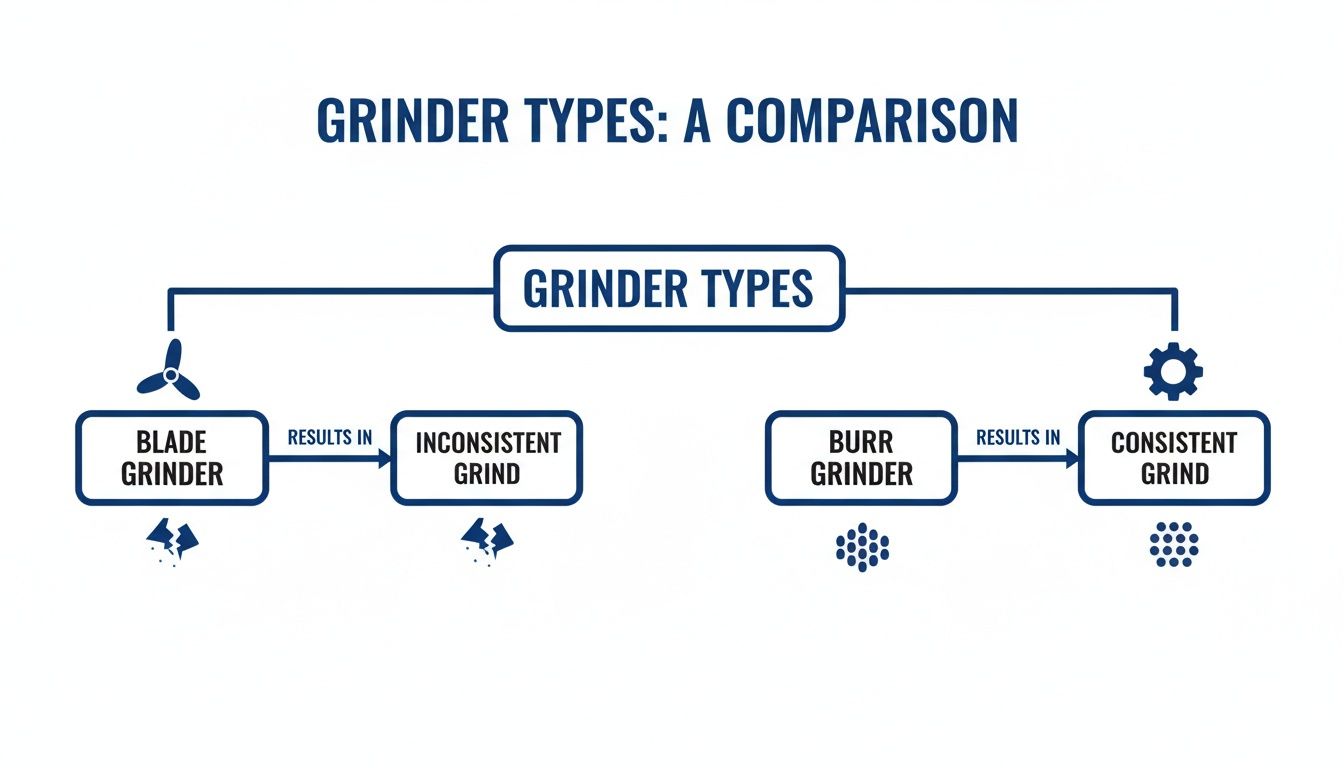
What you’re seeing here is why consistency is king. The uniform particles from a burr grinder give you predictable and even extraction, which is absolutely essential for getting the flavour just right, no matter how you brew.
The Coarse Grind for a Cafetière
The cafetière, or French Press, is a classic. It’s an immersion brewer, meaning the grounds are steeped directly in hot water for around four to five minutes—a lifetime in the coffee world. If you tried that with a fine grind, the water would pull out far too much, leaving you with a harsh, bitter, and sludgy mess.
To get it right, a coarse grind is non-negotiable. The large particles slow the extraction right down, perfectly matching the long steep time. This ensures you get all the sweet, rich flavours without any of the nasty bitterness. As a bonus, it also makes plunging much smoother and keeps that fine sediment at the bottom of your cup to a minimum.
The Medium Grind for Pour-Over and AeroPress
Pour-over methods like the V60 have a much shorter brew time, usually somewhere between two and four minutes. The goal here is to find that sweet spot where the water extracts everything it needs to, without flowing through too quickly (under-extracting) or getting stuck and dripping too slowly (over-extracting).
A medium to medium-fine grind is the perfect place to start. It gives you enough surface area for a balanced extraction while creating just the right amount of resistance to control the flow of water. To dive deeper, our complete coffee grind size guide will help you dial in the perfect setting for your specific brewer.
The AeroPress, of course, is famously flexible. You can use anything from a medium grind for a longer, immersion-style brew to a fine grind for a quick, punchy, espresso-like shot. It really lets you play.
Troubleshooting Your Brew:
- If your coffee tastes sour or weak: Your grounds are likely too coarse, causing under-extraction. Grind finer.
- If your coffee tastes bitter or harsh: Your grounds are probably too fine, leading to over-extraction. Grind coarser.
The Fine Grind for Espresso
Espresso is a completely different beast. The entire brew takes just 25-30 seconds, but it’s happening under about 9 bars of intense pressure. To make that magic happen, you need an extremely fine and uniform grind.
The fine grounds, when tamped, create the resistance needed to stand up to that pressurised water. It’s this resistance that allows the machine to force out the rich oils and soluble solids that create a syrupy, concentrated shot of espresso with that perfect, stable crema on top.
Even the tiniest adjustment to an espresso grind can throw your shot time and flavour way off. This is why proper espresso grinders are built with micro-adjustments, giving you the precision needed to dial in that flawless, balanced shot. Without a capable coffee bean grinder, pulling a great shot is simply impossible.
Choosing the Perfect Grinder for Your Coffee Habits
Alright, you’ve got the basics down. Now for the fun part: finding the grinder that’s just right for you. This isn’t about splashing the most cash; it's about making a smart match between the machine’s capabilities and your daily routine. Think about your budget, the brewing style you love, and the kind of coffee you drink—especially if you're investing in beautiful speciality beans from us here at Seven Sisters Coffee Co. A great grinder is your best insurance policy for protecting those delicate, complex flavours the roaster worked so hard to create.
Choosing wisely means looking past the price tag and thinking about the little details that will shape your morning coffee ritual. Things like how you measure your beans, how the grind size is adjusted, and even the type of burrs inside can completely change the game.
Stepless vs Stepped Adjustments
One of the first forks in the road you'll come to is the choice between stepped and stepless adjustments. A stepped grinder is pretty straightforward. It has a specific number of clicks or settings, and each click moves the burrs a set, predictable distance. This is absolutely brilliant for filter coffee, where the gap between good grind sizes is a bit more forgiving.
A stepless grinder, on the other hand, throws the clicks out the window. It lets you make tiny, infinite tweaks along a smooth continuum from the coarsest to the finest setting. This kind of micro-management is essential for espresso, where a change so small you can barely see it can make the difference between a gusher and a perfectly pulled shot.
Think of it like tuning a guitar. A stepped grinder is like a digital tuner that jumps between notes. A stepless grinder is like tuning by ear—it lets you find those tiny, precise sweet spots that bring everything into perfect harmony.
The demand for this level of control is growing here in the UK. We're seeing a real shift towards premium burr grinders, with the market projected to expand from USD 414.4 million in 2025 to USD 735.1 million by 2035. This isn't just about showing off; people genuinely want better control, quieter machines, and more precise dosing in their home setups.
Finding the Right Grinder for Your Brew Method
More than anything else, your go-to brewing method should steer your decision. A grinder that’s a star at making coarse grounds for a cafetière might completely fall flat when faced with the demands of espresso.
For the Filter Coffee Lover:
If your kitchen counter is home to a V60, AeroPress, or cafetière, you need a grinder that delivers a consistent grind from medium to coarse. You'll want to look for models known for low grind retention (so old coffee doesn't hang around to spoil your next brew) and clear, easy-to-use stepped adjustments. A classic like the Wilfa Svart Coffee Grinder, available from ADS Coffee Supplies, is a fantastic workhorse that gets the job done beautifully for filter brewing.
For the Aspiring Espresso Enthusiast:
Now, if you’re venturing into the wonderful world of espresso, your needs get a lot more specific. You’re going to need a grinder with:
- Stepless micro-adjustments to give you that surgical precision.
- A powerful motor that can handle grinding beans incredibly fine without breaking a sweat.
- Minimal clumping to make sure water flows evenly through your coffee puck.
Models like the Eureka Mignon Specialita are built from the ground up for this very purpose, giving you the control you need to dial in that perfect shot. Making the leap from a manual grinder to a dedicated electric one is a big moment for any home espresso lover. If you're wondering whether it's time, our guide on hand grinders vs electric coffee grinders can help you figure it out.
Dosing Options and Build Quality
Last but not least, think about how you like to measure your coffee. Grinders come with a few different dosing options:
- Timed Dosing: The grinder runs for a pre-set number of seconds.
- Weight-Based Dosing: It grinds until it hits a specific weight (this is more common in high-end models).
- Manual Dosing: It just grinds for as long as you hold the button.
Build quality really matters, too. A grinder with a solid metal casing and high-quality steel or ceramic burrs won't just last longer—it'll also produce less static and be more stable on your counter. While a home barista doesn't need a beast of a commercial machine, anyone dreaming of opening their own place should check out a comprehensive coffee shop equipment checklist to see what the pros use.
Ultimately, picking a grinder is a personal journey. But if you match the features to your habits, you’ll end up with a machine that will serve you brilliantly for years.
Maintaining Your Grinder for Lasting Performance
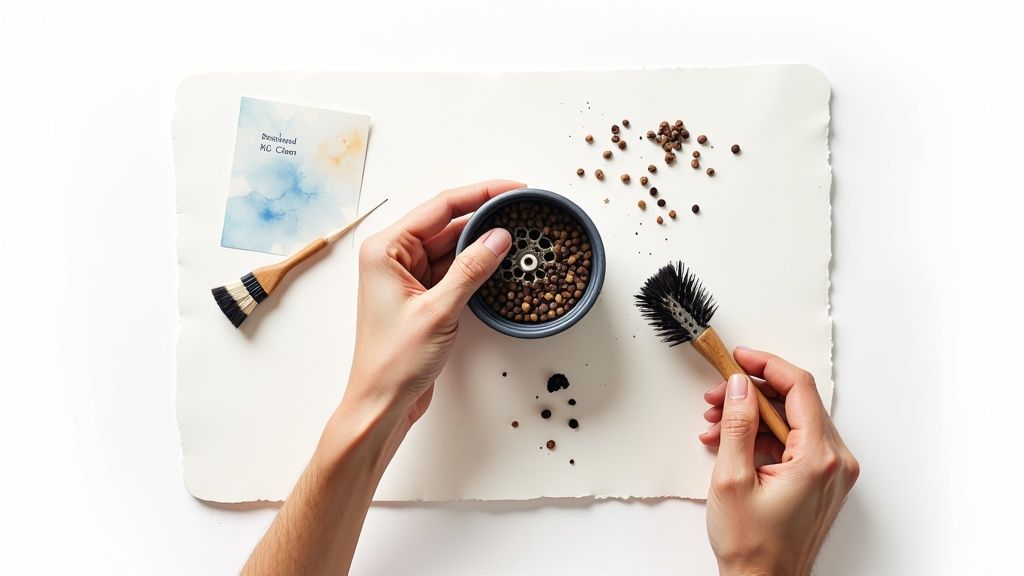
You've invested in a quality grinder, which is a massive step towards incredible coffee. But like any precision tool, it needs a bit of care to keep it performing at its absolute best. Day after day, tiny coffee particles and natural oils build up inside the burrs and grinding chamber.
This isn't just harmless dust. Over time, that residue turns stale and rancid, tainting the beautiful, fresh flavour of your next brew with the ghosts of coffees past. A clean grinder is a happy grinder, ensuring every cup tastes exactly as the roaster intended. A simple routine also protects your investment, extending the life of your machine for years to come.
Quick Cleans vs Deep Cleans
Grinder maintenance isn't a single, daunting task. Think of it as two separate routines: the quick daily brush-down and the more thorough monthly deep clean.
A quick clean is your day-to-day upkeep. It’s as simple as brushing out any loose grounds from the hopper, around the burrs, and in the exit chute. This takes less than a minute but makes a huge difference in preventing old grounds from mixing with your fresh beans.
A deep clean is a more involved process you should tackle every month or so, especially if you enjoy switching between different beans. This means taking the grinder apart to give the burrs and chamber a proper clean, getting rid of all the stubborn oils and impacted fines.
The real goal of maintenance is consistency. When you remove old oils and grounds, the only flavour in your cup is from the fresh beans you just ground. This preserves the delicate notes of a single-origin coffee and the balanced harmony of a blend.
How to Deep Clean Your Burr Grinder
Don't be intimidated by the idea of taking your grinder apart. Most modern grinders are designed with easy maintenance in mind. It's always a good idea to check your specific model's manual first, but the general process is pretty similar across the board.
Here’s a step-by-step guide to get you started:
- Safety First: Before you do anything else, unplug your grinder from the wall. This is the most important step.
- Remove the Hopper: Empty any leftover beans and take off the hopper. Many just twist to unlock. Clean it with a dry cloth—avoid water, as any moisture is bad news for the burrs.
- Access the Burrs: You should now be looking at the upper burr. Most designs allow you to simply lift or unscrew this top burr, which exposes the grinding chamber and the lower burr.
- Brush Everything Thoroughly: Grab a stiff, food-safe brush and meticulously clean both burrs. Get into all the nooks and crannies to dislodge old coffee particles. A vacuum cleaner with a narrow nozzle is fantastic for sucking out all the fine dust.
- Clean the Chute: Don't forget the exit chute where your ground coffee comes out. Use your brush and maybe a bit of compressed air to clear any impacted grounds.
- Reassemble Carefully: Once everything is spotless, put your grinder back together in the reverse order. Make sure the upper burr is seated correctly and the hopper is locked back in place.
This simple process ensures nothing stands between you and the pure flavour of your beans. It's especially important if you're using high-quality beans, as proper storage and a clean grinder work hand-in-hand. For more tips, check out our guide on how to store coffee beans to keep them at their peak freshness.
To make things even easier, here’s a simple schedule you can follow. Sticking to a routine like this will keep your grinder in top shape without feeling like a chore.
Your Weekly Coffee Grinder Cleaning Schedule
| Frequency | Task | Why It's Important |
|---|---|---|
| Daily | Brush out the exit chute and grounds container. | Prevents old grounds from mixing with your fresh brew. |
| Weekly | Empty and wipe the hopper. Brush accessible parts of the burrs. | Stops oil build-up and keeps the path from bean to grounds clear. |
| Monthly | Perform a full deep clean (disassemble and vacuum). | Removes stubborn oils and fine particles for ultimate flavour purity. |
| Every 2-3 Months | Use grinder cleaning pellets (optional). | Tackles hard-to-reach oils and offers a thorough internal clean. |
This checklist turns maintenance from a guessing game into a simple habit, guaranteeing consistently delicious coffee every single day.
When to Use Grinder Cleaning Pellets
Sometimes, a brush and a bit of elbow grease just aren't enough to tackle the really stubborn, oily residue. This is especially true for grinders that are a bit tricky to take apart. That’s where grinder cleaning pellets come in.
These are small, food-safe pellets made from things like grains and cereals, shaped just like coffee beans. You simply run them through your grinder as if you were grinding coffee. As they get crushed, their formulation absorbs the oils and dislodges stuck particles from deep within the burrs and chamber. You can buy quality Puly Caff Grinder Cleaning Crystals from ADS Coffee Supplies.
They're a fantastic, hassle-free way to give your grinder a deep clean from the inside out. Just remember to grind a small amount of coffee afterwards to purge any pellet residue before you make your next cup. They're a brilliant option for a deep clean every couple of months.
Got Questions About Coffee Grinders?
Even after you've got the basics down, a few practical questions always seem to pop up when you get your hands on a new coffee grinder. Let's tackle some of the most common ones to help you get the absolute best out of your machine.
How Often Should I Clean My Coffee Bean Grinder?
For the best possible flavour, a quick clean once a week is a great habit to get into. This is as simple as brushing out any loose grounds from the hopper, burrs, and exit chute. It stops stale coffee from gatecrashing your next brew.
Then, every 1-2 months, it’s time for a deep clean. This means taking the burrs out and giving them a proper scrub to get rid of built-up oils. If you're someone who loves to switch between different beans—especially from an oily dark roast to a delicate single origin—you might want to do this more often.
Can I Use One Grinder for Espresso and Filter Coffee?
You certainly can. Plenty of modern 'all-purpose' grinders are built to cover the entire spectrum, from a chunky cafetière grind right down to a powdery espresso setting. The Fellow Opus Coffee Grinder is a brilliant example of a machine that performs well across the board.
The only catch? Hopping between the two extremes can be a bit of a faff. You usually have to purge a few grams of coffee to clear out the old grind size, which can feel wasteful. It’s why many serious coffee lovers eventually end up with two dedicated grinders—one for filter and one for espresso—to keep things precise and hassle-free.
What Does Dialling In a Grinder Mean?
'Dialling in' is that all-important ritual of fine-tuning your grinder setting to nail the perfect extraction for a specific coffee. It’s most talked about with espresso, but the principle applies to any brewing method. It’s a methodical little dance: you make a small adjustment to the grind size, brew a shot, taste it, and repeat until the flavour hits that perfect balance.
The goal is to find that sweet spot—getting rid of any sourness (a tell-tale sign of under-extraction) and steering clear of any bitterness (which screams over-extraction). This is how you unlock a coffee's true, intended flavour.
Is a Manual Hand Grinder a Good Option?
Absolutely. A high-quality hand grinder is a fantastic bit of kit, especially if you’re usually just brewing for one or two people. They're also perfect for travel or for anyone on a tighter budget who refuses to compromise on grind quality.
Don't let their size fool you. Modern hand grinders often come with exceptional burr sets that produce a remarkably consistent grind, easily rivalling much more expensive electric models. For a great value option, check out the Porlex Mini II Hand Grinder at ADS Coffee Supplies. They’re a particularly great match for pour-over methods like the V60 or immersion brewers like the AeroPress, giving you incredible control and flavour clarity.
Here at Seven Sisters Coffee Co, we’re firm believers that a great grinder is the cornerstone of a perfect cup. When you pair our freshly roasted, speciality beans with a quality grinder, you’re setting yourself up to experience every note and aroma just as our roasters intended. Find your perfect coffee to grind fresh at https://sevensisterscoffee.co.uk.