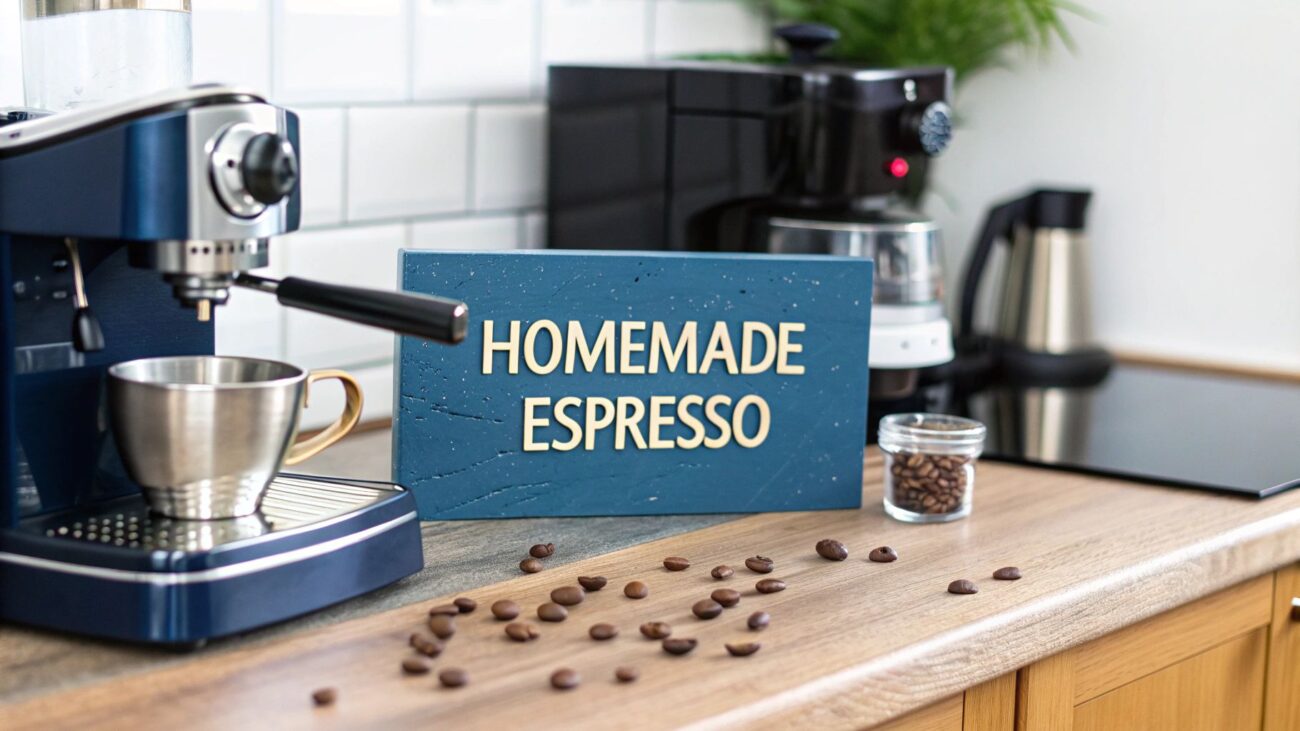
A Home Barista’s Guide to Espresso Ground Coffee

Let's get one thing straight: ‘espresso ground coffee’ isn’t some exotic type of bean. It’s all about the grind size. For a truly great espresso, you're aiming for a super-fine, powdery texture that feels slightly finer than table salt. Getting this right is the most important step in pulling a proper shot at home.
This guide provides practical, actionable advice to help you master the perfect grind and brew cafe-quality espresso. We'll cover what defines espresso ground coffee, why it's so critical, and how to dose, tamp, and dial it in for the perfect extraction every time.
What Defines Espresso Ground Coffee?
The term espresso ground coffee simply describes how finely coffee beans have been milled. While certain roasts are better suited to an espresso machine, the 'espresso' label is all about achieving a specific, almost flour-like consistency. It's the key to a great tasting shot.
Without this precise grind, the whole process falls apart. The high-pressure water from your machine would blast through coarse grounds in seconds, leaving you with a weak, sour, and utterly disappointing brew—a classic case of 'under-extraction'. The fine grind creates the necessary resistance, forcing the water to slow down and extract the rich oils and soluble flavours that make up a perfect, crema-topped shot.
Why Grind Size is So Important
The grind's main job is to control how long the water takes to pass through the coffee. For espresso, we're chasing that golden window of 25-30 seconds for the perfect shot. This short, intense brewing time demands a massive amount of surface area for the water to interact with.
- Fine Grind: Creates a densely packed bed of coffee (known as a 'puck') with millions of tiny particles. The huge surface area allows the hot, pressurised water to quickly dissolve the flavours, oils, and sugars.
- Coarse Grind: Leaves big gaps in the coffee puck and has far less surface area. Water finds the easiest path through, a process called 'channelling', and misses out on extracting all the good stuff.
A good analogy is making tea. A whole tea leaf needs several minutes to infuse properly, but the fine dust inside a teabag releases its flavour almost instantly. Espresso ground coffee works on a similar principle, but with extreme pressure.
The Look and Feel of a Perfect Grind
So, how fine is fine? When you rub a pinch of espresso ground coffee between your fingertips, it should feel a little finer than table salt, but not as dusty as flour. It ought to have a soft, slightly clumpy texture that holds its shape for a moment when you squeeze it.
Getting this consistency right is the first, most crucial step on your home barista journey. It’s the foundation for everything else, from dosing and tamping to pulling the final shot. Of course, starting with incredible, expertly roasted beans is just as vital. Our espresso coffee blends are specifically roasted to bring out those rich, deep flavours that only a proper espresso grind can truly unlock.
How to Get a Perfect Espresso Shot
Now we’ve got a handle on how important grind size is, let’s look at how that fine espresso ground coffee becomes the rich, intense shot we’re all chasing. The magic happens during extraction—a quick and intense process where hot water meets coffee grounds under incredible pressure.
Your espresso machine forces water heated to between 90-96°C through a tightly packed 'puck' of coffee at roughly nine times atmospheric pressure. The water's job is to dissolve and carry away the oils, sugars, and acids from every tiny particle of coffee.
Because the grind is so fine, the coffee has a massive surface area. This gives the water the best possible chance to work its magic in that short 25-30 second window. Get this balance right, and you're rewarded with concentrated flavour and the velvety crema that crowns a great espresso.
Diagnosing Your Shot
The secret to a beautiful extraction is resistance. The tightly packed, fine grounds create a dense bed that slows the water down just enough for it to do its job properly. If your grind is even slightly off, this delicate balance is thrown into chaos, and the flavour of your shot will tell you exactly what’s gone wrong.
"A perfect espresso shot is a fleeting moment of chemical magic. The grind size acts as the conductor, orchestrating the speed and efficiency of the extraction. Get it right, and you have a symphony of flavour; get it wrong, and you're left with a sour or bitter solo."
This visual guide breaks down the key things to look for in your espresso grind. It covers everything from its fine, powdery nature to the resistance it needs to create against the water pressure.

As the map shows, the sweet spot is a grind that’s fine like table salt. If it gets too powdery, you’ll create too much resistance, and the result is a bitter, disappointing cup.
How Grind Size Affects Your Espresso
When you're first learning, it can be tough to figure out what's going wrong. Is it the grind? The tamp? The machine? This cheat sheet is your go-to guide for diagnosing common issues and understanding the direct link between the grind size and the final taste.
| Grind Size | Shot Appearance | Flow Rate | Flavour Profile | Common Problem |
|---|---|---|---|---|
| Too Coarse | Looks watery and pale | Gushes out like a tap | Sour, acidic, weak | Under-extraction |
| Too Fine | Dark and syrupy, struggles to come out | Drips out painfully slowly | Bitter, burnt, harsh | Over-extraction |
| Just Right | Rich, reddish-brown crema | Flows like warm honey | Balanced, sweet, rich | Perfect Extraction |
Getting to grips with this diagnostic approach is at the heart of becoming a skilled home barista. As you get more confident, you'll start to 'read' the shot as it's pulling and know instantly what you need to adjust for the next one.
To truly master espresso ground coffee, it helps to understand the whole process. Learning how to make espresso properly will give you a solid foundation, showing you how all the key variables work together to create that perfect shot. This knowledge, combined with what you now know about grind size, empowers you to troubleshoot any issue that comes your way.
How to Properly Dose and Tamp Your Coffee
Let's move from theory to hands-on skills. Dosing and tamping are where you take control of the brewing process, and mastering them is what separates a good home barista from a great one. It’s all about achieving repeatable control over the final shot.

Dosing is simply getting the right amount of espresso ground coffee into your portafilter. For true consistency, you need a set of digital coffee scales accurate to 0.1 grams. This level of precision is non-negotiable if you want the same great results every time.
Master Your Coffee Dose
There’s no universal "perfect" dose; it changes based on your basket size, coffee beans, and machine. Most standard double-shot baskets are designed for 16 to 19 grams of finely ground coffee. The goal is to find a dose that fills the basket just right after tamping, leaving only a tiny gap between the coffee puck and the group head’s shower screen.
Here’s a simple routine to nail it:
- Place and Tare: Put your empty portafilter on the scales and hit the 'tare' or 'zero' button.
- Grind and Weigh: Grind your beans directly into the portafilter until you’re close to your target weight.
- Adjust: Carefully add or remove a tiny bit of coffee until you hit your exact dose.
With your dose weighed out, distribute the grounds evenly. A few gentle taps on the side of the portafilter or a quick spin with a distribution tool will level the surface. Don’t skip this – it's your best defence against channelling.
The Art of Tamping
Tamping compacts the loose grounds into a dense, level puck. If it’s not packed down evenly, water will just run through the weak spots. In espresso, those weak spots are a disaster.
Water is lazy. It will always find the path of least resistance. An uneven tamp creates tiny, fast-flowing rivers in the coffee puck. Water will gush through these channels instead of extracting flavour evenly from all the grounds. This is called 'channelling', and it’s the number one culprit behind a sour, under-extracted shot.
A solid tamp forces the water to flow through the entire bed of espresso ground coffee at an even rate. This guarantees a balanced, full-flavoured extraction. While people love to debate the exact pressure, what really matters is consistency. You can learn more about how much tamping pressure to use to get that perfect puck.
Follow these steps for a perfect tamp every time:
- Proper Posture: Stand with a straight wrist and your elbow bent at about a 90-degree angle. This lets you use your body weight, not just arm strength.
- Level Application: Place the tamper flat on the grounds. Use your fingertips to feel the gap between the tamper and the basket rim to make sure it’s perfectly level.
- Firm and Even Pressure: Press down firmly and consistently. You don’t need to break a sweat; the goal is to remove air pockets and create a solid disc.
- The Polish: Give the tamper a gentle spin on the surface without pushing down. This smooths, or 'polishes', the puck for a clean finish.
- Inspect Your Work: The final puck should look perfectly flat and level, with a smooth, polished top.
When you combine a precise dose with a firm, level tamp, you’re creating the ideal foundation for a brilliant extraction. These two skills are your best tools for turning quality espresso ground coffee into an exceptional drink.
How to Dial In Your Grinder
Once your dose and tamp are sorted, it’s time to tackle the most important skill for any home barista: 'dialing in' the grinder. This isn't a one-off setting; it's an ongoing process of tiny adjustments to find the sweet spot for each new bag of coffee. This is the skill that separates good coffee from truly great coffee.
Think of it as a conversation with your coffee. You start with a rough guess and then make small, controlled changes—a nudge finer or a smidge coarser—while watching what comes out. Every coffee is different. Its age, roast level, and even the humidity in your kitchen can change how your espresso ground coffee behaves under pressure.
Your main goal is to hit that golden window of a 25-30 second extraction. This timeframe is the accepted standard for a balanced shot, where you extract sweet, rich flavours without straying into sourness (under-extraction) or bitterness (over-extraction).
Step-by-Step Guide to Dialing In
Treat this like a science experiment, changing only one thing at a time: the grind size. Keep your dose (the weight of your coffee) and your tamping pressure the same for every shot.
- Start with a Benchmark: Grind your usual dose, pull a shot, and start a timer the moment you hit the button. Stop it when you stop the flow. Note the time and the weight of your liquid espresso.
- Analyse the Result: How did it go? If the shot gushed out in 18 seconds, your grind is too coarse. If it choked the machine and slowly dripped out over 45 seconds, you've ground it too fine.
- Make One Small Adjustment: Move your grinder’s adjustment dial just one notch in the right direction. Grinding finer will slow the shot down; going coarser will speed it up.
- Purge the Grinder: Always grind and discard a few grams of coffee after an adjustment. This clears out any grounds from the old setting, so your next dose is completely at the new one.
- Pull Another Shot and Repeat: Using the same dose and tamp, pull another shot and time it. You should see a clear difference. Keep making these tiny, single adjustments until you land squarely in that 25-30 second sweet spot.
Dialing in is less of a task and more of a conversation with your coffee. Each adjustment gives you feedback, and your job is to listen and respond until you get the flavour you’re chasing.
Troubleshooting Common Issues
Sometimes things don't go to plan. You might adjust the grinder, but the shot time barely changes. It's a common hurdle, but there's usually a simple reason.
- Channelling: If your puck prep is a bit off, water can punch holes or 'channels' through the coffee and rush out. This leads to unpredictable shot times, even if your grind setting is spot on.
- Grinder Retention: Some grinders hold onto old grounds, which then mix with your newly adjusted grind and mess with your results. That's why purging is so important.
- Stale Beans: As beans get older, they lose CO2 and offer less resistance to water. This leads to fast shots that are difficult to slow down, no matter how fine you grind.
Mastering this skill empowers you to get the absolute best out of every bag of beans. Keeping a steady supply of fresh beans is vital for consistent results. A coffee subscription service ensures you always have something new and freshly roasted to experiment with, making dialing in a rewarding daily ritual.
Why Freshness Is Critical for Ground Coffee
Coffee is a fresh agricultural product, and its number one enemy is oxygen. The moment you grind whole beans, you kickstart oxidation, and the coffee rapidly starts to go stale. For espresso ground coffee, which has a massive surface area, this happens incredibly fast.

Think of it like slicing an apple. Left whole, it stays crisp for days. But once cut, the exposed flesh turns brown and loses its texture within hours. Grinding coffee does the same thing to its delicate, volatile aromatic compounds—the very soul of its flavour and aroma.
The Race Against Staling
As soon as coffee is ground, oxidation and degassing begin. Oxidation is the chemical reaction with air that makes flavours turn flat and lifeless. Degassing is the release of trapped carbon dioxide (CO2) from roasting, which unfortunately carries away precious aromas with it.
With whole beans, this is a slow decline. With pre-ground coffee, it’s a sprint to staleness.
How to Store Ground Coffee for Maximum Flavour
While nothing beats grinding just before you brew, if you use pre-ground coffee, proper storage is non-negotiable. Your goal is to shield it from its four main enemies: oxygen, light, heat, and moisture.
Here’s how to give your coffee the best chance:
- Use an Airtight Container: As soon as you open the bag, transfer your coffee into a dedicated, airtight canister to reduce oxygen exposure.
- Keep it in the Dark: Store the canister in a cool, dark place like a pantry or cupboard. Direct sunlight is a staling accelerator.
- Avoid the Fridge: Storing coffee in the fridge can introduce moisture and absorb unwanted odours.
- Buy Little and Often: Purchase smaller bags of coffee more frequently to ensure you’re always using grounds that are as fresh as possible.
To see just how quickly things change, this table lays out the flavour journey for whole beans versus their pre-ground counterparts.
Freshness Timeline: Whole Bean vs. Ground Coffee
| Time After Roasting | Whole Bean Coffee Flavour | Espresso Ground Coffee Flavour |
|---|---|---|
| Just after Roast | At peak vibrancy, with complex and lively aromatic compounds. | Intense aroma, but already starting the rapid process of fading. |
| 24-48 Hours | Flavours are settling and developing, still rich and aromatic. | Significant loss of aroma and flavour. Tastes noticeably flatter. |
| 1 Week | Still very flavourful, though some of the most delicate notes fade. | Most volatile compounds are gone. Tastes dull and generic. |
| 2-3 Weeks | Good flavour remains, ideal for brewing. | Stale, with woody or papery notes. Little original character left. |
The difference is stark. Grinding on demand is what preserves the vibrant, nuanced flavours we work so hard to create during roasting.
"The single biggest upgrade you can make to your home coffee game isn't a new machine—it's grinding your beans fresh. The flavour difference is night and day, preserving the nuance and vibrancy the roaster intended for you to experience."
To keep your espresso ground coffee at its peak, understanding the science of high-performance pantry food storage is a game-changer. An effective container isn't just about being tidy; it’s a scientific tool for locking in freshness.
This focus on freshness is why we are so committed to delivering freshly roasted beans. You can learn more in our guide on how long coffee beans stay fresh. Our process is designed from the ground up to lock in maximum flavour, giving you the best possible starting point for an amazing cup.
Choosing the Right Beans for Your Espresso
The journey to a perfect shot of espresso starts with the beans. The quality, roast profile, and freshness of your coffee are the fundamental building blocks of flavour. When it comes down to it, selecting the right beans is less about a specific origin and more about the roaster's skill and philosophy.
Our approach at Seven Sisters Coffee Co is built on an artisanal, oxygen-free roasting process. This specialised method is designed to protect the delicate aromatic compounds that create a complex and flavourful cup. It carefully develops the natural sugars within the bean without scorching them, preventing the harsh, baked notes that can ruin a shot.
Ultimately, this technique allows the bean's true origin character to shine through, giving you a clean, vibrant taste that’s perfect for espresso.
Protecting Flavour from Farm to Cup
The foundation of a great espresso ground coffee is a roasting process that respects the bean. Traditional roasting exposes beans to oxygen at high temperatures, which can quickly degrade fragile flavour compounds. Our oxygen-free environment acts like a protective shield, locking in nuance and complexity.
This means you get more of the good stuff:
- Enhanced Sweetness: Careful caramelisation of sugars without burning leads to a naturally sweeter, more balanced shot.
- Clarity of Flavour: The unique notes of a single-origin coffee—be it fruity, floral, or chocolatey—are preserved and amplified.
- Reduced Bitterness: By avoiding the "baked" flavours associated with over-roasting, we produce a smoother, less bitter espresso.
Choosing your coffee beans is like choosing ingredients for a fine meal. The final dish can only ever be as good as the raw materials you start with. A masterful roast ensures those materials are of the highest possible quality.
This commitment to quality extends beyond our roasting room. For many, a cup of coffee is a cherished daily ritual, and its impact goes far beyond the kitchen.
More Than Just a Great Coffee
Our dedication to quality is matched by our commitment to the future of coffee itself. We proudly support the vital work of World Coffee Research, donating a percentage of every order to help secure a sustainable future for coffee farming communities. This isn't just about ethical sourcing; it's about ensuring the long-term health and diversity of the coffee world.
This matters because the UK’s love for coffee is immense. With 98 million cups consumed daily, the choices we make as consumers have a real, tangible impact. That staggering figure highlights the importance of supporting practices that protect both the planet and the livelihoods of farmers.
When you choose our coffee, you're not just buying a bag of beans. You're supporting a system that values quality, sustainability, and transparency from the farm to your cup. It’s an investment in a superior coffee experience that you can feel good about. If you want to find the perfect match for your machine, you might be interested in our guide to the best coffee beans for an espresso machine.
Got More Espresso Questions? We’ve Got Answers
Even when you think you've nailed your technique, a few questions always pop up on the journey to the perfect home espresso. Let’s tackle some of the most common ones with clear, practical answers to build your confidence.
Can I use espresso ground coffee in other brewers?
You can, but you probably won’t like the results. The fine texture of an espresso grind is designed to create resistance against high-pressure water in a short time.
In a brewer that relies on gravity and a longer brew time, like a French press or drip filter, you’ll run into problems:
- Over-extraction: The water sits with the tiny grounds for too long, pulling out bitter and harsh flavours.
- Clogging and Sludge: The fine particles will either clog a paper filter or slip right through the metal mesh of a cafetière, leaving a gritty sludge in your cup.
The golden rule is to always match your grind size to your brewing method. Use a much coarser grind for a French press and a medium grind for a drip coffee maker.
How do I know if my pre-ground coffee is still fresh?
For espresso ground coffee, freshness is everything. If you’re using pre-ground beans, there are a few tell-tale signs that it might be past its prime. The most obvious is the smell. Fresh coffee has a powerful, complex aroma. Stale coffee often smells flat, a bit like wood, or of nothing at all.
The other big clue is the crema on your espresso shot. Fresh coffee is packed with CO2, which is released during extraction and creates that rich, reddish-brown crema. If your shots are pouring thin and pale with hardly any crema, it's a dead giveaway that your grounds are stale.
What’s the difference between an Americano and a Long Black?
This is a great question. They look almost identical and are made with espresso and hot water, but their construction is different, which subtly changes the final drink.
The key difference lies in the order you combine the ingredients. For an Americano, you pour hot water on top of an espresso shot. For a Long Black, you pour the espresso shot on top of the hot water.
This small change makes a noticeable difference. Making a Long Black preserves more of the delicate crema because it settles gently on top of the water. Pouring hot water into an espresso for an Americano, on the other hand, tends to break up the crema and mix it into the drink. For many coffee lovers, the Long Black offers a slightly more aromatic and texturally pleasing experience.
At Seven Sisters Coffee Co, we’re firm believers that starting with exceptional, freshly roasted beans is the secret to an incredible coffee experience at home. Our artisanal, oxygen-free roasting process is designed to lock in every last bit of flavour, just for you.
Explore our full range of speciality coffee beans and find your perfect brew today.