How to Grind Coffee Beans for the Perfect Brew

To truly elevate your morning ritual, you need to be grinding your coffee beans just moments before you brew. Honestly, this one single action is the most powerful change you can make for café-quality flavour at home. It’s how you unlock all the vibrant, complex notes locked inside every whole bean.
Why Fresh Grinding Transforms Your Coffee
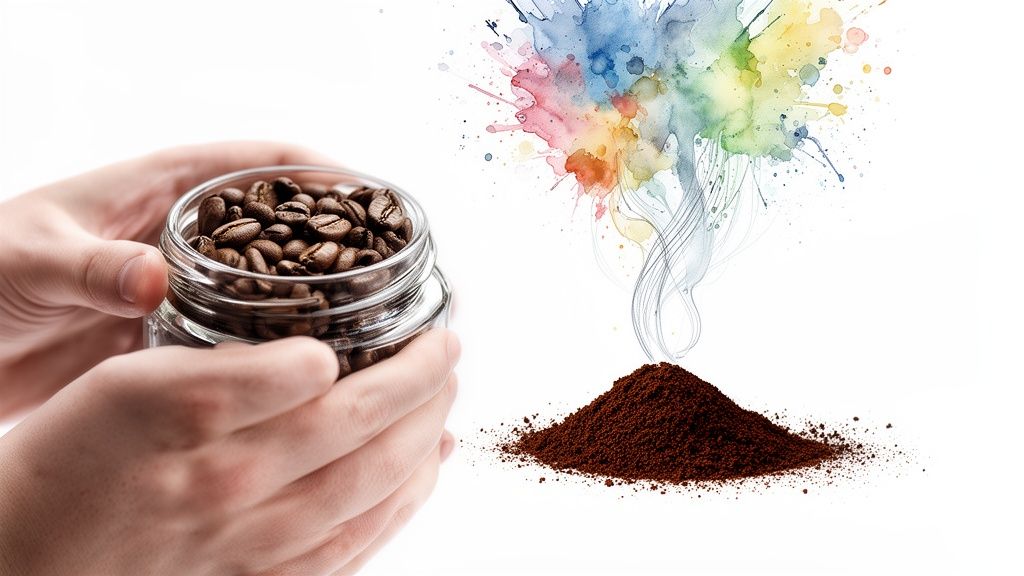
Ever wondered why the coffee from your local café tastes so much better than your home brew? The secret isn't some ridiculously expensive machine or mystical technique; it’s the simple, transformative act of grinding fresh.
Think of a whole coffee bean as a tiny, perfect flavour capsule.
Inside, hundreds of aromatic oils and soluble compounds are kept safe, just waiting to be released. These delicate elements are behind everything you love about a great coffee—the rich aroma, the bright acidity, and that deep, satisfying body. But the moment you grind, you smash open these capsules, exposing everything to oxygen.
The Science of Stale Coffee
Oxygen is the arch-nemesis of fresh coffee. Once you grind the beans, you dramatically increase the surface area, which kicks a process called oxidation into high gear. This chemical reaction rapidly degrades those precious aromatic oils, causing them to evaporate and lose their punch.
It’s a surprisingly fast process. Within just 15 minutes of grinding, a huge chunk of a coffee's aroma and flavour can simply vanish into thin air. That bag of pre-ground coffee sitting on a supermarket shelf for weeks? It has already lost this battle long ago. It’s why it often delivers a flat, one-dimensional, and stale taste—all its most vibrant characteristics have dissipated.
By grinding right before you brew, you take full control. You’re making sure all the incredible flavours we work so hard to develop during roasting—like those in every bag from Seven Sisters Coffee—end up in your cup, not floating around your kitchen.
A Growing UK Appreciation for Freshness
This isn’t just coffee geek talk; the desire for a better coffee experience is growing all across the UK, with more and more people bringing the craft of the café into their own homes. The trend towards grinding beans at home has seen a huge surge.
According to the British Coffee Association, ground coffee is particularly popular with millennials, who now make up 16% of all buyers. With the nation getting through 98 million cups a day, this shift highlights a clear demand for the kind of quality that only fresh grinding can provide.
Ultimately, choosing to grind your own beans is the first proper step in a rewarding brewing ritual. It connects you to the coffee in a way that pre-ground options never can. If you want to dive deeper into keeping that just-roasted taste, have a look at our guide on how long coffee beans stay fresh. It’s the difference between just making coffee and crafting an exceptional experience.
Choosing Your Grinder: Burr vs Blade
Right, so you've decided to start grinding your own coffee beans. This is the first big step, and it's where you'll face the classic dilemma: burr grinder or blade grinder? While they both get the job done on a technical level—turning big bits into smaller bits—how they do it makes all the difference between a truly stunning cup and a muddy, disappointing one.
Think of it like this: you wouldn't try to chop an onion with a hammer, would you? Of course not. You'd grab a sharp chef's knife. One smashes it into random, inconsistent chunks, while the other gives you clean, uniform slices. That's the perfect way to think about blade versus burr grinders.
A blade grinder is the hammer in this scenario. It uses a spinning propeller-like blade to violently smash and shatter the coffee beans. It’s chaotic, and the result is a messy mix of large chunks (we call these boulders) and fine, powdery dust (known as fines). This inconsistency is the absolute enemy of a good brew. The fines will over-extract and turn bitter, while the boulders will under-extract, tasting sour and weak. The result? A confusing and unbalanced cup, no matter how fantastic your beans are.
The Precision of Burr Grinders
A burr grinder, on the other hand, is your chef's knife. It works with precision and control, using two abrasive surfaces—the burrs—to gently mill the beans into a remarkably uniform size. One burr is stationary while the other rotates, and you can adjust the distance between them. This is what gives you incredible accuracy over your final particle size.
This consistency is the secret sauce for a balanced extraction. When all your coffee grounds are a similar size, the water extracts all the good stuff—the sweetness, acidity, and complex flavours—at the same rate. This level of control is what allows you to truly unlock the potential hiding inside your coffee.
If you want to get even more granular, our guide exploring conical vs flat burr grinders breaks down the two main types you'll come across.
A great grinder won’t make bad coffee good, but a bad grinder will always make great coffee taste mediocre. Investing in a quality burr grinder is the single most impactful equipment upgrade you can make to your home coffee setup. You can find our full range of coffee grinders online.
Making the Right Choice for Your Budget
The great news is that you don't need to remortgage your house to get into the burr grinder game. There are fantastic options out there at every price point, and any one of them is a massive leap up from a blade grinder.
- Entry-Level Manual Grinders: If you're just starting out or only brewing a cup or two at a time, a manual hand grinder is a brilliant choice. They're affordable, quiet, portable, and deliver exceptional grind quality for the price. A model like the Hario Skerton Plus Hand Grinder is a fantastic place to start, giving you precise control without a huge investment. You can browse all our manual coffee grinders here.
- Electric Burr Grinders: When convenience and speed are a priority, an electric burr grinder is the way forward. They make grinding for a full cafetière or for daily espressos much, much easier. Look for models with hardened steel or ceramic burrs and a solid range of settings. The Baratza Encore ESP is a widely respected workhorse, known for its consistency and durability. It’s perfect for the dedicated home brewer. Our range of electric coffee grinders has something for every setup.
- Premium Electric Grinders: For the real enthusiast chasing that perfect espresso shot, premium grinders offer unparalleled precision. The Eureka Mignon Specialita, for instance, provides stepless micro-metric adjustment. This allows for tiny, incremental changes that can make a world of difference to your final shot.
Ultimately, choosing a burr grinder is about giving your coffee the respect it deserves. It’s the key to ensuring all the care that goes into cultivating and roasting every bag of Seven Sisters coffee actually translates into a consistently delicious cup, every single time.
The Definitive Coffee Grind Size Guide
Getting your grind right is probably the single biggest leap you can take towards making truly exceptional coffee at home. It’s the key that unlocks all the potential we work so hard to roast into our beans. The size of your coffee grounds dictates how quickly water can pull flavour out of them, and it’s a delicate balancing act.
Go too coarse, and your brew will be weak, sour, and underdeveloped. Grind too fine, and you’ll end up with a bitter, harsh cup that feels like it’s scraping your tongue. It's all about finding that sweet spot.
Think of it in sensory terms. For a French Press, you want a coarse grind that feels chunky, a bit like coarse sea salt. For espresso, it needs to be incredibly fine, almost like flour or powdered sugar. Every brewing method has its own ideal texture.
Matching Your Grind to Your Brewer
The golden rule is pretty straightforward: the longer your water and coffee are in contact, the coarser your grind needs to be.
Fast, high-pressure methods like espresso need a super-fine grind. This creates a huge surface area, allowing the water to extract all the delicious oils and flavours in just 25-30 seconds. On the other hand, slow, full-immersion methods like a French Press or Cold Brew require a very coarse grind to prevent over-extraction during their long brew times.
With the UK now drinking around 98 million cups of coffee every single day, and 80% of Brits popping into a coffee shop at least once a week, people are getting serious about replicating that café experience at home. Nailing your grind is how you get there.
The image below shows exactly why a good burr grinder is non-negotiable for this.
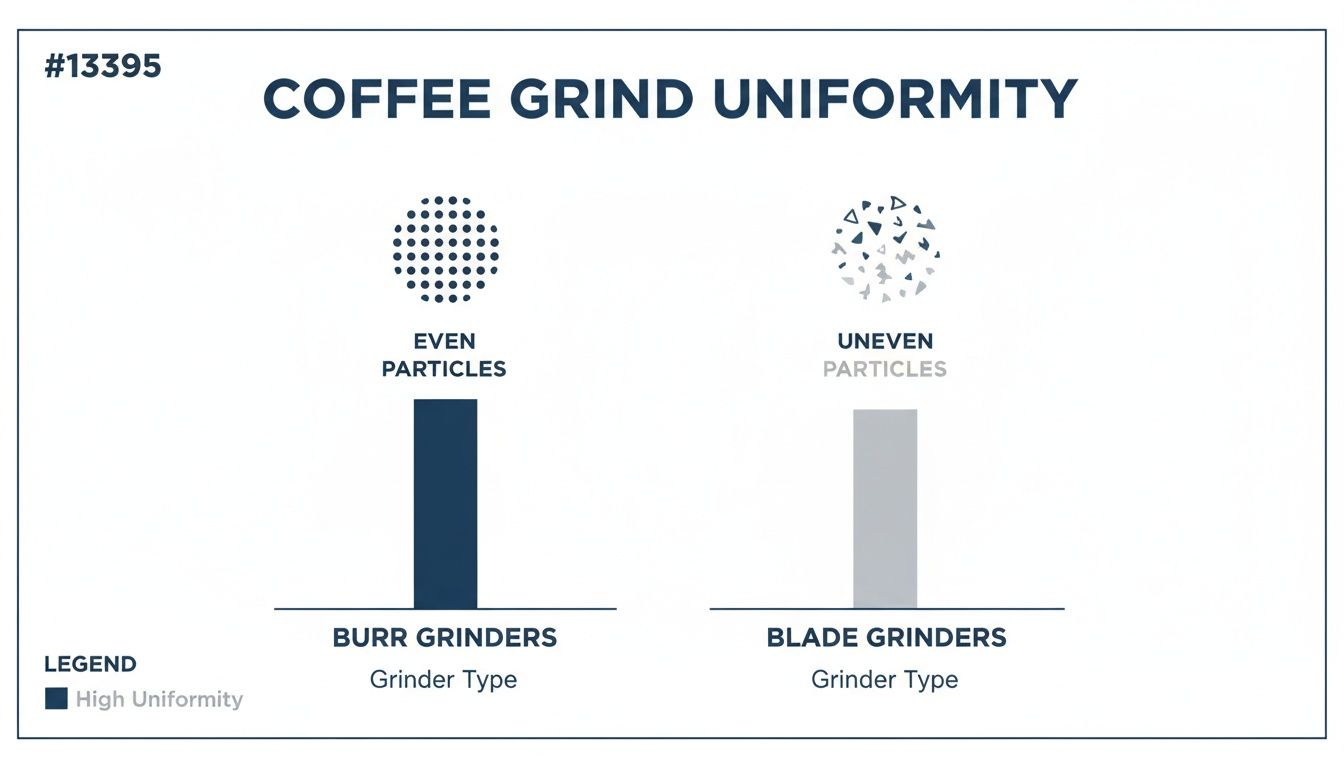
See how the burr grinder creates uniform, evenly sized particles? That means every little piece of coffee extracts at the same rate, giving you a balanced, clean flavour. The blade grinder's chaotic mix of dust and boulders leads to a messy, muddled brew where some parts are over-extracted (bitter) and others are under-extracted (sour).
Grind Size and Brewing Guide for Seven Sisters Coffee
To get you started, we've put together a handy reference chart. Think of this as your starting point, not a rigid set of rules. The best coffee comes from tasting and tweaking, so use this guide to get in the ballpark and then adjust based on what you taste in the cup.
| Brewing Method | Grind Size | Visual Comparison | Suggested Ratio (Coffee:Water) | Approx. Brew Time |
|---|---|---|---|---|
| French Press | Extra Coarse | Coarse Sea Salt | 1:15 | 4-5 Minutes |
| Cold Brew | Extra Coarse | Peppercorns | 1:8 | 12-24 Hours |
| Chemex | Medium-Coarse | Coarse Sand | 1:16 | 3-4 Minutes |
| V60 / Pour-Over | Medium | Table Salt | 1:17 | 2.5-3 Minutes |
| AeroPress | Medium to Fine | Fine Sand | 1:14 | 1-2 Minutes |
| Espresso | Fine | Powdered Sugar | 1:2 | 25-30 Seconds |
| Moka Pot | Fine | Fine Table Salt | 1:10 | Until Brewed |
Remember, this chart is a fantastic baseline, but don't be afraid to experiment. If your V60 tastes a bit weak, try going a notch finer. If your French Press is too muddy, coarsen it up a bit. Your palate is the ultimate judge.
An Insider Tip for Different Roasts
Here’s something that experienced baristas know but is often overlooked at home: the roast level of your coffee completely changes how you should grind it.
- Darker Roasts: These beans are more brittle and have been expanded by the roasting process, making them less dense. They fracture easily, creating more fine particles (or 'fines'). To compensate, you'll often need to use a slightly coarser setting than the chart suggests to avoid a bitter, over-extracted brew.
- Lighter Roasts: Our speciality single-origin coffees tend to be lighter roasts. These beans are much harder and denser. To properly extract their bright, complex, and often delicate flavours, you'll usually need to grind them a little finer than you would for a darker roast using the same brewer.
The most important takeaway is this: always be prepared to adjust your grinder when you open a new bag of coffee. The "perfect" setting isn't just for the brew method; it's for the specific beans you're using right now.
This guide should give you a solid foundation to build on. For a really deep dive into one of the most versatile brewers out there, check out our complete guide on finding the perfect AeroPress grind size. Taking a minute to properly dial in your grind is the most rewarding step in the coffee-making process—it’s what turns a good cup into an unforgettable one.
How to Dial In Your Grinder for Perfect Extraction
Having a great grinder is a fantastic start, but knowing how to use it is what truly unlocks incredible coffee. This is where ‘dialling in’ comes in—it’s the hands-on process of fine-tuning your grinder settings to pull the absolute best flavour from your beans. Think of it as the bridge between coffee theory and a consistently perfect cup.
It’s an art of small, methodical adjustments, guided entirely by what you taste. The goal is to find that elusive ‘sweet spot’ where your coffee is perfectly balanced—not sour, not bitter, just right. It's a lot like tuning an instrument; a slight turn of the dial can bring everything into beautiful harmony.
Reading the Signs in Your Cup
To find that balance, you first need to learn what the extremes of extraction taste like. Your taste buds are your best guide, and they’ll tell you exactly which way to adjust your grinder.
- Under-extraction (Too Coarse): If your coffee tastes sour, weak, or disappointingly thin, your grind is probably too coarse. Water has shot through the grounds too quickly, failing to pull out enough of the good stuff. The solution is simple: grind finer.
- Over-extraction (Too Fine): On the other hand, if your coffee is bitter, astringent, or leaves a harsh, drying sensation on your tongue, you’ve gone too fine. The water spent too much time with the grounds, pulling out undesirable, bitter compounds. The fix here is to grind coarser.
This whole process is a conversation between you and your coffee. You make an adjustment, brew a cup, taste it, and then decide on the next move. It’s a rewarding ritual that puts you in complete control of your brew.
The rule of thumb for any coffee and any brewer is this: grind as fine as you can until you taste that unpleasant bitterness or drying sensation, then dial it back a notch or two coarser. That’s your sweet spot.
A Practical Approach to Dialling In
Let's say you’re making a pour-over with a fresh bag of Seven Sisters beans. You start with the medium grind setting we recommend in our chart, but the result tastes a bit acidic and sour. That's your clear signal of under-extraction.
For your next brew, you’ll just turn the grinder dial one or two clicks finer. This small tweak increases the surface area of the coffee, allowing the water to extract more flavour. You brew again, and this time the sourness is gone, replaced by a pleasing sweetness and complexity. You’ve successfully dialled in your coffee.
This same method applies to every brewing style, but it’s especially critical for espresso, where tiny adjustments can make a world of difference. If you're looking to master this for your home machine, you can learn more from our detailed guide on https://sevensisterscoffee.co.uk/how-to-dial-in-espresso-ratio/.
Pro Techniques for Ultimate Consistency
Once you're comfortable with the basics, a couple of simple techniques can help you achieve even better results every time you grind.
Minimising Retention
Grind retention is just a term for the old coffee grounds that get stuck inside your grinder's burrs and chute. If left there, these stale grounds will mix with your fresh coffee and taint the flavour of your next brew.
To combat this, give your grinder a few firm taps on the side after grinding to dislodge any trapped particles. For many grinders, using a small bellows can puff out any remaining grounds, making sure every brew is as fresh as possible. You can find useful grinder accessories on our site.
The Ross Droplet Technique (RDT)
Grinding coffee often creates static electricity, causing fine coffee particles (chaff) to cling to everything—your grinder, your counter, and your hands. The Ross Droplet Technique is a surprisingly simple yet effective fix for this.
Just before you weigh out your beans, give them a tiny spritz of water or touch them with the damp handle of a spoon. This minuscule amount of moisture is enough to eliminate static entirely, leading to a much cleaner and less wasteful grinding process. It’s a small step that makes a world of difference.
Post-Grind Care and Common Grinding Problems
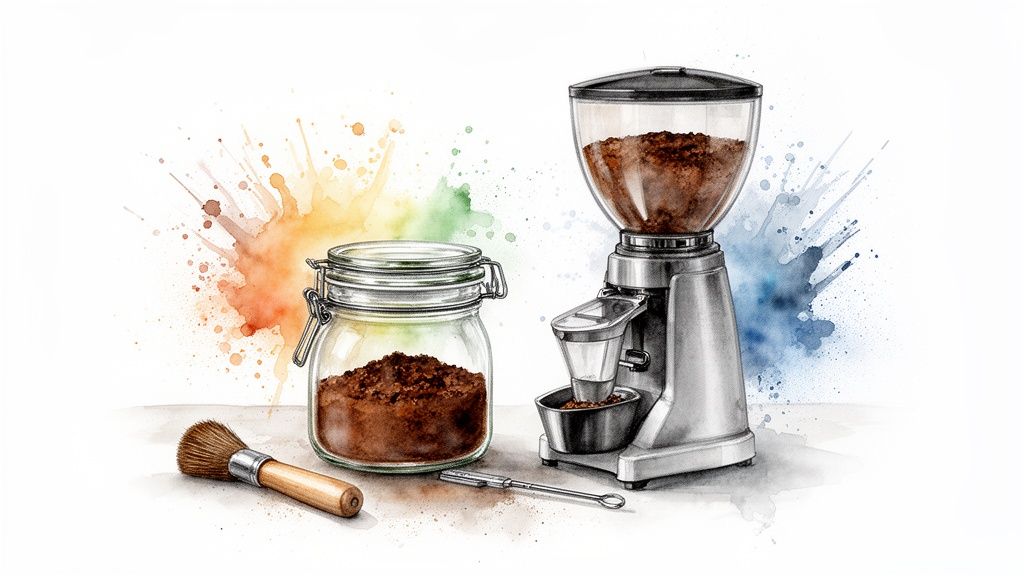
The moment your grinder goes quiet, the clock starts ticking. What you do in the next few seconds and minutes is just as crucial as the grind itself. There’s one golden rule that every experienced brewer lives by: only grind what you need, right before you brew.
Once those beans are broken down, they start a rapid process of oxidation. All the beautiful, complex aromatic compounds we work so hard to develop in our Seven Sisters beans begin to escape, leaving you with a dull, one-dimensional flavour.
Here in the UK, more and more people are grinding their own beans at home, and for good reason. Roasted coffee now makes up a huge portion of all coffee bought, showing a clear shift towards freshness. It's the best way to protect your investment in great beans, because the flavour degrades so quickly after grinding.
What to Do if You Grind Too Much
Look, we've all been there. You get distracted and grind enough for two when you only need one. Ideally, you’d just brew it all, but if you absolutely have to store it, here’s how to do it right.
- Airtight is Non-Negotiable: Get those grounds into a sealed container immediately. We're big fans of the Fellow Atmos Vacuum Canister because it actually removes the air, dramatically slowing down the staling process. We also have a selection of other coffee storage options.
- Keep it Cool, Dark, and Dry: Your kitchen cupboard is perfect. Keep it away from heat sources, direct sunlight, and any moisture. And please, never put coffee—beans or grounds—in the fridge or freezer. Condensation is the enemy of good flavour.
- Time is of the Essence: Even with the best container in the world, you’re on borrowed time. Try to use the grounds within a few hours to salvage as much of the original taste as possible.
Troubleshooting Common Grinding Problems
Even with the best kit, things can sometimes go sideways. Don’t panic. Most grinding headaches have a surprisingly simple fix that will get you back on track without any fuss.
Inconsistent Grind Size
If your coffee tastes muddy or somehow both bitter and sour, an inconsistent grind is almost always the culprit. It's usually a sign that your burrs are crying out for a good clean. Old coffee oils and fine particles build up, stopping the burrs from doing their job properly.
Frustrating Static Cling
Are your coffee grounds trying to escape, sticking to everything in sight? That’s static electricity for you. There's a brilliant little trick called the Ross Droplet Technique (RDT) that solves this instantly. Just a tiny spritz of water on your beans before you grind them eliminates static completely. It’s a game-changer.
Jammed Grinder
A jam typically happens when a particularly dense bean (often a light roast) gets stuck. First things first: turn it off and unplug it immediately. Try coarsening the grind setting all the way; this can sometimes create enough space to release the bean. If that fails, you’ll have to get your hands dirty and disassemble the burrs to clear it manually.
A bitter brew is often blamed on a grind that's too fine, causing over-extraction. But if you've coarsened the grind and you're still getting that harshness, it's time to look at other culprits.
Sometimes bitterness creeps in from things like your water temperature being too high or your brew time dragging on for too long. For a proper deep-dive into this particular problem, you might be interested in our guide on why your espresso tastes bitter.
Your Grinding Questions, Answered
Even with the best guide, there are always a few questions that pop up. Getting to grips with grinding your own beans is a journey, and we’re here to help you along the way. We've pulled together some of the most common queries we hear from home brewers just like you.
Think of this as your go-to reference for troubleshooting those little issues, refining your technique, and building the confidence to brew a consistently brilliant cup, every single time.
How Often Should I Clean My Coffee Grinder?
For the best possible flavour, a light clean every week or two is a great habit to get into. This isn't a deep-dive operation—just brushing out loose grounds and wiping down the hopper and catch bin is usually enough to keep things fresh.
About once a month, though, it's time for a proper deep clean, especially if you're a daily coffee drinker. For this, we recommend using grinder-specific cleaning tablets like the ones from Urnex. These food-safe pellets are fantastic at soaking up the stubborn coffee oils that build up on the burrs. You can find our full range of cleaning products to keep all your equipment in top shape.
Why bother? Those old oils can turn rancid, and if left in your grinder, they’ll impart a stale, unpleasant taste to your fresh coffee. Regular cleaning is the simplest way to protect the pure, vibrant flavour of your Seven Sisters beans.
Can I Use a Blender to Grind Coffee Beans?
In a real pinch, you technically can, but it’s something we’d never recommend for a quality brew. The difference boils down to one simple concept: smashing versus milling.
A blender uses a flat, fast-spinning blade to violently shatter the beans. It’s a chaotic process that gives you a wild mix of particle sizes—from big, chunky pieces down to fine, powdery dust. This inconsistency is the absolute enemy of a good extraction.
In the brew, the fine dust over-extracts almost instantly, releasing bitter, harsh flavours. At the same time, the large chunks under-extract, adding a sour, weak taste. The final cup is just a muddled, unbalanced mess.
For a clean and flavourful cup, a proper burr grinder is always a worthwhile investment. It mills the beans with precision, creating the uniform particles you need for a delicious, even extraction.
Does the Coffee Roast Level Affect My Grind Setting?
Yes, absolutely. This is a brilliant question, and paying attention to this detail is what separates good home coffee from great home coffee. The roast level dramatically changes the physical structure of the bean, which affects how it behaves in your grinder.
- Darker Roasts: These beans are more brittle and less dense. They’ve expanded more during roasting, causing them to fracture easily and produce more fine particles. To avoid a bitter, over-extracted brew, you’ll often need to set your grinder slightly coarser for a dark roast.
- Lighter Roasts: Think of our speciality single origins—these beans are much harder and denser. To properly break them down and expose enough surface area for a balanced extraction, you'll usually need a finer grind setting.
The key takeaway is to be ready to make small adjustments to your grinder every time you open a new bag. The "perfect" setting isn't just for your brewer; it's for the specific coffee you're using at that moment.
Is a Manual Hand Grinder as Good as an Electric One?
A high-quality manual grinder can easily match, and in some cases even outperform, many entry-level electric grinders. The real difference isn't about the potential for quality, but about workflow, convenience, and how much coffee you’re making.
A manual grinder like the Hario Mini Mill Plus offers some fantastic perks. They are:
- Portable: Perfect for travel or brewing a great cup at the office.
- Quiet: You won't wake the whole house for your morning brew.
- Affordable: They provide exceptional grind consistency for a modest price tag.
Their main limitation is the effort involved and the small capacity, which makes them ideal for brewing just one or two cups at a time.
Electric grinders, on the other hand, bring speed and ease to the table. For anyone brewing a full French press or needing the daily consistency for espresso, a model like the Baratza Encore ESP is a lifesaver. It delivers consistent results with just the push of a button.
Ultimately, the choice comes down to your personal brewing habits and budget. Both are excellent paths to better coffee.
At Seven Sisters Coffee Co, we believe that the journey to a perfect cup begins with freshly ground, high-quality beans. By taking control of this crucial step, you unlock the full flavour potential that we carefully roast into every batch.
Explore our collection of exceptional single-origin and blended coffees to start your own brewing adventure at sevensisterscoffee.co.uk.