How to Make Espresso Coffee Without a Machine

Got a craving for that rich, intense flavour of a proper espresso but don’t have a machine cluttering up your worktop? Good news. You can brew a surprisingly powerful, espresso-style coffee using simple kit you might already own, like a Moka pot, AeroPress, or even a French press. The secret isn’t in the hardware; it’s all about the technique—a finer grind, a higher coffee-to-water ratio, and getting the knack of your chosen brewer.
The Secret to Rich Coffee Without an Espresso Machine
Forget the expensive, counter-hogging gadgets for a moment. Crafting a genuinely rich, intense espresso-style coffee is entirely possible right in your own kitchen using classic, affordable brewers. The real magic isn't hidden away in high-pressure machines. It's found by mastering the fundamentals—the right beans, the perfect grind, and proven techniques that bring out the absolute best in your coffee. This guide is here to prove that incredible flavour is accessible to everyone.
The desire for café-quality coffee at home has never been stronger. As a nation, we get through an incredible 98 million cups of coffee daily. With coffee shop prices soaring by 17% since 2022, it’s no surprise more people are looking for ways to replicate their favourite drinks without the daily dent in their wallet. Data shows that weekly trips to the coffee shop are steadily rising, fuelling the demand for home alternatives that actually deliver on taste.
Why Technique Trumps Technology
At its heart, a great espresso-style coffee is all about concentrated flavour extraction, not just high pressure. By tweaking your grind, dose, and water temperature, you can create a potent brew that stands up beautifully as a base for lattes, flat whites, or a strong Americano. This guide is all about methods that turn your daily coffee into a small moment of craft.
We'll dive into how to get the most from:
- The Stovetop Moka Pot: A timeless Italian method for a bold, syrupy coffee.
- The AeroPress: A versatile tool for a clean yet powerful concentrated shot.
- The French Press: A common household item that can be hacked for a full-bodied brew.
The journey to making espresso-style coffee without a machine is about celebrating the ritual. It connects you directly to the quality of the beans, like the ones we roast here in East Sussex, and empowers you to create something truly special with your own hands.
While these methods differ, their success all comes down to understanding basic brewing principles. For some more general insights that apply across different methods, you might find some useful tips in How To Brew Peak Performance Coffee. Each brewer has its own personality, and if you’re curious about how a Moka pot brew stacks up against a machine, you can read our deep dive here: https://sevensisterscoffee.co.uk/moka-pot-vs-espresso-machine-at-home/
Brewing with the Stovetop Moka Pot
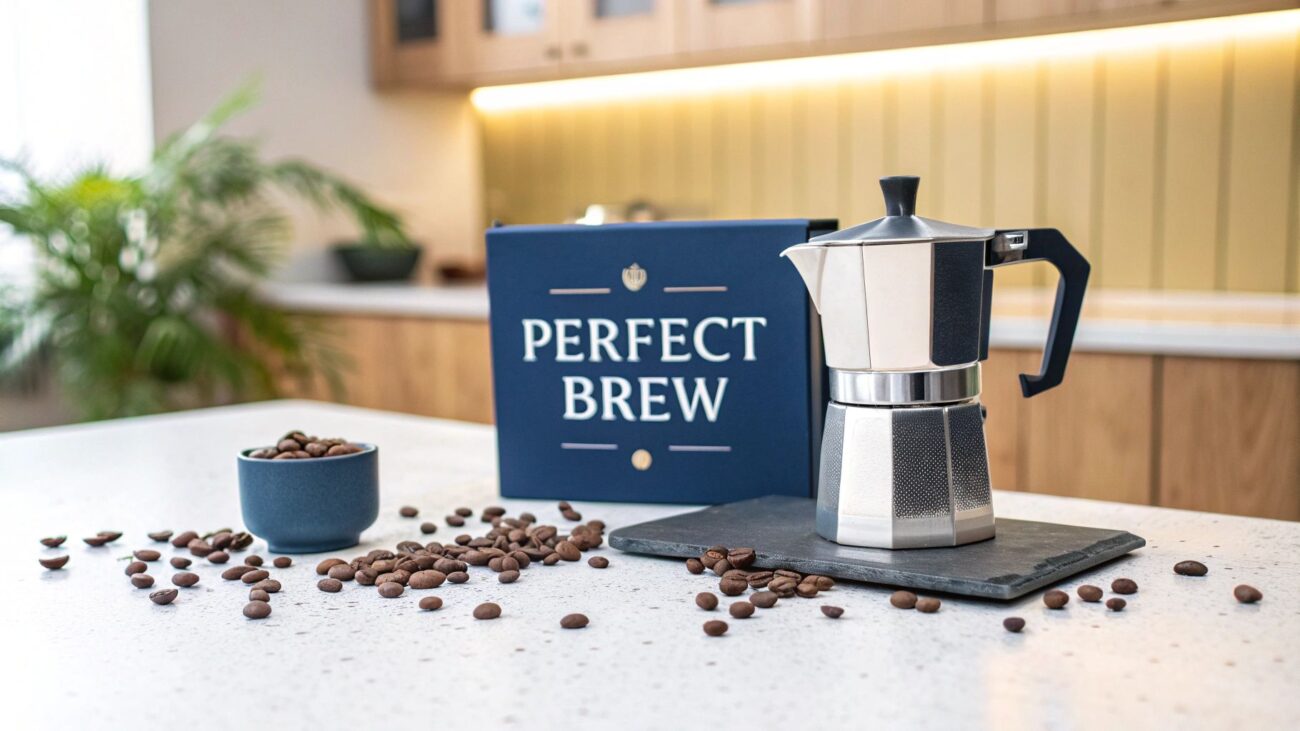
For many of us, the Moka pot is the closest we can get to real espresso flavour without splashing out on a hefty machine. It's that iconic Italian brewer that uses simple steam pressure to force water up through the coffee grounds, creating a short, sharp, and incredibly rich brew. It’s a classic for a reason.
While it looks simple, there’s a definite knack to using a Moka pot. A few small tweaks can take your coffee from just okay to truly exceptional. Getting it right means you can sidestep that bitter, metallic taste that sometimes gives these brewers a bad name.
Choosing Your Pot and Your Grind
First things first, size matters. Moka pots are sold by "cup" size, but don't be fooled—these are tiny 50ml espresso-style cups, not the mug you’d use for your morning tea. A "3-cup" pot will give you a concentrated shot of around 90ml. It’s always best to pick a size that you’ll drink in one sitting, as they brew most effectively when filled to capacity.
Once you’ve got your pot, the grind is everything. You're aiming for a medium-fine grind, something that feels like table salt. It needs to be a little coarser than a true espresso grind but finer than what you’d use for a drip filter. Go too fine, and you’ll clog the filter, resulting in a bitter, over-extracted coffee. Too coarse, and the water will just rush through, leaving you with a weak, watery brew.
To give you a quick reference, here’s a simple table to keep the key variables in check.
Moka Pot Brewing at a Glance
| Variable | Recommendation | Why It Matters |
|---|---|---|
| Grind Size | Medium-fine (like table salt) | Prevents clogging (too fine) or weak coffee (too coarse). |
| Water | Pre-heated, just off the boil | Reduces time on the stove, avoiding a "cooked" metallic taste. |
| Coffee Dose | Fill the basket, level off | Ensures even extraction without choking the pot. Do not tamp! |
| Heat Level | Medium-low | Promotes a steady, even flow rather than sputtering. |
| Extraction | Remove from heat at the gurgle | Stops the brew before it becomes bitter. |
Nailing these points is the secret to getting a consistently great cup every time you use your Moka pot.
The Secret to a Cleaner Brew: Pre-Heated Water
Here's a tip that will immediately level up your Moka pot game: always start with hot water. Instead of filling the base with cold tap water, boil your kettle first and fill the bottom chamber with water that’s just off the boil.
This simple step drastically cuts down the amount of time the pot spends on the stove. Why does that matter? It stops the metal from getting too hot and literally "cooking" the grounds before the water even reaches them. This is the main culprit behind that burnt, metallic taste many people complain about. Just be careful—the base will be hot when you screw the top on.
Loading and Brewing Technique
With your hot water in the base (fill it to just below the little safety valve), you’re ready for the coffee. Spoon your grounds loosely into the filter basket and level it off with your finger.
The golden rule here is do not tamp the coffee down. A Moka pot works on low pressure and can't force water through a compressed puck like a proper espresso machine. Tamping will just block the flow and could even cause a dangerous pressure build-up.
Screw the top on tightly and pop the pot on a medium-low heat. If you're not using a gas hob, a good electric hot plate can give you brilliant temperature control.
Now, just listen. After a minute or two, a steady, dark stream of coffee will begin to fill the top chamber. You’re looking for a flow that’s smooth, almost like warm honey. If it’s sputtering and shooting out, your heat is way too high.
As soon as the stream turns a pale, honey colour and you hear that final gurgling sound, take it off the heat immediately. To be extra sure you've stopped the brewing process, you can run the base under a cold tap. This halts extraction instantly and locks in all the rich flavours, keeping bitterness at bay.
For an even more in-depth guide, check out our complete tutorial on how to brew with a Moka pot. What you’re left with is a wonderfully rich and aromatic coffee shot, perfect for sipping as is or using as the base for a homemade latte or flat white.
Making an AeroPress Espresso Style Shot
The AeroPress has become a modern classic for a reason. It’s loved for its incredible versatility and the clean, grit-free cup it brews. While it’s brilliant for a standard filter-style coffee, its real party trick is creating a punchy, espresso-like concentrate with just a few small tweaks to the normal method. You can find a range of AeroPress brewers here.
This brewer uses manual pressure to force water through the coffee, which is how it gets so close to the intensity of a true espresso. It’s also lightweight, tough, and ridiculously easy to clean up, making it perfect for travelling, camping, or just saving space in the kitchen.
Mastering the Inverted Method
To get that rich, concentrated shot, we need to forget the standard AeroPress technique and use the "inverted method" instead. This clever hack means assembling the brewer upside down, which lets the coffee steep fully without dripping through the filter too early.
This gives you total control over the brewing time—essential for pulling out the deep, complex flavours you want in an espresso-style shot. It stops the coffee from being under-extracted and makes sure every last gram contributes to the final taste.
Here’s the basic approach:
- Set Up: Stand the plunger on a sturdy surface, facing up. Now, fit the main chamber securely over the plunger so the whole thing is standing upside down.
- Dose: Add your finely ground coffee straight into the chamber. A good starting point is 18-20 grams for a single, potent shot.
- Steep: Hit start on your timer and pour in about 60ml of hot water, making sure all the grounds get wet. A quick stir will help kick-start the extraction.
By flipping the traditional process on its head, the inverted method transforms the AeroPress from a simple drip brewer into a powerful immersion device. This single change is the key to achieving that desirable espresso-like body and intensity.
Fine-Tuning Your Grind and Water Temperature
Like any brewing method, the details are what make the difference. For an AeroPress espresso-style shot, you’ll want to adjust your usual settings to get that concentrated extraction just right.
Your grind size should be finer than you'd use for filter coffee but a touch coarser than a true espresso grind. Think of the texture of fine table salt. If you go too fine, plunging becomes a workout, and the shot can taste bitter. Too coarse, and you'll end up with a weak, watery coffee.
Water temperature is the other critical piece of the puzzle. While it’s tempting to use boiling water, it can easily scorch the delicate grounds, especially with a finer grind. For this method, aim for water between 85-90°C. This slightly cooler temperature helps pull out sweetness and complexity while keeping harsh, bitter notes out of your cup. No temperature-controlled kettle? Just let your boiled water sit for about a minute before pouring.
Once you’ve got the basics down, our comprehensive guide offers even more tips for perfecting your espresso in an AeroPress technique.
The Plunge and Final Shot
After your coffee has steeped for around 60-90 seconds, you’re ready for the final step. Secure the filter cap—with a rinsed paper or metal filter inside—onto the brewing chamber.
With a steady hand, carefully flip the entire AeroPress over and place it directly onto a sturdy mug. Now, it’s time to plunge. The trick here is to apply firm, consistent pressure. You're aiming for a plunge that takes around 20-30 seconds. If it’s too easy, your grind is probably too coarse; if it's a real struggle, it's too fine.
You’ll know you’re done when you hear a distinct hissing sound. That means all the water has been pushed through the grounds. What you’re left with is a small, highly concentrated shot, perfect for all sorts of drinks.
You can enjoy this potent shot in a few different ways:
- Straight: For a powerful, clean coffee experience.
- As an Americano: Just top it up with hot water to your preferred strength.
- As a base for milk drinks: It holds up beautifully against milk for a homemade latte or flat white.
Using the French Press Espresso Hack
Almost everyone has a French press tucked away in a cupboard, but few realise its potential for making a dense, espresso-like concentrate. This isn’t about brewing your standard, gentle cafetière coffee. This is the ‘French press hack’—a method designed to create a powerful base for milk drinks by radically changing your technique.
It’s a brilliant way to learn how to make espresso-style coffee without a machine, using kit you almost certainly already own.
The key is to forget your usual 1:15 coffee-to-water ratio. To get that espresso-like intensity, we’re going to push the boundaries with a much stronger ratio, somewhere in the region of 1:7. This means using roughly double the amount of coffee you normally would for the same volume of water. The result is a thick, potent, and incredibly flavourful concentrate.
While it won't produce a true crema, the result is a full-bodied, oily shot that holds up beautifully in cappuccinos, iced lattes, and other coffee cocktails. It’s the perfect solution when you need a strong coffee base without any specialised equipment.
The Importance of a Coarse Grind
When you're making a brew this strong, your grind size is absolutely critical. For this hack, you must use a coarse grind—think of the texture of coarse sea salt. If you use a finer grind, you’ll end up with an over-extracted, muddy, and unpleasantly bitter cup after the four-minute steep. It’ll be a silty mess.
A coarse grind is your best friend for this technique for a few reasons:
- It prevents murkiness. The larger particle size stops fine sediment from slipping through the metal filter, keeping your final concentrate much cleaner.
- It controls extraction. A coarse grind slows down the extraction rate, letting you steep for longer without pulling out those harsh, bitter compounds.
- Plunging is much easier. A coarse grind offers less resistance, making the final plunge smoother and preventing grounds from being forced around the filter.
The French press is all about immersion, where coffee and water mingle for a good while. A coarse grind ensures the final concentrate is rich and bold, not gritty and astringent.
Steeping and Plunging for Maximum Body
Once you’ve added your coarsely ground coffee and hot water (just off the boil is perfect), let it steep for a full four minutes. This extended contact time is essential for extracting the maximum body and flavour oils from the grounds, which is what gives the brew its satisfying weight and richness.
After the four minutes are up, it’s time to plunge. Don’t rush this part. A slow, steady, and deliberate plunge is crucial here. If you push down too quickly, you'll agitate the coffee grounds, forcing fine particles straight through the filter and creating sediment in your cup.
Apply gentle, even pressure and take around 20 seconds to press the filter all the way to the bottom. This slow plunge ensures a cleaner separation, leaving you with a potent shot that’s ready to use. If you're new to this brewer, you might find our detailed guide on how to use a cafetière helpful for mastering the basics.
The final result is a powerful concentrate that, while different from a machine-pulled shot, delivers a similar punch. And if your old French press has seen better days, you can explore our curated selection of high-quality French presses to upgrade your setup.
Why Your Grind and Milk Matter Most
We can talk all day about brewers, techniques, and fancy gadgets, but let's be honest: two things will make or break your attempt at a café-quality coffee at home. Get these right, and you're golden. Get them wrong, and even the best beans won't save you.
I’m talking about a consistent grind and properly textured milk. They are the absolute foundation.
The Power of a Consistent Grind
First up, the grind. It's easily the most important step in the entire process. While the convenience of pre-ground coffee is tempting, it’s a massive compromise on flavour. The moment coffee is ground, it starts losing its delicate aromatic compounds. That bag on the supermarket shelf? It’s already a shadow of its former self.
To really unlock the rich, complex notes hiding in your beans, you have to grind them fresh, right before you brew. It's non-negotiable. This is where a quality burr grinder becomes the single best investment for your home coffee setup. You can browse our coffee grinders here. Unlike blade grinders that just smash beans into a chaotic mix of dust and chunks, burr grinders mill the coffee between two revolving surfaces. The result is a far more uniform particle size.
So, why does consistency matter so much? It all comes down to an even extraction. When your coffee grounds are all roughly the same size, water flows through them at a steady rate, pulling out all the good stuff—the sugars, the oils, the delicate flavours—evenly. Uneven grounds lead to a muddled, disappointing cup. The fine dust over-extracts and turns bitter, while the big chunks under-extract, leaving a sour taste. A good burr grinder is the difference between a balanced, flavourful shot and something that just tastes vaguely of ‘coffee’.
For anyone ready to get serious about their home brew, our detailed coffee grind size guide is the perfect resource for matching your grind setting to your brewer.
To give you a better idea of what to aim for, here’s a quick rundown of the grind sizes you'll need for the most common machine-free methods.
Grind Size Guide for Machine-Free Methods
| Brewing Method | Recommended Grind Size | Visual Comparison |
|---|---|---|
| Moka Pot | Medium-Fine | Like table salt |
| AeroPress | Fine to Medium | Between table salt and sand |
| French Press | Coarse | Like coarse sea salt or breadcrumbs |
Getting this right is crucial for controlling the extraction and avoiding a bitter or weak brew.
As you can see, making this method work hinges on getting three things right: a strong coffee-to-water ratio, that all-important coarse grind, and a slow, steady plunge.
Creating Silky Microfoam Without a Steam Wand
Once you’ve pulled your concentrated coffee shot, the next challenge for drinks like a flat white or latte is the milk. The good news is you don’t need an expensive machine with a built-in steam wand to create that velvety, sweet-tasting microfoam you get in a proper coffee shop.
The secret is all about temperature and texture. First, you need to get your milk to the sweet spot, which is around 60–65°C. Any hotter and the proteins start to burn; any cooler and you won't get that lovely natural sweetness as the lactose breaks down. A simple kitchen thermometer is your best friend here.
Once it's warm, it's time to add the texture. You’ve got a couple of fantastic, low-cost options:
- A French Press: This is a brilliant hack. Pour your warm milk into the cafetière (don't fill it more than halfway) and plunge the filter up and down rapidly for about 30 seconds. This forces air into the milk and creates a surprisingly dense, stable foam.
- A Handheld Frother: These little battery-powered whisks are incredibly effective. Just submerge the whisk head below the surface of your warm milk, switch it on, and let it create a vortex. In under a minute, you’ll have beautifully silky milk. You can find a selection of milk frothers here.
Here’s a pro tip: after frothing, give the milk jug a firm tap on the counter to pop any large, unsightly bubbles. Then, swirl the milk gently. This integrates the foam with the liquid, giving you that glossy, paint-like texture that’s perfect for pouring.
Your Questions on Machine-Free Espresso Answered
Diving into the world of making espresso-style coffee without a fancy machine is bound to bring up a few questions. That's perfectly normal. Getting these details right is what refines your technique, turning a good coffee into a brilliant one. Let's tackle some of the most common queries to clear up any lingering doubts.
Can I Really Get Crema Without an Espresso Machine?
This is the big one, isn't it? While that thick, reddish-brown crema is the hallmark of a high-pressure machine, you can definitely get close. A Moka pot, when you get the hang of it and use fresh beans, often produces a lovely dark foam on top.
An AeroPress can also create a fine layer, especially if you swap out the paper for a metal filter. This little trick lets more of the coffee oils pass through, which helps build that foam. The French press, however, won't produce any crema because of its immersion brewing style.
The real secret to any kind of foam or crema is using freshly roasted beans. The CO2 gases that create that gorgeous layer dissipate over time, so the fresher your beans, the better your chances.
What's the Best Coffee for These Methods?
For a strong, espresso-style brew that really packs a punch, we always reach for a medium to dark roast. Look for beans with tasting notes of chocolate, nuts, or caramel, as these flavours become incredibly rich and concentrated when brewed this way. An espresso blend is an obvious choice, as it’s designed to deliver a rich, balanced shot and works beautifully in a Moka pot or AeroPress. We have a selection of great espresso beans available.
If you're more of a single-origin fan, a Brazilian or Colombian coffee with a full, rounded body will also produce a fantastic and flavourful concentrate. These roasts are robust enough to stand up to these more intense brewing methods without losing their character.
How Much Coffee Should I Use for a Single Shot?
There's no single right answer here, as the ideal dose varies quite a bit depending on your chosen method. Think of these as excellent starting points for your own experimentation.
- For a Moka pot: It's simple – you just fill the basket. A standard 3-cup pot typically holds around 15-17 grams of coffee.
- For an AeroPress shot: A great place to start is 18-20 grams of coffee to about 60ml of water for a very concentrated brew.
- For the French press hack: You'll want a much higher ratio to get that strength. For a 300ml press, try using 40 grams of coffee to 280ml of water to create a powerful base.
Don't be afraid to adjust these ratios. Your personal taste is what matters most, so tweak the dose until you land on a strength you really enjoy.
Does Water Quality Make a Difference?
Absolutely. It’s easy to forget that your coffee is over 98% water, so its quality has a huge impact on the final taste. Hard water, which is common in many parts of the UK, is packed with minerals that can lead to over-extraction and a dull, slightly chalky taste in the cup.
Using filtered water gives you a much cleaner, more neutral base to work with. This simple change allows the true, delicate flavours of your coffee beans to shine through properly. As a bonus, it also helps prevent limescale build-up in your brewing kit, keeping it in great condition for longer.
At Seven Sisters Coffee Co, we believe that incredible coffee should be accessible to everyone, with or without a machine. Explore our range of freshly roasted coffee beans, perfect for any brewing method, and discover your new favourite today at https://sevensisterscoffee.co.uk.