Best Coffee Grinder for Home: Discover the best coffee grinder for home options

If you're serious about brewing exceptional coffee at home, let me share a secret that might surprise you: it’s not about the fancy machine. The single most important piece of kit in your setup is the grinder. A quality burr grinder is the one investment that will dramatically elevate your daily brew, unlocking the complex flavours and aromas we work so hard to develop in our beans. It all comes down to two things: grind consistency and freshness.
Why Your Grinder Is Your Most Important Coffee Investment
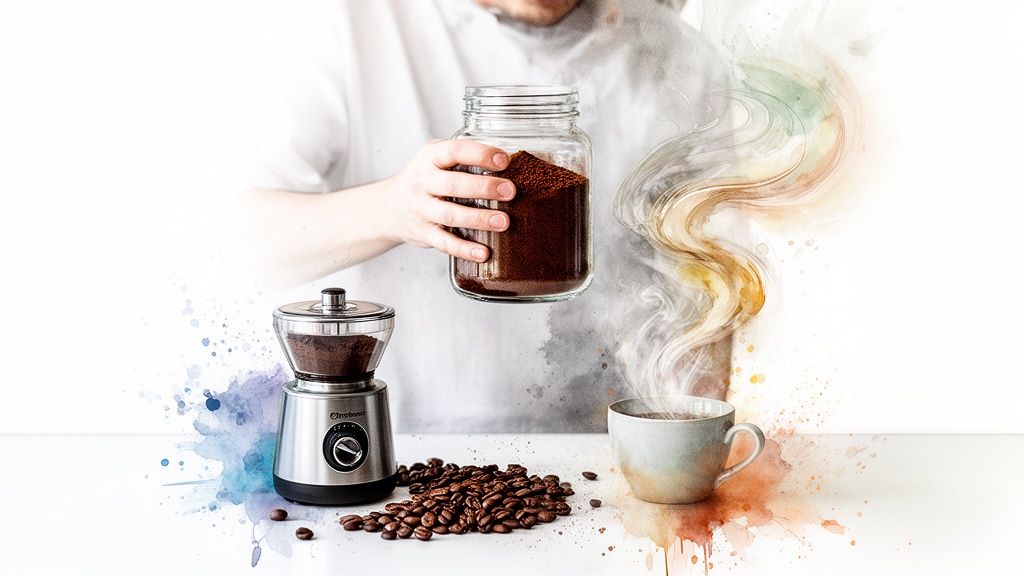
It’s easy to get drawn in by a gleaming new espresso machine or a stylish brewer, thinking it holds the key to café-quality results. But the real magic happens just moments before you start brewing. The grinder is the unsung hero of home coffee, and upgrading from a basic blade model to a proper burr grinder will transform your coffee ritual from simply "good" to genuinely incredible.
The reason is simple. Whole coffee beans are like tiny, sealed vaults, protecting delicate oils and aromatic compounds. The moment you grind them, these elements start to degrade, losing their vibrancy within minutes. Grinding your beans right before you brew ensures you capture their absolute peak flavour potential. You can get a deeper understanding of this critical window by reading up on how long coffee beans stay fresh.
The Power of Consistency
Freshness is one half of the equation; the other is grind consistency. If your grinder produces a mix of large "boulders" and fine "dust," you're setting yourself up for an uneven extraction. The tiny particles will over-extract and turn bitter, while the big chunks will under-extract, adding a sour, weak taste. The result is a muddled, disappointing cup. A quality grinder, on the other hand, produces uniform particles, allowing water to extract flavour evenly for a balanced, sweet, and delicious brew.
This shift in focus from brewer to grinder is happening all over the UK. As speciality coffee culture has grown, so has the demand for better home equipment. The UK coffee grinder market has expanded from £320 million and is projected to hit £520 million by 2032. Today, 59% of UK households own a grinder, a huge jump from 42% in 2020, which lines up with a 20% increase in speciality bean imports. You can read the full research on the coffee grinder market here.
Unlocking True Flavour
Think of our Seven Sisters Coffee Co. beans as a treasure chest filled with incredible flavour notes—chocolate, fruit, nuts, and florals. Your grinder is the key that unlocks it.
A great grinder doesn't just crush beans; it prepares them for perfect extraction. It's the difference between tasting the coffee and tasting the potential of the coffee.
By investing in the right grinder for your home, you gain control over the single most important variable in your brewing process. This guide will walk you through everything you need to know to choose the perfect model, making sure every cup you brew is a true reflection of the beautiful beans you’ve chosen.
Understanding the Grinder Showdown: Burr Versus Blade
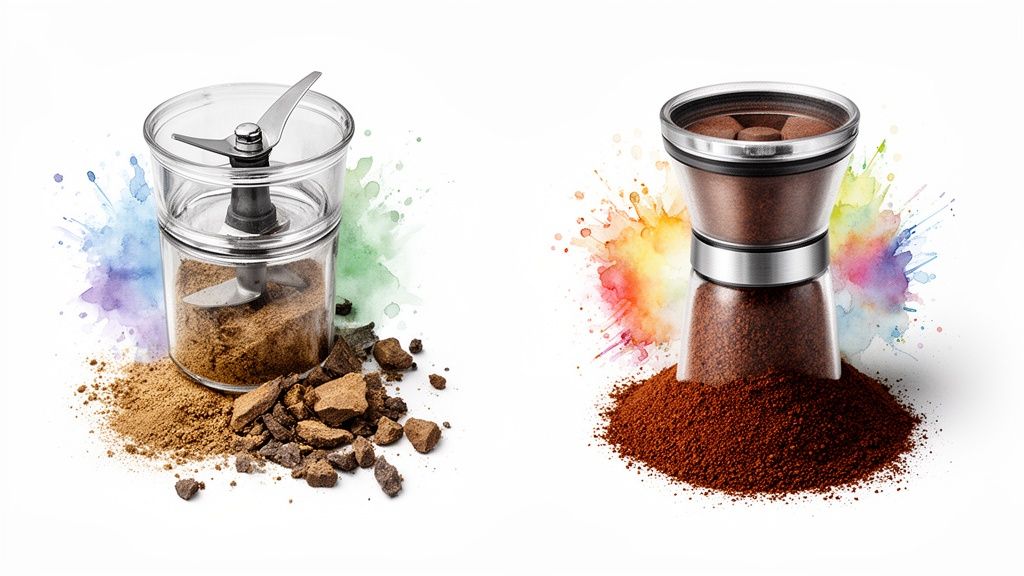
When you’re looking to get the best out of your coffee beans, the first big decision you’ll face is choosing between a burr and a blade grinder. On the surface, they both seem to do the same job, but how they get there—and the results they produce—are worlds apart. This isn’t just a minor technical detail; it’s the difference between a consistently delicious cup and one that’s just plain disappointing.
A blade grinder is essentially a tiny food processor. It uses a spinning blade to violently smash coffee beans into smaller pieces. The whole process is chaotic and generates a jumble of different-sized particles, from large chunks to super-fine dust, all mixed together in the same batch. This is where the problems begin.
When you brew with these uneven grounds, the fine dust extracts way too quickly, releasing a wave of bitterness. At the same time, the larger chunks don't get enough contact with the water and under-extract, adding a weak, sour taste. No amount of brewing expertise can salvage a cup that starts with such an inconsistent foundation.
The Precision of Burr Grinders
A burr grinder, on the other hand, operates with far more finesse. Instead of smashing the beans, it carefully mills them between two abrasive surfaces, or ‘burrs’. These are set at a very specific distance from each other, ensuring that as the beans pass through, they are ground down to a perfectly uniform size.
This consistency is the secret ingredient for a balanced brew. When all the coffee grounds are the same size, water can extract their flavour compounds evenly, creating a cup that is sweet, clean, and full of character. It’s what allows you to truly appreciate the distinct notes in your Seven Sisters Coffee Co. beans.
The core principle is simple: uniformity breeds consistency. A burr grinder gives you the control needed to produce uniform grounds, which is non-negotiable for anyone serious about brewing exceptional coffee.
This isn’t just coffee snobbery; the numbers back it up. In the UK, burr grinders command 65% of the electric coffee grinder market, proving they’re the go-to choice for home brewers who care about taste. Their ability to deliver consistent grounds is crucial, especially for speciality coffees. By contrast, blade grinders produce such uneven particles that they can lead to 25% more bitterness in brewing tests due to over-extraction.
Why the Choice Matters for Your Daily Brew
Let’s think about this in a real-world scenario. Imagine making a pour-over. With grounds from a blade grinder, the fine powder clogs the filter paper, causing the water to drain too slowly and pull out harsh, bitter flavours. Meanwhile, the larger chunks barely get touched, leaving all their best flavours locked away.
Now, picture that same pour-over using grounds from a quality burr grinder. The uniform particles allow the water to flow through at a steady, controlled rate, extracting all that delicious sweetness and acidity in perfect harmony. The difference in the final cup is night and day.
To really nail this, you need to understand how different grind sizes affect your brew. If you want to dive deeper into dialling in the perfect setting for your favourite method, check out our detailed coffee grind size guide.
While a blade grinder might seem like a wallet-friendly entry point, it ultimately holds your coffee back. If you're investing in high-quality, freshly roasted beans, using a blade grinder is like buying a high-performance car and fitting it with budget tyres—you’ll simply never unlock its true potential. A good burr grinder is the foundational upgrade that lets every other part of your setup shine.
Choosing Your Burr Grinder: Conical Versus Flat
Alright, we’ve settled the big debate: a burr grinder is your ticket to better coffee at home. Now it's time to zoom in on the heart of the machine—the burrs themselves. You'll mainly come across two designs, conical and flat, and while both are built for precision, their shapes create subtle but crucial differences in the final cup.
This isn’t about one being flat-out better than the other. It's about matching the burr type to your taste and how you like to brew your coffee. Getting to know how each one works will help you pick a grinder that nails the exact flavour profile you're after.
The All-Rounder: Conical Burrs
Conical burrs are made up of a cone-shaped inner burr that spins inside a ring-shaped outer burr. This design is incredibly common in home grinders, and for very good reason. Gravity pulls the coffee beans down, breaking them into smaller and smaller pieces, which gives you a consistent grind but with a slightly wider range of particle sizes.
This mix of different sizes, sometimes called a bimodal distribution, isn't a defect; it's a feature. The blend of finer and coarser particles works together to create a coffee with a rich, full body and a more complex, well-rounded flavour. This makes conical burrs fantastic all-rounders, perfect for anything from a coarse French press to a fine espresso.
For instance, the Baratza Sette 270 is a much-loved home grinder that uses its conical burrs to deliver speed, low grind retention, and brilliant versatility. If you're someone who values texture and a complex, harmonious cup, a conical burr grinder is probably your best bet.
The Specialist: Flat Burrs
Flat burrs, just as the name implies, are two parallel, ring-shaped burrs with cutting teeth that sit horizontally. One ring stays put while the other spins, grinding the beans between them. What's special about this design is that it produces an incredibly uniform grind with very few fine particles, what we call a unimodal distribution.
This exceptional consistency is where flat burrs truly shine. By creating particles of almost identical size, they allow for a very even and precise extraction. In the cup, this often translates to incredible clarity, sweetness, and a more distinct separation of flavour notes. If you love brewing delicate pour-overs with single-origin beans, a flat burr grinder will help you taste every last subtle nuance.
You can think of it like this: conical burrs tend to mute acidity and boost body, creating a rich and blended taste. Flat burrs, on the other hand, highlight acidity and clarity, allowing individual flavour notes to pop.
For those who really want to get into the specifics of different coffee beans, understanding how your grind affects flavour is a game-changer. You can learn more about picking out specific tastes by exploring these detailed notes of coffee.
A Practical Comparison
To help you decide, let's break down the differences based on what really matters when you're brewing at home.
Conical vs Flat Burr Grinders at a Glance
This table gives a straightforward comparison, focusing on the practical outcomes for home brewers—from flavour profile and cost to the brewing methods each grinder excels at.
| Feature | Conical Burr Grinders | Flat Burr Grinders |
|---|---|---|
| Flavour Profile | Full-bodied, complex, and blended flavours. | High clarity, sweetness, and distinct notes. |
| Best For | All-round use, French press, espresso. | Pour-over, exploring single-origin coffees. |
| Grind Distribution | Bimodal (a mix of particle sizes). | Unimodal (highly uniform particles). |
| Commonly Found In | Versatile home and entry-level grinders. | High-end home and commercial grinders. |
| Example Model | Baratza Sette 270 | Eureka Mignon Specialita |
Ultimately, choosing between conical and flat burrs boils down to what you want from your coffee. Do you prefer a comforting, full-bodied brew that’s forgiving and works for pretty much anything? A conical burr grinder is an excellent choice. Or are you a flavour-chaser who wants to dissect the unique notes of a prized Geisha coffee? Then a flat burr grinder will be your best friend.
Both will deliver a fantastic cup, but they'll get you there via slightly different paths.
Manual vs Electric: Which Grinder Suits Your Ritual?
Beyond the burrs themselves, your next big decision is whether to go manual or electric. This isn't a simple case of one being better than the other; it’s about finding the grinder that fits your lifestyle, your daily coffee habits, and of course, your budget. When you understand the real-world trade-offs, you can pick a machine that feels like it was made just for you.
We can really break this down into two distinct approaches. On one side, you have the hands-on enthusiast who loves the process. On the other, you have the brewer who just needs a great cup of coffee, fast. Neither is wrong—they just serve different moments.
The Case For a Manual Grinder
A high-quality manual grinder is a beautiful piece of engineering. It delivers exceptional grind quality, often matching electric models that cost several times more, but it does ask for a bit of elbow grease. This path is perfect for a few specific types of coffee drinkers.
- The Weekend Coffee Artist: You genuinely love the ritual of making coffee. The quiet, almost meditative process of hand-grinding your beans is part of the joy. You’re not in a hurry and you value the control and connection you feel.
- The Travelling Enthusiast: The thought of bad coffee on holiday or a camping trip is just unbearable. A manual grinder is compact, tough as nails, and needs no electricity, making it the perfect companion for brewing great coffee anywhere.
- The Quiet Brewer: If you're an early riser, the last thing you want is to wake the entire house with the roar of a motor. Manual grinders are wonderfully quiet, letting you start the day in peace.
If this sounds like you, a top-tier manual model like the Comandante C40 MK4 Nitro Blade Grinder is a fantastic investment. It produces world-class grind consistency in a beautifully engineered package, offering a satisfying, tactile experience that’s hard to beat. The only trade-off is time and effort—grinding for espresso can take a minute or two of solid work.
Choosing a manual grinder is about embracing the process. It's for the person who sees coffee brewing not just as a means to an end, but as a rewarding ritual in itself.
The Argument For an Electric Grinder
An electric grinder, on the other hand, is built for convenience, speed, and consistency at the push of a button. It’s the workhorse of the modern kitchen, an indispensable tool for anyone who needs excellent results without the manual labour.
This is the ideal choice for:
- The Daily Espresso Drinker: Pulling shots every morning? You need a fine, consistent grind, and you need it now. An electric grinder designed for espresso gives you the precision and power required, often with handy features like timed dosing for perfect repeatability.
- The Busy Morning Brewer: Your mornings are a whirlwind, and you need that coffee fix fast. An electric grinder can churn out enough grounds for a full pot of filter coffee in just a few seconds, making your routine much smoother.
- The Multi-User Household: When several people in your home are making coffee throughout the day, the sheer ease and speed of an electric grinder make it a practical necessity.
For those who put a premium on efficiency, the Eureka Mignon Silenzio Coffee Grinder is a superb choice. It pairs commercial-grade flat burrs with sound-insulating tech for a quiet, powerful, and incredibly consistent grind. It’s a brilliant addition to any serious home coffee setup. To see how different settings affect your brew, our coffee grind size chart has some great visual guides.
Ultimately, the right choice comes down to what you prioritise. If your coffee moment is a deliberate, cherished ritual, the manual route offers an unmatched level of engagement. But if it's a vital, high-quality part of a busy day, the convenience of an electric grinder is simply essential.
Matching Your Grinder to Your Brew Method
Picking the right type of grinder is a massive step forward, but the path to a truly perfect cup of coffee doesn't stop there. To really unleash the potential locked inside your beans, you need to match your grind size to your specific brewing method. It's this beautiful synergy between the grinder and the brewer that turns simple consistency into delicious, repeatable results, every single time.
Every brewing method has a sweet spot for grind size, which is all down to how long the water hangs around with the coffee grounds. Get this wrong, and you're destined for a cup that's either disappointingly sour and weak (that's under-extraction) or harsh and bitter (over-extraction). Learning to "dial in" your grinder is probably the single most powerful skill any home barista can master.
This process of dialling in is all about finding that perfect setting for each coffee and brew method. A great rule of thumb to start with: grind as fine as you can before you taste any unpleasant bitterness or a drying sensation, then just back it off a tiny bit. That's your ideal starting point.
It’s this desire for precision that drives purchasing decisions. For home use, burr grinders hold a 72% market preference over blade types, simply because they deliver the uniform grounds essential for methods like pour-over and espresso. And while a UK Coffee Association survey found that 82% of respondents investing in grinders chose models under £100, sales of premium conical burr grinders still shot up by 25%, showing a clear trend among enthusiasts who are chasing that perfect grind.
This decision tree can help you visualise that initial choice between a manual and an electric grinder, depending on what matters most to you.
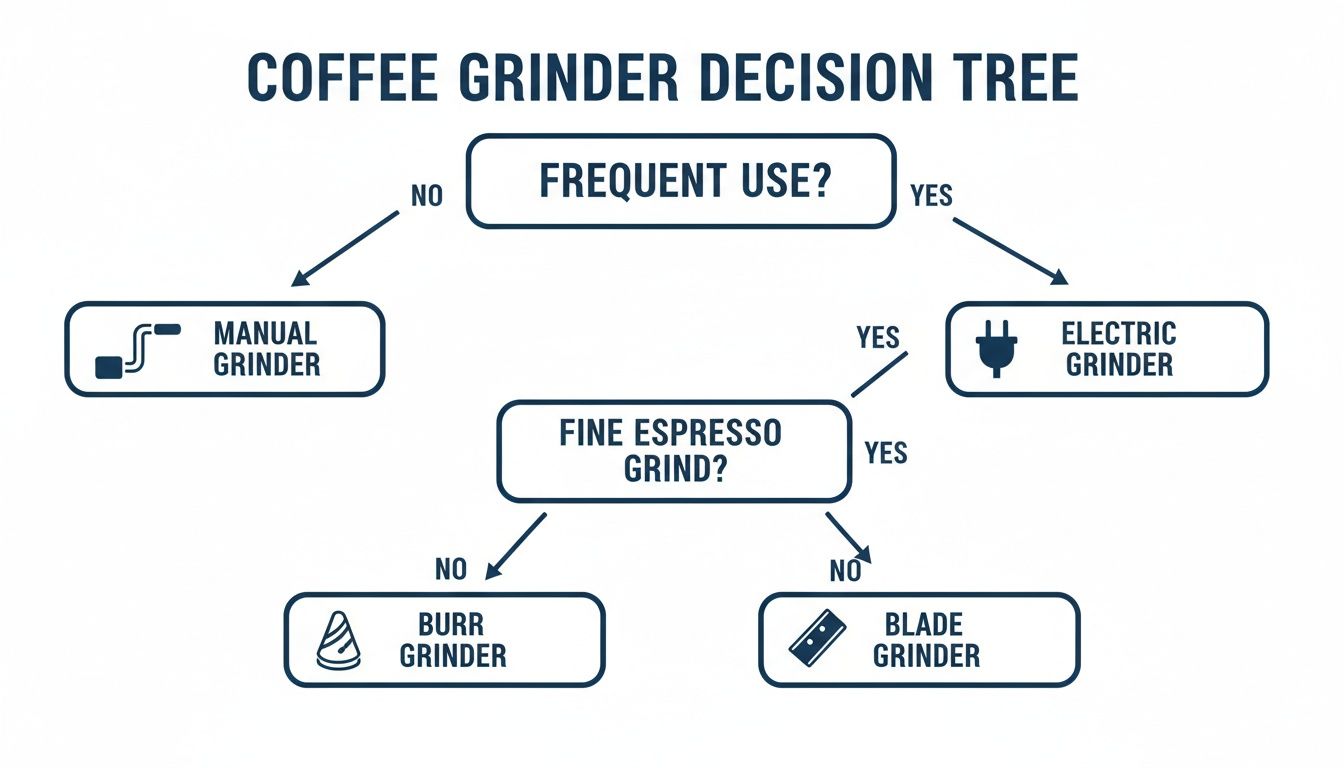
The flowchart breaks down the selection process, steering you towards a manual model if you value the ritual and portability, or an electric one if speed and convenience are top of your list.
Espresso: The Finest Grind
Espresso is the most demanding of all brewing methods. It requires a very fine, consistent grind that feels a bit like table salt. Because the water is blasted through the coffee puck under intense pressure in just 25-30 seconds, that fine grind is absolutely essential to create enough resistance for a proper extraction.
If your grind is too coarse, the water will just gush through, leaving you with a sour, watery shot. Too fine, and the water will choke, struggling to pass through and resulting in a bitter, burnt-tasting espresso.
Pour-Over and Drip: A Medium Grind
For popular methods like the V60, Kalita Wave, or a standard automatic drip machine, you’re aiming for a medium grind, often compared to the texture of granulated sugar. This size allows for a balanced flow rate, giving you a total brew time of around two to four minutes.
The grind size here is your primary tool for controlling extraction time. Going slightly finer will slow the water down, increasing the contact time and pulling more flavour from the grounds. A coarser setting will speed things up. This is where you can really start to play around to bring out the incredible notes in your Seven Sisters Coffee beans.
Your grinder gives you direct control over flavour. Too sour? Grind finer. Too bitter? Grind coarser. It’s that simple.
French Press and Cold Brew: The Coarsest Grind
Immersion methods, where the coffee grounds are left to steep in water for an extended period, demand a very coarse grind. For a French press, think of something like coarse sea salt or even breadcrumbs.
This coarse setting is vital for two main reasons. First, it prevents over-extraction during the long steep time (usually about four minutes). Second, it makes plunging and filtering much cleaner, dramatically reducing the amount of fine sediment, or "sludge," that makes its way into your cup. The exact same logic applies to cold brew, which steeps for 12-24 hours.
AeroPress: A Versatile All-Rounder
The AeroPress is a bit of a maverick. Its quick, pressure-assisted brewing works brilliantly with a massive range of grind sizes, from fine all the way to medium-coarse. This flexibility makes it incredibly forgiving and a fantastic brewer for experimentation.
You can use a finer, espresso-like grind to produce a short, concentrated shot, or go for a medium grind to create a longer, filter-style brew.
Ultimately, mastering your grinder is all about tasting, tweaking, and trusting your palate. To learn more about how each technique brings out different characteristics in your final cup, check out our guide on the best coffee brewing methods. Don't be afraid to experiment—that's how you'll discover the perfect settings to make every coffee you brew truly exceptional.
Answering Your Home Coffee Grinder Questions
Even when you've done your homework, picking out and using a coffee grinder can throw a few curveballs your way. Let's tackle some of the most common questions that pop up, with some practical advice to help you get the absolute best out of your grinder and brew fantastic coffee every single time.
How Often Should I Clean My Coffee Grinder?
If you're using your grinder every day, a quick clean every week or two is a great habit to get into. This doesn't have to be a major operation – just a simple brush-out of the hopper, chute, and burrs will do the trick. The goal is to get rid of any loose, dry grounds before they have a chance to build up.
About once a month, it's time for a proper deep clean. This is really important because coffee beans contain oils that, over time, stick to the burrs along with super-fine coffee dust. Eventually, these oils go rancid and will make your fresh, beautiful beans taste stale and bitter.
For this job, you'll want to use cleaning crystals made specifically for grinders. Something like Urnex Grindz is perfect. You just run the pellets through the machine like they're coffee beans, and they do a brilliant job of absorbing and dislodging all that old residue. Afterwards, grind a few grams of actual coffee to flush out any leftover cleaner, and you're good to go.
Whatever you do, never use water to clean the burrs themselves. They can rust in a heartbeat, and that will completely ruin your grinder. A clean grinder is non-negotiable if you want to taste the delicate, true notes of your coffee.
What Is Grind Retention and Why Does It Matter?
Grind retention is just a term for the leftover ground coffee that stays inside the grinder after you've finished. It might seem like a small detail, but it has a surprisingly big impact on how fresh your coffee tastes.
Some grinders, especially older or less thoughtfully designed models, can trap several grams of coffee in their chutes and around the burrs. When you grind your next coffee, these old, stale grounds get pushed out and mixed in with your fresh ones. If you only make a coffee or two a day, those trapped grounds could be hours, or even a full day, old – completely compromising the flavour you're trying to achieve.
This is why you'll hear people talk about "low-retention" or "zero-retention" grinders. They're designed to make sure that pretty much everything you put in, you get out. This is a massive plus if you like to switch between different beans or change your grind setting for different brew methods, as it guarantees you're getting maximum freshness in every single cup.
Can I Use One Grinder for Both Espresso and Filter Coffee?
The short answer is yes. Many modern grinders are built to cover the full range, from a coarse French press grind all the way down to a super-fine powder for espresso. That said, it's worth knowing the trade-offs when you're looking for one machine to do it all.
Grinders that are genuinely brilliant across that entire spectrum tend to come with a premium price tag. The Niche Zero Coffee Grinder is a perfect example; it's famous for letting you jump between settings effortlessly with almost zero grind retention.
More budget-friendly all-rounders can be fantastic for filter brewing but might lack the micro-adjustments and rock-solid consistency you need for a truly dialled-in espresso. If you do switch from a very coarse setting to a very fine one, it’s always smart to "purge" the grinder. Just run a few grams of beans through at the new setting to clear out any larger grounds left behind from the last brew.
Is a More Expensive Coffee Grinder Really Worth It?
Up to a point, yes – one hundred per cent. The jump in cup quality you'll experience going from a blade grinder to even an entry-level burr grinder is nothing short of night and day. It is, without question, the single best upgrade you can make to your entire coffee setup at home.
As you move up in price, you're not just paying for a brand name; you're paying for real, tangible improvements that make your coffee taste better. These include:
- Superior Build Quality: Better grinders use solid metal components instead of plastic. This means more stability, less wobble, and a machine that's built to last for years, not months.
- More Powerful Motors: A good motor doesn't have to spin like a jet engine. In fact, the best ones run at lower RPMs, which means less heat and static. This is crucial for preserving the delicate aromatic oils in your coffee.
- Larger, More Precise Burrs: Big burrs have more surface area, which means they can grind your coffee faster and more consistently, again with less heat. The engineering and materials used are also far superior, so they stay sharp and perfectly aligned for much longer.
For most of us brewing at home, the aim isn't to own the most expensive machine out there. It's about finding that sweet spot – investing in a quality burr grinder that gives you the consistency needed to unlock all the flavour packed into your beans. A great grinder makes sure your investment in freshly roasted, speciality coffee actually pays off in the cup.
Ready to unlock the true potential of your daily brew? Explore our curated collection of grinders at ADS Coffee Supplies and find the perfect match for your home coffee ritual. Discover the difference precision grinding makes by checking out our range of high-quality coffee grinders today.