Experience v60 drip coffee: Master Cafe-Quality Brews

The Hario V60 is a beautifully simple path to brewing exceptional coffee at home. It’s essentially a cone-shaped dripper, but it gives you an incredible amount of control over the final cup, which is why it has become such a beloved tool for anyone serious about unlocking the subtle flavours in high-quality beans.
The real magic is in its design. It’s what allows you to really get hands-on and master the art of pour-over brewing.
What Makes the V60 a Home Brewing Favourite?
More than just a dripper, the V60 has turned the daily coffee routine into a thoughtful craft for thousands of people. It’s a chance to step away from the automatic machine and take the reins, discovering a world of flavour that often gets lost in the process. This is precisely why it’s become the go-to brewer for so many coffee lovers across the UK.
The genius is hidden in a few key details:
- The Conical Shape: Its steep 60-degree angle channels water towards the centre of the coffee bed. This extends the contact time between the water and the grounds, ensuring a more thorough and balanced extraction.
- A Large Single Hole: Unlike other drippers that have several small holes, the V60 has one large opening. This feature is crucial because it means you control the flow rate with your pouring speed. A faster pour will give you a lighter-bodied coffee, whereas a slower, more deliberate pour creates a richer, fuller cup.
- Spiral Ribs: Look inside the cone and you'll see unique ridges spiralling up the sides. These aren't just for show; they create a small air gap between the filter paper and the dripper wall. This allows the coffee grounds to expand and ‘bloom’ properly, leading to a much cleaner and more nuanced flavour in the final brew.
The Perfect Partner for Speciality Coffee
This level of precision makes the V60 the ideal brewer for showcasing high-quality, single-origin beans where delicate notes can easily be overpowered or lost. At Seven Sisters Coffee Co., our oxygen-free roasting process is specifically designed to preserve these fragile flavour profiles. When you pair our beans with a V60, you're giving them the perfect stage to perform.
This desire for more control at home is part of a bigger picture. The UK coffee market's share of eating out turnover is expected to hit 7.1% by 2025, a clear sign of how much both café culture and sophisticated home brewing have boomed. You can dig deeper into this trend in Lumina Intelligence's market analysis.
While it shares some DNA with other manual brewers, the V60's unique design truly sets it apart. We dive into this more in our V60 vs AeroPress comparison guide.
Assembling Your V60 Brewing Toolkit
Before you can even think about that perfect V60 brew, you need to get your gear in order. Think of it as your brewing arsenal; every single piece plays a part in shaping the final cup, from flavour clarity to how much control you have over the extraction.
Getting this right from the start makes everything that follows so much easier.
The Core Four: Your V60 Essentials
You don’t need a lab full of equipment, but these four items are non-negotiable for getting consistently great results.
- Hario V60 02 Dripper: This is the heart of the setup. They come in plastic, ceramic, or metal, and your choice actually affects how the dripper handles heat. We'll get into that in a moment.
- Precision Gooseneck Kettle: That elegant spout isn't just for looks. It gives you surgical control over where your water goes and how fast it flows, which is absolutely vital for an even extraction.
- Digital Scale with Timer: Guesswork is the enemy of good coffee. A scale that measures to 0.1g is your best friend for nailing the coffee-to-water ratio every single time. Repeatability is key.
- Quality Burr Grinder: If you invest in one piece of kit, make it this. A good burr grinder produces uniform coffee grounds, which is the secret to avoiding a brew that’s simultaneously sour and bitter.
Choosing the Right Dripper Material
The material of your V60 isn't just about aesthetics; it changes how you brew.
Plastic is a brilliant starting point. It's forgiving, great for travel, and heats up almost instantly, giving you a very stable brew temperature right from the first pour.
Ceramic drippers look fantastic and are excellent at holding onto heat. This makes them ideal for longer, slower brews where maintaining a consistent temperature is crucial for a full extraction.
Then you have metal drippers, like copper or brass. They're built like tanks and transfer heat incredibly quickly, offering a robust and reliable brewing experience.
Match the dripper material to your brewing style and routine. It's a small detail that makes a surprisingly big difference to your extraction.
Filters and Grinders: The Unsung Heroes
It’s easy to overlook filters, but they are the gatekeepers of flavour clarity in your V60. The demand for quality filter paper in the UK is soaring, expected to make up 24.6% of the European market by 2025. This boom is part of a global obsession with pour-over coffee, a market set to grow from USD 448 million in 2023 to USD 736 million by 2032, with Hario’s V60 leading the charge. You can find more on this trend over at Statista's UK coffee market report.
We also have a detailed guide to Hario V60 filter papers size 02 at Seven Sisters Coffee.
As for the grinder, a quality burr model is essential to prevent "channelling" – where water finds the path of least resistance and bypasses most of the coffee. Conical burrs are generally considered the gold standard for producing consistently even grounds, which stops parts of your brew from being under-extracted while others are over-extracted.
Key Tools for Precision Brewing
A gooseneck kettle isn't just a recommendation; it’s fundamental. It allows you to pour in gentle, controlled spirals, ensuring the entire coffee bed gets saturated evenly. This controlled pour directly impacts the bloom, the speed of extraction, and the final body of the coffee.
Your digital scale is just as important. Weighing your coffee and water meticulously helps you hit that ideal 1:16 ratio. And timing the whole process, aiming for that 2:30–3:00 minute window, is what makes a great brew repeatable.
Precise measurements and a controlled, steady pour are the absolute cornerstones of consistent V60 coffee.
Here's a look at the kind of gear you'll want to have on your countertop.
Starting with quality tools like these from ADS Coffee Supplies simply makes your life easier and your coffee taste better. You'll get more predictable results from day one.
A Few Personal Toolkit Tips
From one coffee lover to another, here’s how I keep my brewing process smooth and enjoyable.
Keep your dripper, filters, and grinder all in one place. It sounds obvious, but it seriously cuts down on setup time when you're rushing in the morning.
I also like to label my grinder settings on a small sticker next to each bag of beans. It helps me remember the perfect grind size for that specific coffee without having to dial it in every single time.
A streamlined workspace makes brewing faster and a lot more fun.
Now that your toolkit is sorted, let's move on to the good stuff: fine-tuning these tools with our tried-and-tested Seven Sisters pour-over method.
Mastering the Seven Sisters Pour Over Method
This is where the magic really happens. A truly great pour over isn't about following rigid rules like a robot; it’s about understanding the ‘why’ behind each part of the process. We’ll walk you through our tried-and-tested technique, covering everything from the setup to that final, satisfying pour. The goal is to give you the confidence to craft a brilliant cup, every single time.
Believe it or not, the process starts well before water ever touches the coffee. It all begins with your grind and your ratio. Nailing these two things lays the foundation for everything that follows, so getting them right is non-negotiable if you want a balanced, flavourful brew.
Setting the Stage for a Perfect Brew
First things first, let's lock in the coffee-to-water ratio. A fantastic starting point that we always come back to is 1:16. In simple terms, for every 1 gram of coffee, you'll want 16 grams (which is the same as 16ml) of water. For a single, generous cup, that usually looks like 15g of coffee to 250g of water. This ratio strikes a perfect balance between strength and clarity, really letting the coffee's unique character shine.
Next up is the grind. For a V60, you're aiming for something that looks and feels like table salt—a solid medium-fine grind. If you go too coarse, the water will just rush through, leaving you with a weak, sour, and under-extracted cup. On the flip side, go too fine, and the water will get stuck, leading to a bitter, over-extracted mess. If you want to get really nerdy about it, our comprehensive coffee grind size guide will help you dial in the perfect setting on your grinder.
Once your coffee is ground and weighed, it's time to prep the V60 itself.
- Pop the V60 dripper on top of your favourite mug or server.
- Fold your filter paper along its seam and settle it into the cone.
- Give that paper a thorough rinse with hot water.
This rinse is a game-changer for two reasons. Firstly, it washes away any of that papery taste from the filter. More importantly, it preheats the V60 and whatever you're brewing into. A warm brewer stops the water temperature from crashing on contact, creating a much more stable environment for a clean extraction.
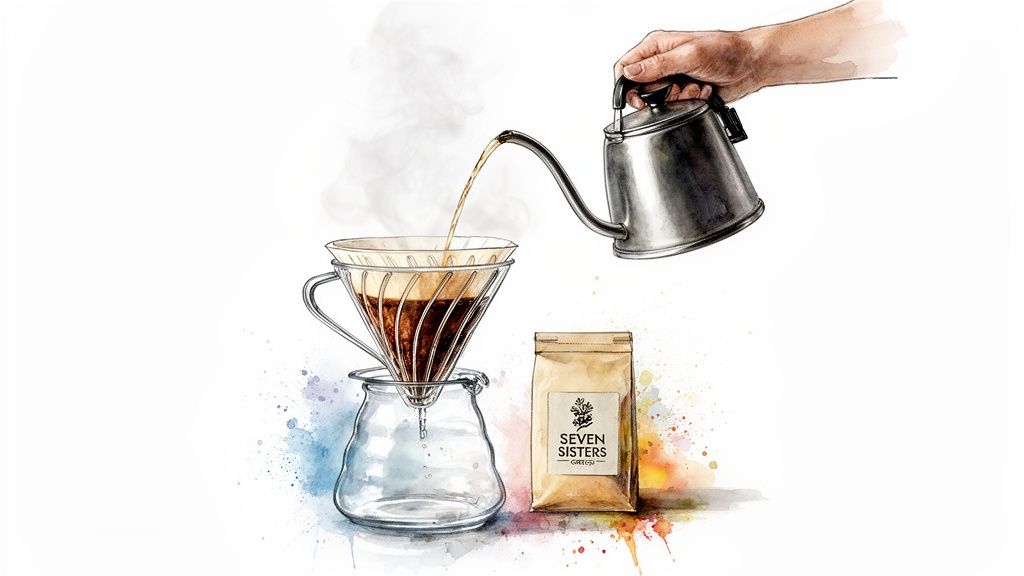
The simple diagram below shows the essential kit you'll be working with.
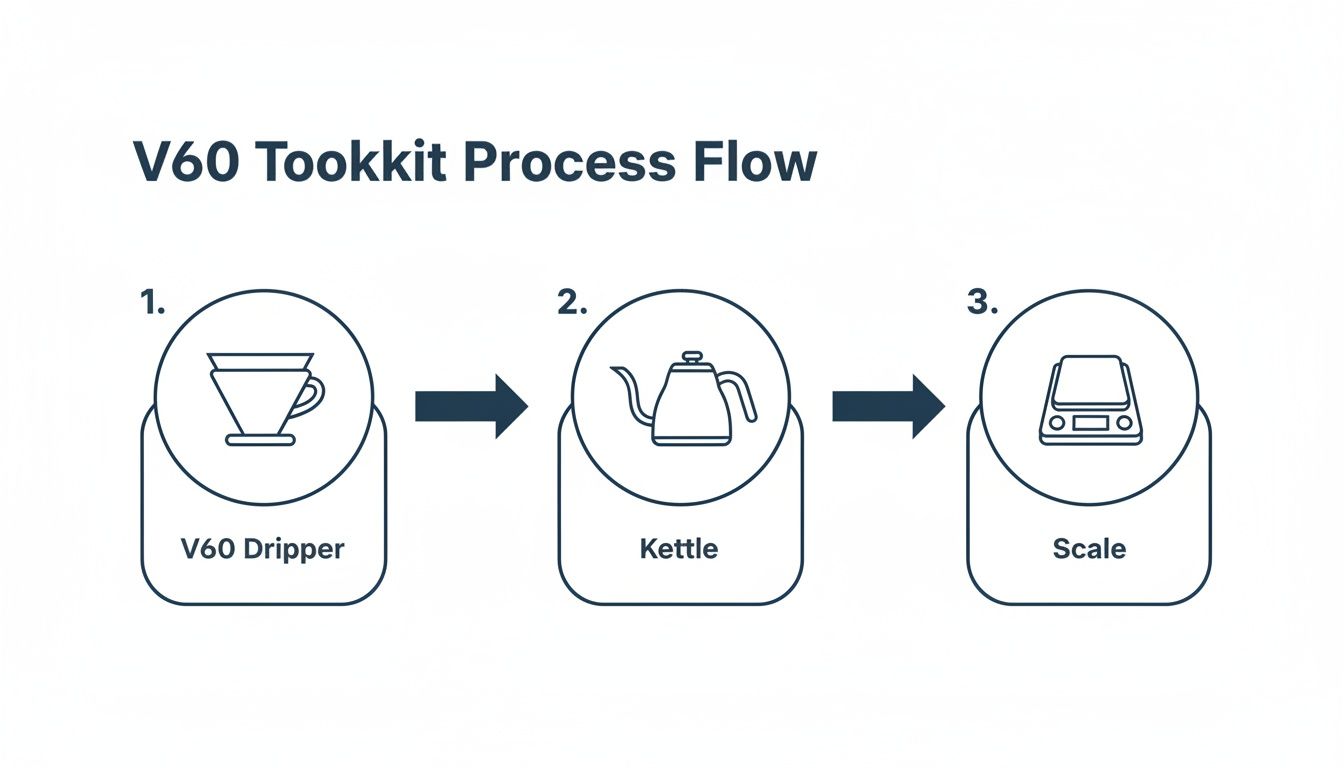
This highlights the holy trinity of pour over: the V60 dripper, a gooseneck kettle for precision, and a digital scale for accuracy. Together, they give you total command over the brew.
For a quick reference, here are the core parameters we've just discussed.
V60 Brewing Recipe Quick Reference
| Parameter | Recommendation | Why It Matters |
|---|---|---|
| Coffee Dose | 15g | The foundation of the recipe's strength and flavour. |
| Water Weight | 250g | Ensures the correct ratio for a balanced extraction. |
| Ratio | 1:16 | A classic starting point for optimal strength and clarity. |
| Grind Size | Medium-Fine (like table salt) | Controls the flow rate and total extraction time. |
| Water Temp | 92-96°C | Ideal range to extract desirable compounds without scorching. |
| Brew Time | 2:30 – 3:00 mins | A key indicator of a well-dialled-in grind and pour. |
This table acts as a great cheat sheet when you're just getting started or need a quick reminder.
The Bloom and the Pour
Right, this is the most critical part: the bloom. After you’ve tipped out the rinse water, add your ground coffee to the filter. Give the dripper a gentle tap to create a nice, level bed of coffee. Place it all on your scale, hit 'tare' to zero it out, and start your timer.
Now, pour just enough hot water to completely saturate the grounds—about double the weight of your coffee, so 30-40g for our 15g dose. You’ll see the coffee bed puff up and bubble as it releases trapped CO2. This 30-second bloom is absolutely essential. It prevents water from just finding dry pockets and channelling through later, ensuring a much more even extraction.
A well-executed bloom is the secret to unlocking a coffee's full flavour spectrum. Rushing this stage is probably the most common mistake home brewers make.
Once those 30 seconds are up, it's time for the main pour. Using your gooseneck kettle, start pouring in a gentle, steady, circular motion. Work your way from the centre outwards and then back in again, but try to avoid pouring directly onto the paper filter itself. The goal here is to keep a consistent water level and gently agitate the grounds so they are all extracting evenly.
You should aim to have poured all of your water (up to the total of 250g) by about the 1:30 minute mark. Control and consistency are everything. A slow, graceful pour is far more effective than just dumping the water in.
Keep an eye on the visual cues. The stream of coffee dripping from the cone should look like a mouse's tail—thin and steady. If the whole thing is over too quickly (under two minutes), your grind is likely too coarse. If it's dragging on (over three minutes), chances are your grind is too fine. The sweet spot for a total brew time is around 2 minutes and 30 seconds. This is more of a guideline than a hard rule, but it's a fantastic target for a balanced and deeply satisfying v60 drip coffee.
By mastering these phases, you're not just making coffee; you're engaging in a rewarding craft.
Finding the Perfect Coffee for Your V60
The V60 is a remarkable bit of kit for one simple reason: it reveals a coffee's true personality. Its design is brilliant at highlighting the subtle, complex, and vibrant notes that make speciality coffee so exciting in the first place. Choosing the right beans isn't about finding a single "best" option, but about matching the coffee's inherent flavour profile to the experience you want to create.
Think of this as your guide to exploring flavour with Seven Sisters coffee. The clean extraction of a v60 drip coffee brew means every nuance, from bright citrus to deep chocolate, gets its moment to shine.
Matching Beans to Your Palate
The beans you choose will completely transform your V60 experience. Different origins, processing methods, and roast levels all bring unique characteristics to the table that the V60 is perfectly suited to amplify. This is your chance to discover what you really enjoy in a cup.
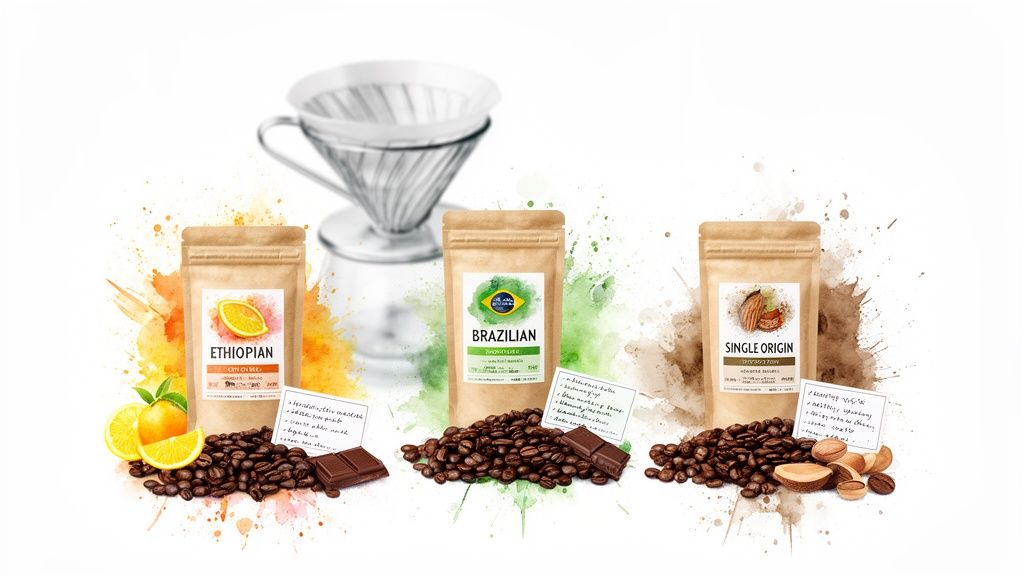
For instance, if you love a bright, lively, and almost tea-like coffee, an Ethiopian Yirgacheffe is an exceptional choice. The V60’s clean brewing process brings its naturally vibrant notes of lemon, bergamot, and delicate florals right to the forefront. The resulting cup is crisp, aromatic, and absolutely full of life.
On the other hand, if you’re leaning towards a smoother, more comforting brew, our Brazilian Santos is an excellent partner for your V60. This coffee offers a completely different world of flavour, with rich, nutty notes of chocolate and caramel. It produces a cup with a fuller body and a wonderfully mellow, satisfying finish.
The V60 doesn't create flavours; it reveals them. Your choice of beans is the single most important factor in determining the final character of your brew.
Tweaking Your Brew for Different Beans
Once you've picked your coffee, you can refine the flavour even further with small adjustments to your brewing variables. This is where you can truly start to play, bringing out the absolute best in each specific bean.
Consider these adjustments as your flavour dials:
- For Fruity, Light Roasts (like Ethiopian): These coffees often benefit from a slightly higher water temperature, around 96°C. That extra heat helps to properly extract their delicate and complex acidic compounds, unlocking more of that bright, fruity character.
- For Richer, Medium Roasts (like Brazilian): For beans with chocolatey and nutty profiles, try dropping the temperature to around 92°C. This helps to avoid over-extracting any bitter notes, promoting a smoother, sweeter, and more balanced cup.
Your grind size also plays a massive role. A slightly finer grind can help you pull more sweetness and complexity from a light roast that tastes a little too acidic. Conversely, going a touch coarser can mellow out a darker roast that's tasting a bit too intense or bitter. Don't be afraid to make tiny changes to your grinder setting between brews; it's the best way to learn how each coffee responds.
Exploring different beans is one of the most rewarding parts of the coffee journey. You can browse our full range of single-origin and blended options in our collection of speciality coffee beans to find your next favourite. Each one offers a unique story and a distinct flavour profile just waiting to be discovered with your V60.
How to Fix Common V60 Brewing Issues
Even with years of experience, every so often a brew just doesn't hit the mark. It happens to all of us. Instead of getting frustrated, I’ve learned to see these moments as the best way to sharpen my skills. Figuring out what went wrong is exactly how you build the instinct and consistency needed to master the V60.
Let’s walk through how to diagnose and fix the most common problems that stand between you and a perfect cup.
Nine times out of ten, a disappointing brew boils down to one of two things: under-extraction or over-extraction. Each leaves a very clear signature in the cup, making it easy to spot and correct once you know what you’re looking for.
Is Your Coffee Sour or Weak?
If your coffee tastes unpleasantly sharp, almost like a tart lemon, or it feels disappointingly thin and watery, you're looking at under-extraction. All this means is the water didn't have enough time or energy to pull out all the good stuff—the sugars and deeper flavours—from the coffee grounds. It just grabbed the easy-to-dissolve sour compounds and ran.
To fix this, we need to increase extraction. Here are the levers you can pull:
- Grind Finer: This is your most powerful tool. A finer grind creates more surface area for the water to work with, slowing down the flow and giving it more time to extract all those lovely, sweet flavours.
- Increase Water Temperature: Hotter water has more energy to dissolve the coffee solids. Make sure your kettle is hitting that sweet spot between 92-96°C. For a proper deep dive, check out our guide on finding the best water temperature for coffee.
- Pour Slower: A gentle, more controlled pour will naturally extend the total brew time, giving the water more contact with the grounds.
Is Your Coffee Bitter or Harsh?
On the flip side, if a brew tastes overwhelmingly bitter, astringent, and leaves your mouth feeling dry and hollow, that's a classic sign of over-extraction. It’s the exact opposite problem: the water hung around for too long and pulled out too much, including the unpleasant, bitter compounds that are best left in the grounds.
The goal here is simple: reduce the overall extraction.
- Grind Coarser: This should be your first adjustment. A coarser grind lets water flow through the coffee bed much faster, cutting down the contact time.
- Use a Quicker Pour: Speeding up your pour can significantly shorten the brew time, preventing the water from lingering and pulling out those bitter notes.
Think of troubleshooting as a balancing act. Always change just one thing at a time—like grind size—to see its direct effect. This methodical approach is the fastest way to get your recipe dialled in perfectly.
The passion home brewers show for perfecting their V60 technique is part of a much bigger picture. The UK's professional drip coffee machine market hit USD 4.3 million in 2024 and is expected to climb to USD 7.0 million by 2033. This growth in the pro scene inspires coffee lovers to chase that café-quality brew at home, contributing to the staggering 98 million cups of coffee we drink daily in the UK. You can read more on these professional coffee market trends and insights at grandviewresearch.com.
Your V60 Drip Coffee Questions Answered
To wrap things up, let's tackle some of the most common questions that pop up when you're getting to grips with the V60. Think of these as the finishing touches that can elevate your technique from good to truly great, helping you understand the why behind the brew.
What is the Best Water Temperature for V60?
The sweet spot for your water is between 92-96°C. If you’re brewing a lighter roast, pushing towards the higher end of that range really helps to unlock those delicate floral and fruit notes. For darker roasts, I’d pull it back a bit, aiming for around 92°C to avoid drawing out any harsh, bitter flavours.
Don't have a fancy temperature-controlled kettle? No problem. Just bring your water to a full boil, then let it sit for about 30-60 seconds before you start your pour. That'll get you right in the zone. If you are looking to upgrade, a good gooseneck kettle from ADS Coffee Supplies is a game-changer for control.
How is V60 Coffee Different from a Chemex Brew?
It all comes down to the design of the dripper and the thickness of the filter paper, which completely changes the final cup. The V60 has a large single hole and uses a thinner filter, which encourages a faster flow rate. This puts more control in your hands and generally brews a cup with a lighter body and clean, vibrant flavours.
A Chemex, on the other hand, uses a much thicker paper filter. This clever design removes more of the coffee oils, resulting in an exceptionally clean and heavier-bodied brew. The trade-off is that it can sometimes mute some of the more subtle, complex notes in the coffee. It really boils down to personal preference: do you want clarity and brightness (V60), or a super-clean, full-bodied cup (Chemex)?
The V60 gives the brewer more direct control over flow rate, making it a fantastic tool for exploring how small changes affect the final cup's flavour profile.
Can I Brew More than One Cup at a Time?
Absolutely. Hario makes the V60 in a few different sizes for this very reason. The '01' is designed for a perfect single cup, the '02' is the most popular size and is ideal for 1-4 cups, and the larger '03' can handle batches for 3-6 people. For most home brewers, the versatile Hario V60 02 Dripper offers the best flexibility.
When you're brewing a bigger batch, the main trick is to coarsen up your grind slightly compared to what you'd use for a single cup. This simple adjustment stops the brew from dragging on for too long and over-extracting. Just remember to scale up your coffee and water to maintain your ratio (like 1:16), and you'll get a brilliant v60 drip coffee experience, no matter how many you're brewing for.
Ready to start your V60 journey? Explore the full range of brewing equipment and freshly roasted beans at Seven Sisters Coffee Co and discover the perfect setup to match your taste. Shop our V60 collection now.