Coffee From Indonesia: Discover coffee from indonesia, flavours & brewing tips
Picture an archipelago of over 17,000 volcanic islands, each producing coffee with its own unique story. This is the world of Indonesian coffee—one of the most diverse and vital coffee-producing nations on Earth, responsible for some of the most distinctive flavours you'll ever experience.
Your Journey into Indonesia's Coffee Archipelago
This guide is your passport to what makes Indonesian coffee so special. We'll explore how the unique combination of volcanic soil, a tropical climate, and distinct farming traditions—what the experts call terroir—creates a spectacular spectrum of flavours.
From the deep, earthy notes of Sumatra to the bright, clean tastes of Flores, the variety is astounding. To truly appreciate this coffee, it helps to understand the rich culture and geography of the country itself; you can learn more about Indonesia to get a better sense of place.
We've designed this guide to be your map for this adventure, covering everything you need to know.
What You Will Discover
In the sections ahead, we will explore:
- The Famous Coffee Islands: A flavour tour of key regions like Sumatra, Java, and Sulawesi.
- The Secret to the Flavour: Uncovering the unique wet-hulling process, or 'Giling Basah'.
- Perfect Brewing at Home: Practical tips for getting the best out of your beans.
- Our Sourcing Promise: How ADS Coffee Supplies brings these exceptional coffees to you.
Whether you're new to the world of speciality coffee or a seasoned enthusiast, you'll gain a deeper appreciation for these beans. Our passion is to bring these exceptional coffees directly to your cup, ensuring every sip tells a story of its origin.
This journey is all about connection—from the farmer to the roaster to your morning ritual. By the end, you'll not only understand what makes these coffees distinct but also feel more confident in selecting the perfect brew.
If you're eager to start exploring, you can browse our curated selection of single-origin coffee beans to see what we currently have on offer from this fascinating region and beyond. Your next favourite cup is waiting to be discovered.
A Flavour Tour of Indonesia's Famous Coffee Islands
When you think of Indonesian coffee, what comes to mind? For many, it’s a deep, earthy, and bold flavour. But that's just one note in a complex chord. The archipelago is a mosaic of coffee-growing islands, each with its own unique microclimate, volcanic soil, and centuries of tradition that shape the beans in remarkable ways.
To truly understand Indonesian coffee, you have to think of it not as one origin, but as many. Let's take a quick trip across the key islands to discover the personality in every cup.
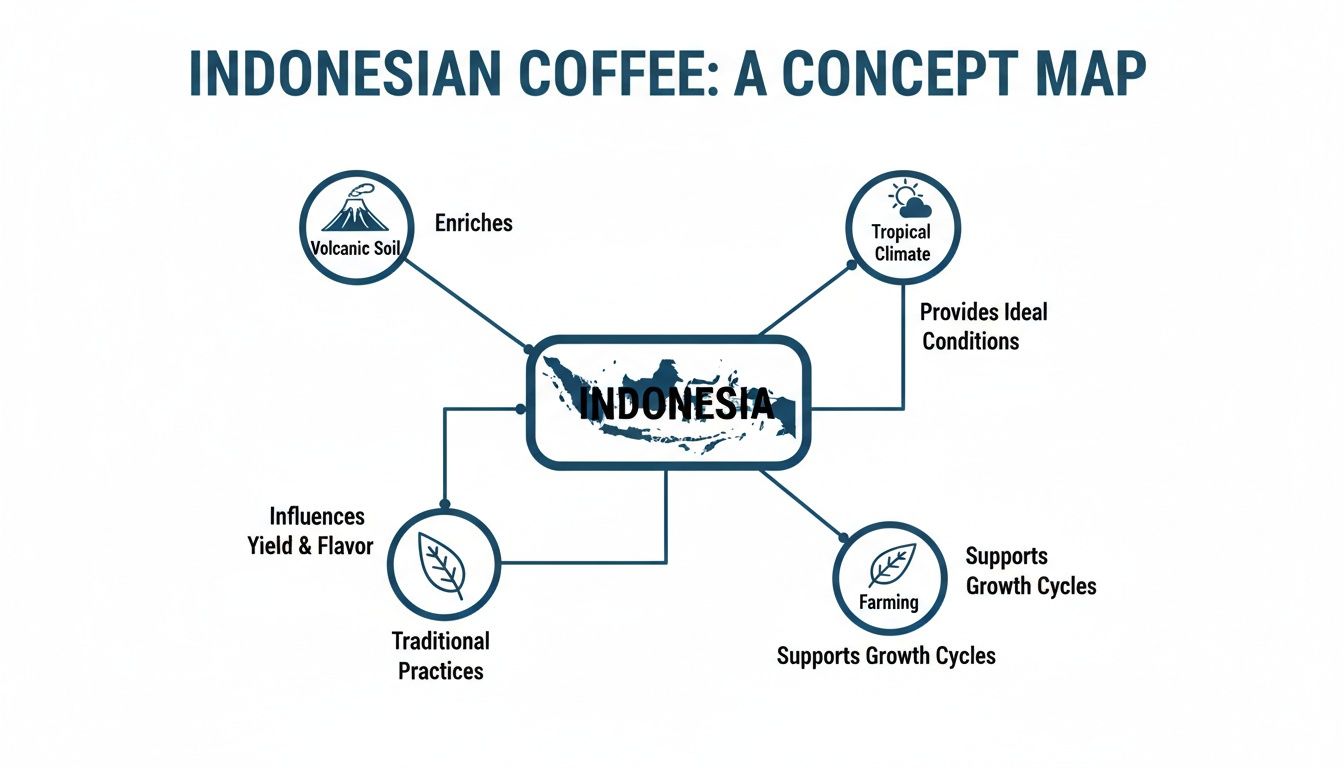
As the map illustrates, it's the interplay between rich volcanic earth, a humid tropical climate, and specific local farming methods that sets the stage for the diverse flavours we're about to explore.
Sumatra: The Bold and Earthy Giant
If there’s one island that defines the classic Indonesian profile, it’s Sumatra. This is home to legendary names like Mandheling and Aceh, coffees celebrated for their heavy, almost syrupy body and profoundly earthy notes.
Thanks to a characteristically low acidity, Sumatran beans let deep flavours of dark chocolate, cedar, and rich soil shine through. It’s an intense, brooding cup of coffee, and an absolute favourite for those who want their brew to pack a punch.
Java: The Historic and Balanced Classic
Java is where the story of Indonesian coffee began, with the Dutch introducing coffee plants way back in the 17th century. Javanese coffees offer a more classic, well-balanced profile, tasting much cleaner than their wilder Sumatran cousins.
Here, you can expect a satisfying medium body with smooth notes of nut, caramel, and a subtle herbaceous finish. It’s an incredibly approachable coffee that acts as a perfect bridge between the boldness of Sumatra and the brightness of other islands.
Sulawesi: The Complex and Vibrant Star
Head northeast to the island of Sulawesi, and you’ll find the celebrated Toraja coffees. These beans are prized for their wonderful complexity, striking a beautiful balance between a full body and a much more vibrant acidity.
The flavour profile here is often more nuanced, revealing notes of ripe dark fruit, bittersweet chocolate, and warm spices like cinnamon or clove. It’s a coffee that really rewards mindful sipping, as new layers seem to emerge with every taste.
Bali and Flores: The Bright and Floral Newcomers
The volcanic islands of Bali and Flores represent the brighter side of Indonesian coffee. Thanks to their incredibly rich soil and a greater willingness to experiment with processing methods, these regions produce beans with a distinctly different character.
Here, the flavour profiles are lighter and more aromatic. You’ll discover citrusy, floral, and sometimes sweet, syrupy notes that offer a refreshing contrast to the heavier, earthier coffees from the larger islands.
This incredible diversity creates a dynamic market, even here in the UK. The import value of coffee from Indonesia can swing dramatically, peaking at over USD 7.23 million one month and dropping the next, reflecting the shifting demand for these unique origins. For roasters, it means that while these coffees are prized, securing consistent lots requires careful planning. You can see more data on these UK import trends on CEIC.
For those just starting their journey with these flavours, here's a quick cheat sheet to help you navigate the islands.
Indonesian Coffee Regions at a Glance
This table offers a quick reference to the main flavour profiles you can expect from each of Indonesia's primary coffee-growing regions.
| Region | Primary Tasting Notes | Acidity | Body |
|---|---|---|---|
| Sumatra | Earthy, dark chocolate, cedar, spice | Low | Heavy, syrupy |
| Java | Nutty, caramel, herbaceous | Medium | Medium |
| Sulawesi | Ripe fruit, dark chocolate, warm spice | Vibrant | Full |
| Bali & Flores | Citrus, floral, sweet syrup | Bright | Light to Medium |
Of course, the best way to understand the differences is to taste them for yourself.
A great place to start is with a Coffee Taster Pack. Sampling beans from various origins side-by-side is the quickest way to find out which island's profile speaks to you. It’s the perfect way to take your own flavour tour.
The Secret Behind Indonesia's Unique Coffee Flavours
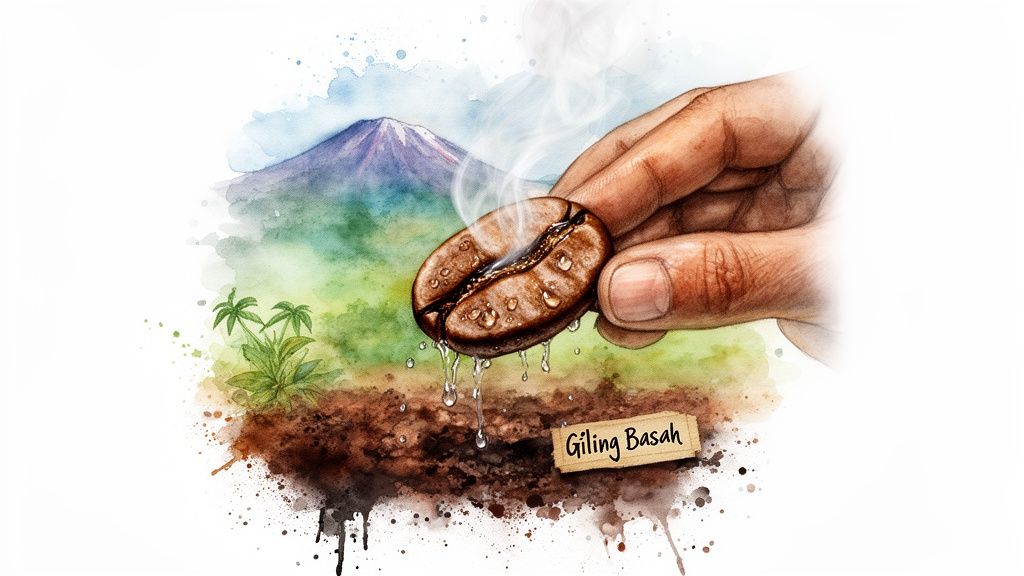
Ever wondered why a cup of Sumatran coffee feels so full-bodied and tastes so distinctly earthy? The secret is a unique processing method called Giling Basah, or wet-hulling. It's the key that unlocks those deep, wild flavours that have made coffee from Indonesia famous across the globe.
Think of it this way: most coffee beans are dried fully while still protected by their parchment layer, almost like leaving a seed inside its shell. Giling Basah flips this on its head. The parchment is stripped off while the bean is still damp, with a moisture content of around 30-50%.
This unusual step, born out of Indonesia's humid climate, exposes the raw bean to the elements much earlier. It’s a move that completely changes its chemical makeup and, ultimately, the taste in your cup.
Giling Basah: The Wet-Hulling Method
This process wasn't designed in a lab; it was a clever, practical solution to Indonesia's damp, tropical environment. Traditional drying methods would be far too slow, risking mould and rot. So, instead of fighting the humidity, farmers learned to work with it.
By removing the parchment early, the beans dry much faster. But this shortcut comes with a trade-off: the exposed, vulnerable beans absorb characteristics from everything around them. This is what creates that signature Indonesian profile—a heavy, syrupy body, muted acidity, and complex notes of earth, cedar, and spice.
It’s a hands-on method that forges a direct link between the farmer’s work and your morning brew. Every step is a deliberate choice that shapes the coffee’s personality, showcasing the expertise behind every bag from ADS Coffee Supplies.
As roasters here in the UK, understanding these methods is vital. When sourcing high-value single-origin Arabica, we pay close attention to how the coffee was processed. Techniques like wet-hulling are what dictate the flavour and, ultimately, the experience for coffee lovers across the UK.
How Processing Changes Everything
While Giling Basah is iconic, it’s not the only method you'll find in Indonesia. Looking at the alternatives really puts its unique character into perspective:
- Washed Process: Here, all the fruit pulp is washed off the bean before it's dried. This creates a clean, bright cup that lets the coffee's natural acidity and floral or fruity notes shine through.
- Natural Process: With this method, the entire coffee cherry is dried intact. The fruit's sugars ferment and seep into the bean, resulting in a sweet, fruity, and often wine-like flavour.
Each technique has a profound impact on the final taste. For a deeper look into how we perceive these nuances, understanding what is a flavor profile is a great place to start. The choice of processing is just as important as the roast itself, which you can learn more about in our guide on https://sevensisterscoffee.co.uk/coffee-roasting-profiles-explained-master-every-brew/.
How to Perfectly Brew Indonesian Coffee at Home
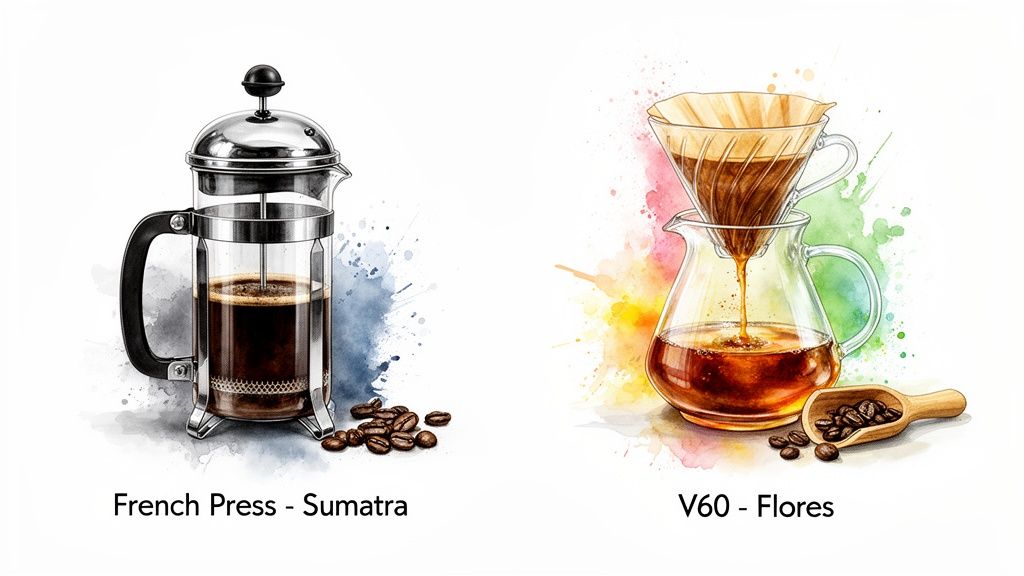
This is where all that knowledge about Indonesian coffee comes alive. The secret to a truly great cup is matching your brewing method to the bean's character, unlocking all the incredible work the farmers and roasters have put in.
We’re not just making coffee here; we're trying to do justice to each unique origin. A heavy, earthy Sumatran needs a completely different touch than a bright, floral bean from Flores. This guide will give you the confidence to brew a café-quality cup right in your own kitchen.
Cafetière for Full-Bodied Sumatran and Javanese Coffee
When you've got beans with a heavy, syrupy body and those deep, earthy notes, the Cafetière (or French Press) is your best friend. Its full-immersion brewing and metal filter are key, as they let all the coffee's natural oils and fine particles into the cup. The result? A rich texture and an intense, satisfying flavour.
This method is a perfect match for the classic profiles of Sumatran and Javanese coffees. Instead of stripping away their signature boldness, it enhances it, delivering that truly full-bodied experience these beans are famous for.
Here’s a solid starting point for your brew:
- Grind: Coarse, like the texture of rough sea salt.
- Ratio: Use 60 grams of coffee for every 1 litre of water.
- Water Temperature: Just off the boil is perfect, around 94°C.
- Brew Time: Let it steep for a full 4 minutes before you slowly press the plunger.
The full immersion of the Cafetière is what makes it so good for these coffees. It guarantees a complete extraction, which is exactly what you need to pull out those deep chocolatey, spicy, and earthy notes.
V60 for Brighter Coffees from Flores and Bali
On the other hand, if you're working with a lighter, more delicate coffee from Indonesia—think beans from Bali or Flores—a pour-over brewer like the V60 is the way to go. Its iconic cone shape and large opening create a faster brew that really makes the coffee’s brightness and clarity pop.
The paper filter used in a V60 traps most of the oils and sediment. What you're left with is an exceptionally clean, crisp cup that lets all the nuanced floral, citrus, and sweet notes shine through. It's the ideal way to explore the more subtle side of Indonesian coffee.
Try these settings to get going:
- Grind: Medium-fine, closer to the consistency of table salt.
- Ratio: The 60 grams of coffee to 1 litre of water is still a great rule of thumb.
- Water Temperature: Again, stick to around 94°C.
- Brew Time: You’re aiming for a total brew time of about 2:30 to 3:00 minutes.
Getting the hang of a pour-over can take a bit of practice, but the delicious results are more than worth it. For a more detailed walkthrough, have a look at our guide on brewing with a V-60 coffee pour-over. Don't be afraid to experiment with these recipes until you find what tastes best to you.
Our Commitment to Sourcing Exceptional Indonesian Coffee
Bringing an exceptional Indonesian coffee to your cup is about so much more than just finding a great bean. For us, it’s a story of partnership, precision, and a deep respect for the entire journey—from the volcanic slopes of the archipelago right through to your morning brew. At ADS Coffee Supplies, this philosophy is the bedrock of everything we do.
Our commitment really starts with traceability. We believe you should know the story behind your coffee, which is why we build strong, direct relationships with the farmers and cooperatives on the ground. This connection isn't just about guaranteeing quality; it’s about supporting the very communities that produce these incredible coffees. If you want to dive deeper into what this means, check out our guide on what Fair Trade coffee really involves.
The ADS Coffee Supplies Roasting Difference
Sourcing the finest green coffee is only half the battle. The real magic happens in the roaster, and to preserve the rich, complex flavours of Indonesian beans, we use a unique oxygen-free roasting process. By carefully controlling the environment, we prevent the delicate flavour compounds from breaking down through oxidation.
It’s a technique we’ve calibrated to enhance the deep, earthy notes of a Sumatran or coax out the bright, floral character of a coffee from Bali. This meticulous approach allows us to unlock the full potential of every single bean, delivering a cleaner, more vibrant taste profile.
A Focus on Speciality
The UK market for Indonesian coffee is an interesting one. Indonesia produces a staggering 600,000–750,000 metric tons of coffee each year, yet only a tiny fraction of that ever makes it to our shores. For UK roasters, this means Indonesian lots are almost exclusively sourced as high-quality speciality offerings. We focus on securing these premium single-origin Arabica beans, prized for their distinct character and ability to capture the imagination. You can get a sense of these UK coffee import volumes from Statista.
This is our promise to you: every bag of coffee from Indonesia that we offer is a product of careful selection and precise roasting. We invest in quality and sustainability not just because it creates a better cup, but because it helps secure a brighter future for coffee.
By supporting initiatives like World Coffee Research, we’re doing our part to contribute to a more sustainable coffee industry for generations to come. It’s a commitment that ensures your daily ritual is one you can feel truly good about.
Time to Start Your Indonesian Coffee Adventure
So, there you have it. You’ve journeyed with us through the islands, gotten to grips with the unique processing methods, and picked up a few brewing secrets along the way. Now, all that’s left is to dive in and experience the incredible diversity of coffee from Indonesia for yourself. Think of this guide as your passport to one of the world’s most fascinating coffee origins—we hope it’s left you inspired to keep exploring.
At ADS Coffee Supplies, we’re here to be your guide on this journey. We invite you to explore our carefully curated selection of single-origin beans, where each one tells the story of its island home. Your next favourite cup is just waiting to be discovered.
Embarking on your Indonesian coffee journey is about more than just taste; it's about connecting with a rich culture and a unique history. Let every sip transport you to the volcanic slopes of Sumatra or the bright shores of Bali.
Ready to put your newfound knowledge to the test? Browse our full range of speciality coffee beans and find the perfect brew to begin your adventure today.
Your Indonesian Coffee Questions Answered
To wrap things up, let's tackle a few common questions we get asked all the time about Indonesian coffee. These quick insights should clear up any lingering mysteries and help you feel even more confident as you dive into this incredible coffee origin.
What Makes Indonesian Coffee Different From South American Coffee?
The biggest difference comes down to the flavour you get in the cup, which is a direct result of the unique volcanic soil, humid climate, and special processing methods found across the islands. Coffees from Indonesia, particularly Sumatra, are famous for their full body, low acidity, and deep, earthy notes like dark chocolate or cedar.
South American coffees from places like Colombia or Brazil, on the other hand, tend to be much brighter. They usually have a zippier acidity and more forward-facing nutty, caramel, or fruity flavours, offering a completely different kind of tasting experience.
Is Sumatran Coffee Always Dark Roasted?
This is a classic myth we're happy to bust. While the rich, earthy character of a good Sumatran bean can absolutely stand up to a darker roast, a truly high-quality single-origin Sumatra often shines brightest with a medium roast profile.
A carefully handled medium roast allows the bean's inherent tasting notes of dark chocolate, cedar, and spice to come through without being overpowered by any burnt or overly "roasty" flavours. Here at ADS Coffee Supplies, we dial in our roast for each specific bean to bring out its absolute best.
What Is The Best Way To Store Indonesian Coffee Beans?
Great question, because proper storage is everything when it comes to preserving those amazing flavours. The golden rule is simple: keep your beans in an airtight container at room temperature, and make sure it's away from direct sunlight, heat, and moisture. For some top-notch storage ideas, you can browse these coffee accessories.
Whatever you do, avoid the fridge or freezer. The moisture and condensation will wreak havoc on the delicate oils that give coffee its incredible aroma and taste, turning a complex Indonesian bean into a flat, disappointing brew.
Finally, always remember that whole beans stay fresh much, much longer than ground coffee. Grinding your beans just moments before you brew is the single most effective thing you can do to guarantee a flavour-packed cup every single time. If you're in the market for a new grinder, have a look at the brilliant options in our coffee grinders section.
At ADS Coffee Supplies, we're completely obsessed with sourcing and roasting the finest Indonesian coffees for you to enjoy. Explore our collection today and discover a world of flavour. Pop over to https://ads-coffee-supplies.co.uk to find your next favourite brew.