Best Water for Coffee UK (tap vs filtered): A Guide to Better Brews

Let's get one thing straight: if you want the best water for coffee in the UK, filtered is consistently better than tap. It’s a simple truth. While you can absolutely trust that your tap water is safe to drink, its journey through the UK's varied geology means its mineral content is a total lottery. For the consistency needed to unlock the real flavour of your coffee, filtered is the only way to go.
After all, your coffee is over 98% water. It’s the most significant ingredient in your brew, yet it's almost always the most overlooked.
Why Water Is Your Most Overlooked Coffee Ingredient
Many home baristas will happily splash out on high-end grinders and specialty beans but then pour straight from the tap, completely neglecting the single largest component of their drink. The chemical makeup of your water is what dictates which flavour compounds are pulled from the coffee grounds. In short, it’s the very foundation of every cup you make.
This isn’t about safety. UK tap water meets incredibly strict standards under the Water Supply (Water Quality) Regulations. But its suitability for brewing is a whole other story. Regional hardness levels are the real villain here, with places like the South East having notoriously hard water that’s packed with minerals.
Even in softer areas, the numbers can be surprising. Data from North West Lakes shows that total hardness can still average 136.54 mg/l, which is more than enough to cause limescale build-up in your machine and leave your coffee tasting flat and chalky. It’s well worth exploring your local water quality reports to see what you’re dealing with.
Key Water Components Affecting Flavour
There are three main culprits in your water that can either help or hinder your coffee’s flavour. Getting your head around these is the first step towards brewing cafe-quality coffee at home.
- Total Dissolved Solids (TDS): This is the measure of all the minerals, salts, and metals dissolved in your water. Too low, and your coffee will taste thin and sour. Too high, and it will be dull, heavy, and chalky.
- Hardness (Calcium & Magnesium): You actually want some of these minerals for good flavour extraction. Magnesium is particularly brilliant at pulling sweet, fruity compounds from coffee. The problem is when calcium carbonate gets too high, leading to that dreaded limescale that will ruin your equipment.
- Chlorine: Used to disinfect our water supplies, chlorine is a flavour killer. It introduces a chemical or swimming-pool taste that completely masks the delicate, aromatic notes we’re trying so hard to find in our coffee.
A quick side-by-side look makes the difference between tap and filtered water pretty clear.
| Feature | UK Tap Water | Filtered Water |
|---|---|---|
| Flavour Clarity | Often muted by high mineral content or chlorine. | Excellent; lets the coffee's unique origin notes shine. |
| Consistency | Wildly inconsistent due to regional variations across the UK. | Highly consistent, giving you predictable results every time. |
| Equipment Health | High risk of limescale in hard water areas, damaging machines. | Protects your gear by reducing the minerals that cause scale. |
The goal isn't to use "pure" water like distilled. That stuff has zero minerals and will make for a terrible, lifeless brew. What we're aiming for is a balanced mineral profile that complements the coffee rather than overpowering it.
Ultimately, taking control of your water is one of the biggest upgrades you can make to your coffee game. It turns brewing from a game of chance into a craft you can actually perfect. For more tips on nailing your technique, check out our comprehensive guides on how to brew coffee.
Understanding the UK's Regional Water Lottery
Ever wondered why the flat white you loved in Edinburgh tastes completely different from the one you brew at home in Brighton? The answer isn't just the barista or the beans—it's almost certainly the water. The UK is a patchwork of diverse geological landscapes, creating a dramatic regional water lottery that directly impacts your daily coffee.
Your tap water's journey dictates its chemical makeup. In places like Scotland, Wales, and parts of the North West, water flows over non-porous rock like granite. This means it picks up very few minerals on its way to you, resulting in naturally soft water.
Head down to London and across the South East, and it's a completely different story. Here, water filters through chalk and limestone bedrock, enriching it with high concentrations of calcium and magnesium and creating notoriously hard water. This isn't just a minor difference; it fundamentally changes how your coffee extracts and tastes.
How Water Hardness Affects Flavour
A common mistake is thinking all minerals are bad for coffee. Actually, some are essential. Certain minerals, especially magnesium, are fantastic at bonding with desirable flavour compounds and pulling them out of the coffee grounds, enhancing sweetness and complexity. The trouble starts when the mineral balance is way off.
Excessive calcium carbonate, the main culprit in hard water, is a flavour bully. It creates a high-alkalinity environment that neutralises the delicate, bright acids in coffee—the very things responsible for the vibrant, fruity, and floral notes in high-quality single-origin beans.
When your water is too hard, it acts like a buffer, flattening the coffee's flavour profile. The result is often a dull, chalky, or even slightly bitter brew, where all the subtle characteristics you paid for are completely masked.
This is especially noticeable in lighter roasts, where acidity is a huge part of the experience. If you find your coffee often lacks that pleasant sparkle, exploring the world of low acid coffee brands can be a great starting point, but checking your water hardness is just as crucial.
The contrast between regions is stark:
- Soft Water Regions (e.g., Glasgow, Manchester): The low mineral content here can sometimes lead to under-extraction. Without enough minerals to grab onto the soluble flavours, you can end up with a sour or weak-tasting coffee.
- Hard Water Regions (e.g., London, Bristol): The high mineral content, particularly calcium, often leads to over-extraction of bitter compounds while muting acidity. This results in a heavy, flat, and uninspiring cup.
The Problem with Chlorine
Beyond minerals, there's another common chemical in UK tap water that messes with your coffee’s natural aromatics: chlorine. Added to public water supplies as a crucial disinfectant, chlorine does a brilliant job of keeping our water safe. For your brew, however, its presence is a bit of a disaster.
Chlorine introduces a distinct chemical or medicinal taste, often described as being like a swimming pool. This unwanted flavour clashes directly with the delicate organic compounds that create a coffee's beautiful aroma and taste profile. When hot water hits the coffee grounds, any residual chlorine can react and create new, unpleasant compounds called chlorophenols.
Even if you can't actively taste the chlorine in a glass of water, its impact on the subtle notes of a specialty coffee can be massive. It's another key reason why a one-size-fits-all approach to using tap water for coffee just doesn't work and why getting to know your local supply is the first step toward a better brew.
A Detailed Comparison of Tap vs Filtered Water
When it comes to brewing coffee in the UK, the choice between tap and filtered water isn’t just a minor detail—it’s a game-changer. While our tap water is perfectly safe to drink, its wildly variable chemistry is often the biggest obstacle standing between you and a truly exceptional cup.
Let's break down the four key areas where filtered water consistently comes out on top for anyone serious about their coffee: flavour, extraction, equipment health, and consistency.
Flavour Clarity
The most immediate difference you’ll notice is in the taste. Tap water, especially in the hard water belts of the UK, is loaded with minerals and often treated with chlorine. That faint chemical tang from chlorine is notorious for masking the delicate, complex aromatics we work so hard to develop in our beans.
Excess minerals like calcium carbonate can also flatten the taste, leaving your coffee tasting dull or even slightly chalky. Filtration strips out these distracting elements, creating a clean, bright canvas. This clarity allows the coffee's true origin notes—whether they're floral, fruity, or chocolatey—to shine through without being muffled by unwanted background noise from the water itself.
Extraction Efficiency
Think of water as the solvent that pulls all the delicious, soluble compounds out of your coffee grounds. How well it does its job is directly tied to its mineral content.
- Hard Tap Water: Water that is already saturated with minerals struggles to dissolve much more from the coffee. This leads to under-extraction, which is why brews made with hard water often taste weak, sour, or disappointingly thin.
- Filtered Water: By reducing the mineral load, filtered water becomes a far more effective solvent. It has the capacity to pull out the perfect amount of flavour compounds, resulting in a balanced, sweet, and complex extraction, time after time.
This is especially critical when you're learning how to make an espresso, where every variable counts. Well-balanced water is the key to pulling a rich, syrupy shot instead of a sharp, unsatisfying one.
Equipment Health and Longevity
Perhaps the most practical argument for filtered water in the UK is protecting your gear. Hard tap water is the main culprit behind limescale—that crusty, chalky deposit of calcium carbonate that wreaks havoc on coffee machines, kettles, and boilers.
Limescale build-up chokes heating elements and clogs tiny pipes, drastically reducing the efficiency and lifespan of your expensive equipment. Using filtered water significantly reduces these scale-forming minerals, protecting your investment and keeping your machine running as it should. While you still need to clean your gear, filtration slows down limescale formation to a crawl. If you've ever had to descale a kettle, you'll know exactly what we mean—it's a problem worth avoiding, and understanding limescale build-up in household appliances like kettles shows just how damaging it can be.
Consistency and Control
The UK’s regional water differences mean that what comes out of your tap can change subtly from one day to the next. This makes dialling in your brew a frustrating moving target. One day your recipe is perfect; the next, it’s completely off.
Filtering your water removes this huge variable from the equation. It provides a stable, predictable foundation, giving you total control over the brewing process. This consistency is the secret to replicating that perfect cup, every single day.
The map below shows just how dramatic the difference in water hardness is across the UK, from Scotland to the South East.
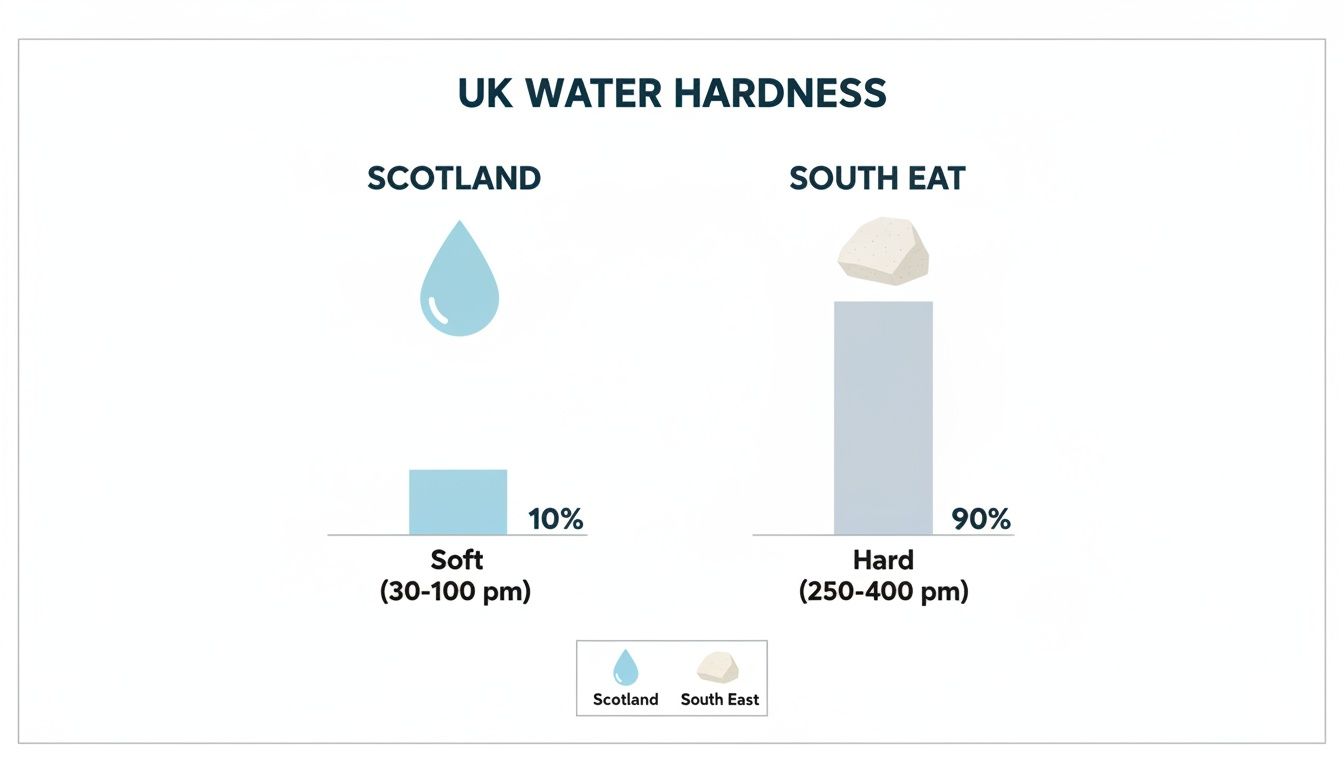
This really brings home what a lottery using tap water can be for coffee brewing, depending on where you live.
This table provides a quick look at how tap water stacks up against filtered water for the key factors in brewing.
Tap Water vs Filtered Water at a Glance
| Brewing Factor | UK Tap Water (Variable) | Filtered Water (Ideal) |
|---|---|---|
| Flavour Clarity | Often muted by chlorine & mineral taste (chalky, flat) | Clean, bright, and transparent, letting coffee notes shine |
| Extraction | Inefficient in hard water, leading to under-extraction (sour) | Efficient solvent for a balanced, sweet, and complex brew |
| Equipment Health | High risk of limescale, causing damage and poor performance | Protects machines by significantly reducing scale build-up |
| Consistency | Highly variable by region and day, hard to control | Stable and predictable base for repeatable, perfect results |
Ultimately, while tap water will get the job done, filtered water is what elevates a good coffee to a great one. For any coffee lover in the UK, making the switch is one of the most significant and worthwhile upgrades you can make to your home brewing setup.
Choosing Your Ideal Water Filtration Method
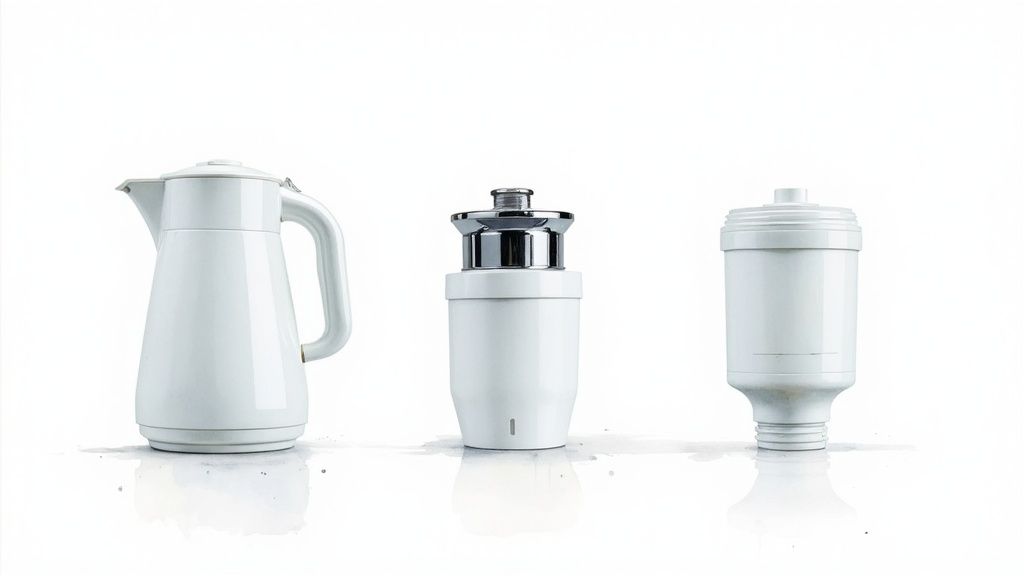
Diving into the world of home water filtration can feel a bit overwhelming, but getting it right is a massive step toward consistently brilliant coffee. The goal is simple: reduce the things that wreck the flavour and your machine—like chlorine and excessive hardness—while keeping the good minerals that help your coffee extract properly. This guide will walk you through the most common filtration methods in the UK, helping you find the right fit for your setup and budget.
We'll compare the good, the bad, and the practical of popular options, from the humble jug filter to more permanent under-sink solutions. Every system has a different effect on your water's chemistry, not to mention cost and convenience, so figuring out these differences is key.
Jug Filters: The Accessible Starting Point
For most of us, the first step into filtered water is a simple filter jug from a brand like Brita. They’re popular for a reason: they’re affordable, easy to find, and require zero installation. Just fill it up from the tap, and gravity pulls the water through a replaceable cartridge.
These cartridges usually contain activated carbon to get rid of chlorine and other funky tastes, which is an immediate improvement. Many also have an ion-exchange resin to tackle temporary hardness (calcium carbonate)—the main culprit behind limescale. The catch? Their performance isn't always consistent.
A jug filter is a huge improvement on straight tap water, but its ability to soften your water drops off fast as the cartridge gets older. If you're in a very hard water area, you might only get that perfect water profile for the first week or two of a new filter's life.
They're an excellent, low-commitment way to start, but they might not give you the reliability you need for a perfectly dialled-in espresso machine.
On-Tap and Under-Sink Systems
If you're after more convenience and steady performance, filters that connect directly to your plumbing are the next logical step. These systems give you filtered water on demand, so you can ditch the constant refilling of a jug.
- On-Tap Filters: These little units screw straight onto your kitchen tap. A simple switch lets you toggle between filtered and unfiltered water, making them super practical for everyday use. The filtration they offer is generally a step up from a standard jug.
- Under-Sink Systems: Tucked away out of sight, these are a more permanent and powerful solution. They connect to your cold water line and use a separate, dedicated tap for filtered water, offering a fantastic balance of performance and convenience.
The initial cost for an under-sink system is higher, but in the long run, they often work out cheaper than buying endless jug cartridges. More importantly, they provide consistently filtered water that protects your expensive coffee kit from damaging limescale. We dive deeper into this in our guide on how to descale a coffee machine.
Reverse Osmosis: The Blank Slate Approach
For the true coffee purist who wants total control, Reverse Osmosis (RO) is the gold standard. An RO system uses a special membrane to strip almost everything out of your water—minerals, contaminants, the lot. What you're left with is incredibly pure water, essentially a blank slate.
This might sound like the dream, but water with zero minerals is actually terrible for coffee. It can't extract flavour properly and usually produces a flat, lifeless, and often sour brew. The real magic of RO for coffee is that it lets you build your perfect water from scratch by adding specific mineral sachets back in. This way, you can hit the exact TDS and hardness profile you're aiming for. For a source of highly purified water just for your kitchen, systems like under-sink reverse osmosis systems are a brilliant choice.
This level of precision is usually reserved for speciality cafes or the most dedicated home brewers. While it delivers results you can't get any other way, it comes with a higher price tag, a more involved installation, and more maintenance. It also produces wastewater during purification, which is something to bear in mind if you're environmentally conscious.
Creating the Perfect Water Recipe for Your Brew
Turning all this water theory into practice is where your coffee goes from pretty good to genuinely exceptional. While a decent filter gets you most of the way there, understanding the ideal water profiles lets you fine-tune every single brew. This isn't just for pro baristas anymore; it's a level of control that's now completely accessible to any coffee lover in the UK.
The Specialty Coffee Association (SCA) has a "gold standard" for coffee water that makes a brilliant target. You don't need to hit these numbers with scientific precision, but getting into this ballpark will dramatically improve your results.
SCA Target Water Profile
- Total Dissolved Solids (TDS): 75-250 ppm (parts per million), aiming for a sweet spot of 150 ppm.
- Total Hardness: 50-175 ppm, with an ideal target around 68 ppm.
- Alkalinity: 40-75 ppm.
- pH: Between 6.5 and 7.5.
- Chlorine: 0 mg/L (it needs to be completely gone).
Striking this balance ensures your water can properly dissolve all those lovely flavour compounds without being so hard that it mutes acidity or starts clogging up your machine with limescale.
Test Your Tap Water
Before you can fix your water, you’ve got to know what you’re starting with. No need for a chemistry lab—a simple and cheap water testing kit from online retailers is all you need. These usually come as paper strips that change colour to show you the hardness, alkalinity, and pH levels.
A quick test will instantly tell you if you’re dealing with the soft water of Manchester or the liquid rock coming out of taps in London. This one simple step is the foundation for making much smarter decisions about your brewing.
Knowing your water's starting point is incredibly empowering. You stop guessing why your coffee tastes flat and start knowing exactly which dial to turn for a better cup.
Once you have this information, you've got a clear path forward. You can either learn to work with what you've got or take the final step towards total control.
Adjusting Your Brew for Tap Water
If you decide to stick with your local tap water, your test results are your guide to making smart tweaks to your brew recipe. It’s all about compensating for the water's shortcomings to get a more balanced extraction.
- For Very Hard Water: Hard water struggles to extract flavour efficiently, often leading to under-extraction. To fight this, you could try grinding your coffee a little finer or letting it brew for longer. This gives the less effective water more time to pull out all the good stuff.
- For Very Soft Water: Soft water is a much more aggressive solvent, meaning it can easily over-extract coffee and leave you with a bitter, harsh taste. Here, you'll want to do the opposite: grind a bit coarser or shorten your brew time to avoid pulling out those unpleasant compounds.
Remember, water is just one piece of the puzzle, sitting alongside grind size and temperature. If you want to go deeper into how heat changes your brew, our guide on the best water temperature for coffee is packed with essential insights.
Build Your Own Perfect Coffee Water
For those who want to eliminate all the guesswork, the ultimate move is to build your own coffee water from scratch. It sounds daunting, but it’s surprisingly straightforward. You start with a blank slate—distilled, deionised, or reverse osmosis (RO) water—and simply add specific minerals back in.
The easiest way to do this is with pre-made mineral concentrates or sachets. Brands like Third Wave Water and Perfect Coffee Water offer perfectly formulated mineral packets designed to be mixed with a set amount of pure water. Just add one sachet to a big bottle of distilled water, give it a good shake, and you’ve got a gallon of SCA-standard brew water ready to go.
This method gives you unparalleled consistency. It guarantees every single cup you brew is made with the ideal water profile, meaning the only variable is the coffee itself. This allows you to truly taste the unique character of every bean—and if you’re investing in premium single-origin coffees, this is the absolute best way to do them justice.
Final Verdict for UK Home Baristas
So, where do we land in the great UK water debate? After looking at tap vs filtered, the verdict is pretty clear. While our tap water is brilliantly safe to drink, its wild regional differences make properly filtered water the undeniable champion for anyone serious about brewing exceptional coffee.
For most of us brewing at home, a quality filter jug or system hits the sweet spot. It's the perfect middle ground: affordable, convenient, and gives you consistent results. A decent filter gets rid of that flavour-dulling chlorine and tames the excessive hardness that plagues so much of the country, especially down South and East. This not only unlocks the vibrant, delicate notes in your coffee beans but also prevents damaging limescale build-up in your machine. Even with filtered water, it's always smart to keep a good descaler handy to keep your equipment in prime condition.
Your Path to a Better Brew
Ultimately, getting a grip on your water is the single biggest upgrade you can make to your home coffee game. It's a far more sensible and sustainable path than relying on bottled water, which is both expensive and a nightmare for the environment. It gives you a stable foundation, letting you tweak your recipes and nail that perfect, cafe-quality brew every single time.
By taking the great British water lottery out of the equation, you stop leaving flavour to chance and start brewing with intention. The difference isn't just noticeable; it's a completely different experience.
We really encourage you to experiment. Test your own tap water, look into the different filter options, and discover for yourself the huge impact great water has on your daily cup. If you're looking for systems that are perfect for coffee lovers, check out our curated range of water filters. Your taste buds—and your coffee machine—will thank you for it.
Got Questions? We’ve Got Answers
When it comes to the best water for coffee, a few questions pop up time and time again. From local tap water quirks to common brewing myths, let's clear the air and get you on the path to a better cup.
Is London Tap Water Really That Bad for Coffee?
In a word, yes. While it’s perfectly safe to drink, London’s tap water is notoriously hard, packed with minerals that can make your coffee taste flat, chalky, and uninspiring. It completely smothers the delicate, interesting notes we work so hard to develop in our beans.
Worse still, that high mineral content is a nightmare for your equipment. It causes aggressive limescale build-up that can clog and seriously damage your coffee machine, leading to some very expensive repairs. For anyone serious about their coffee in London, a good filter isn’t just a recommendation—it’s essential.
Should I Just Use Bottled Water Instead?
We get why this seems like an easy fix, but we generally steer people away from using bottled water. For one, it’s expensive and creates a mountain of plastic waste. But more importantly, the mineral content can be just as unpredictable and unsuitable as tap water.
The whole point is to achieve consistent, balanced water for a repeatable, delicious brew. Bottled water is a wild card. Its mineral profile varies massively from brand to brand, making it an unreliable choice for great coffee.
A quality home filtration system gives you far more control and consistency, all while being cheaper and kinder to the planet in the long run.
Does Boiling Tap Water Make It Better for Coffee?
This is a classic myth that, believe it or not, can actually make your water worse for brewing. Boiling does help dissipate some chlorine, which might give you a tiny improvement in taste, but it backfires in a big way.
As the water boils and steam escapes, the minerals get left behind, becoming more concentrated. This process effectively makes hard water even harder, amplifying all the negative effects on your coffee’s flavour and your machine's lifespan. Filtration is the only reliable way to get your water chemistry right.
At Seven Sisters Coffee, we know that brilliant coffee starts with brilliant water. To give your machine the protection it needs and unlock the true flavour of your beans, take a look at our hand-picked selection of Water Filters.