Espresso Scale vs Timer Which to Buy for Perfect Home Coffee

If you're wondering whether to buy an espresso scale or a timer, let me give you the short answer: a high-quality espresso scale is the single most impactful tool you can get to improve your coffee. While a timer is certainly useful, it’s the ability to accurately weigh your espresso shot that gives you ultimate control over flavour and consistency.
The Essential Question: Espresso Scale or Timer?
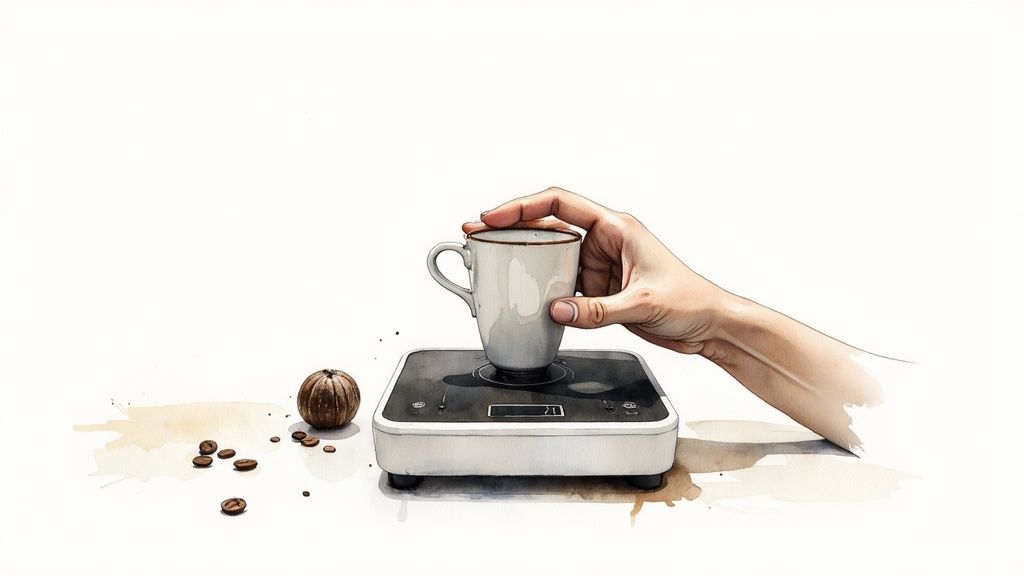
For anyone serious about making better espresso at home, the journey always starts with eliminating guesswork. Time is, of course, a crucial variable in the brewing process, but it’s really a secondary metric. The real foundation of a repeatable, delicious shot lies in precision measurement by weight.
This is where two key concepts come into play: brew ratio and extraction time. Understanding how these two work together is the key to mastering your machine.
- Brew Ratio: This is the simple but powerful relationship between the weight of your dry coffee grounds (your ‘dose’) and the weight of the final liquid espresso (your ‘yield’). A great starting point is a 1:2 ratio, meaning for 18 grams of coffee, you’re aiming for a 36-gram espresso shot.
- Extraction Time: This is the total time it takes for your target yield to pour, from the moment you start the pump. A typical target is somewhere between 25-35 seconds.
Relying on time alone just isn't reliable. So many factors—from the freshness of your beans to the fineness of your grind—can change how quickly water flows through the coffee puck. A scale, however, measures the actual output, making sure you hit your target yield every single time, regardless of how long it takes. For a deeper dive into the fundamentals, check out our guide on how to make an espresso, which covers all the essential steps.
Why Weight Beats Volume and Time
Measuring espresso by volume (in millilitres, for instance) is notoriously inaccurate because of crema, that lovely rich foam on top of a fresh shot. Crema is mostly gas, and its volume can vary dramatically from one shot to the next. This means 30ml of espresso today might contain a completely different amount of liquid coffee than 30ml tomorrow.
A scale sidesteps this problem entirely. It measures mass, not volume, giving you a true, accurate reading of your espresso yield. This accuracy is what allows you to consistently replicate that perfect shot once you've dialled it in.
The preference for precision tools is really taking hold in the UK home coffee scene. A recent UK consumer survey revealed that 65% of espresso hobbyists now use an espresso scale, often one with an integrated timer. This clearly shows a shift towards prioritising weight-based brewing.
This table breaks down the fundamental differences between using a scale and a timer as your main tool.
| Feature | Espresso Scale | Espresso Timer |
|---|---|---|
| Primary Metric | Weight (grams) | Time (seconds) |
| Measures | The amount of coffee extracted | The speed of the extraction |
| Main Benefit | Guarantees consistent shot yield and flavour | Helps diagnose grind size issues (too fast/slow) |
| Key Role | Recipe control and repeatability | Diagnostic tool for troubleshooting |
Ultimately, a scale tells you the 'what' and the 'how much', while a timer tells you the 'how fast'. To achieve café-quality results at home, controlling the 'how much' with a scale is easily the most critical first step you can take.
Why a Scale Is Your Most Important Brewing Tool
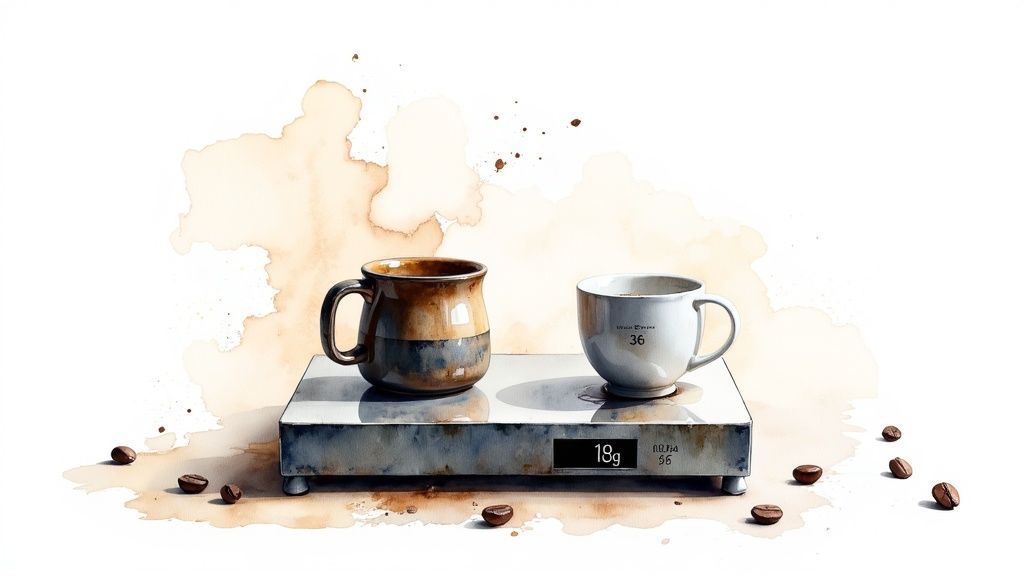
If you're stuck on the "espresso scale vs timer, which to buy?" dilemma, the answer is all about control. A scale isn’t just another gadget; it's the single most powerful tool for taking complete command of your coffee’s flavour. It lets you master the brew ratio—the absolute cornerstone of every great espresso recipe.
The brew ratio is simply the relationship between the weight of your dry coffee grounds (your dose) and the weight of the liquid espresso in your cup (your yield). By measuring both, you create a repeatable recipe that you can tweak until the taste is perfect.
This weight-based approach is what moves you from guesswork to genuine craft. It turns espresso-making from a game of chance into an act of precision. For a deep dive into this crucial technique, check out our post on how to dial in an espresso ratio.
The Problem with Time Alone
Relying only on a timer is a bit like trying to bake a cake using just an oven thermometer, without ever measuring the flour. Time is a result, not an ingredient. Countless variables can mess with how quickly your shot pours, making the clock a surprisingly unreliable guide.
Think about these everyday factors:
- Bean Age: As coffee gets older, it loses CO2 and water flows through it faster. A 30-second shot with fresh beans might give you 36g of espresso, but that same 30 seconds with older beans could pump out 45g, leading to a weak, over-extracted disappointment.
- Grind Size Adjustments: The tiniest nudge on your grinder dial changes everything. Grinding a little finer slows the shot down, while going coarser speeds it up. Without a scale, you have no idea if your 30-second shot produced the right amount of coffee.
- Tamping Pressure: How hard you press the coffee tamper makes a real difference. Tamping harder can slow the flow, while a lighter touch can speed it up, once again changing your final yield even if the time stays the same.
A scale makes all of these variables manageable. It doesn't matter if the shot runs a few seconds faster or slower today. What matters is stopping it at your exact target weight.
Real-World Control with a Scale
Let’s say your recipe calls for an 18g dose of coffee to produce a 36g espresso yield. You pop your cup on a scale like the popular Felicita Arc Espresso Scale, hit ‘tare’ to zero it out, and start your machine.
As the espresso pours, you ignore the clock. You just watch the numbers on the scale climb: 25g… 30g… 34g… then you stop the machine the moment it hits 36g. You’ve nailed a perfect 1:2 ratio, guaranteeing the flavour you were aiming for. That level of control is simply impossible with a timer alone.
This preference for weight is widely recognised in the coffee community. UK consumer studies show that while about 50% of home espresso machine owners buy accessories like scales within the first year, a significant 20-30% come to see timers alone as insufficient for consistency. These variables are exactly why. You can see this shift towards precision tools reflected in UK coffee machine market trends.
Ultimately, a scale removes the biggest variable in making espresso: the final yield. It transforms an inconsistent art into a repeatable science, ensuring that every single cup you pull is as delicious as the last.
Understanding the Role and Limits of a Timer
While a scale gives you the ultimate say over your espresso recipe, it would be a mistake to dismiss the timer entirely. When we talk about an espresso scale vs. a timer, it’s less about picking one over the other and more about appreciating their distinct jobs. Think of the timer as a vital diagnostic partner; it provides critical feedback on the speed of your extraction.
The time it takes to pull a shot is a direct reflection of how water is flowing through your coffee puck. That simple number—usually somewhere in the 25-35 second window—is your first clue as to whether your grind setting is in the right ballpark.
A timer is like an early warning system, helping you spot potential issues before you even taste the coffee. It tells a story about your puck prep and grind size.
What the Timer Tells You
At its core, time tells you how much resistance the water met. A shot that pulls too quickly, say in 15 seconds, means the water rushed through the grounds with almost no effort. This usually points to a grind that’s too coarse, leading to an under-extracted shot that will taste sour and thin.
On the other hand, a shot that drags on for 45 seconds or more to hit its target weight tells you the water really struggled to get through. This is a classic sign of a grind that's too fine, which will give you an over-extracted espresso tasting bitter, harsh, and burnt. For a deeper dive into this crucial step, exploring a comprehensive coffee grind size guide can help you visualise how these adjustments play out.
A timer provides the 'how fast', but only a scale can confirm the 'how much'. Together, they create a complete picture of your extraction, allowing you to troubleshoot with precision and repeat your successes.
The Critical Limits of a Timer Alone
Here’s where relying on a timer alone falls apart: it can't measure the actual liquid in your cup. A shot can hit that perfect 30-second mark but produce a wildly incorrect amount of espresso, completely wrecking the flavour profile you were aiming for. The usual culprit here is an issue known as channelling.
Channelling happens when water finds a path of least resistance through the coffee puck, bypassing most of the grounds. This can be caused by an uneven grind, poor distribution of coffee in the portafilter, or inconsistent tamping pressure.
Imagine water carving tiny tunnels through the coffee bed. It gushes through these channels, extracting very little flavour, while other parts of the puck remain under-touched. The result? You might hit your 30-second target, but because the water flowed so inefficiently, you end up with 50g of weak, watery espresso instead of the rich, balanced 36g you wanted.
This scenario perfectly illustrates why a timer is a flawed master. It can tell you that the shot looked right on the clock, but it has no way of knowing that the final yield was completely wrong. This is the fundamental reason why a scale is considered the more essential tool for achieving consistently delicious espresso, shot after shot.
A Practical Comparison to Guide Your First Purchase
So, you're trying to choose between an espresso scale and a timer. It can feel like a big decision, but honestly, it all comes down to your immediate goals, your budget, and what's already on your coffee bar. Let’s break it down and figure out the smartest first investment for your UK home setup.
If you’re just starting out and the budget is tight, don’t worry. You can get surprisingly far with a simple digital kitchen scale and the timer on your smartphone. It’s not glamorous, but it works. This basic setup lets you start weighing your dose and yield, which is without a doubt the most important step towards making consistently good espresso.
But for any enthusiast who’s serious about chasing that perfect, repeatable shot, an all-in-one espresso scale with a built-in timer is the single most valuable upgrade you can make. It combines two critical tools into one, streamlines your entire workflow, and gives you the real-time data you need to truly dial in your coffee.
Budget vs Premium Espresso Scales
The world of coffee scales is surprisingly vast, with options ranging from cheap-and-cheerful models to seriously slick, feature-packed devices. To give you a real sense of what you're paying for, let's compare a basic budget option with a more advanced model you might find at a specialist shop like ADS Coffee Supplies.
A budget scale, usually under £40, will get the job done. It'll give you 0.1g accuracy and have a manual timer. The catch? They almost always have a noticeable lag. The numbers on the display struggle to keep up with the espresso flowing into the cup, making it incredibly easy to overshoot your target yield. It's functional, but can be a bit frustrating.
In contrast, a premium scale like the Felicita Arc Espresso Scale is built from the ground up for espresso. The extra investment gets you features that actually make a difference:
- Near-Instant Response Time: The weight updates in a flash, so you can stop your shot with pinpoint accuracy right when you mean to.
- Water Resistance: It’s designed to live on a drip tray. Splashes and drips are inevitable, and this feature massively boosts its lifespan.
- Auto-Start Functions: Many high-end scales can start the timer automatically the moment the first drop of coffee hits the cup. It’s a small thing that makes a huge difference to your workflow.
- Compact Size: These scales are low-profile, designed specifically to slip under a portafilter with plenty of clearance for your favourite mug.
These aren't just bells and whistles; they’re practical features that lead to a more precise, less stressful brewing routine. It's also worth remembering that your grinder is your other key partner in consistency. If you want to dive deeper, this guide explaining conical vs flat burr grinders is a great read.
A Decision Guide for Your Coffee Journey
To help you decide where to put your money first, I’ve put together a quick guide based on different barista profiles. Think of it as a roadmap to your next piece of kit.
Decision Guide: Scale vs Timer
This table should help you decide whether to prioritise a scale, a timer, or a combined unit based on your barista level, goals, and budget.
| Barista Profile | Primary Goal | Recommended Tool | Why It's Recommended |
|---|---|---|---|
| The Curious Beginner | To stop guessing and start learning about brew ratios on a shoestring budget. | A basic kitchen scale and your phone's timer. | This zero-cost approach introduces you to the essential habit of weighing your dose and yield without any initial investment. |
| The Improving Enthusiast | To pull consistent, repeatable shots and make the morning routine smoother. | An all-in-one espresso scale like the Timemore Black Mirror Nano. | This tool is the sweet spot. It combines accuracy, speed, and a compact design, making it the most effective upgrade for controlling your espresso. |
| The Prosumer Perfectionist | To gain total control, analyse shot data, and perfect every extraction. | A premium, water-resistant scale with advanced features, like the Felicita Arc. | High-end scales offer unmatched responsiveness and durability, with smart features that support a meticulous and data-driven workflow. |
By focusing on your main goal, the decision becomes much clearer.
Ultimately, the "espresso scale vs timer" debate isn't much of a debate at all. If your goal is consistency, the scale is the undisputed winner. It’s the only tool that measures the actual coffee in your cup, turning what feels like a guessing game into a repeatable science.
For most home baristas here in the UK, investing in a quality combination scale and timer is the most direct route to better espresso. It tackles both key variables with one purpose-built device, giving you the confidence to pull fantastic shots every single time.
Integrating a Scale and Timer into Your Workflow
Moving from theory to practice is where the real fun begins. Once you get the hang of it, bringing a scale and timer into your daily routine is what turns espresso making from a game of chance into a precise, repeatable craft. This mini-tutorial will walk you through a smooth, harmonious brewing workflow, step by step.
The goal here is to stitch together dose, yield, and time into one seamless process. With a good all-in-one scale, this becomes surprisingly simple and only adds a few seconds to your routine compared to just pulling a shot blind.
Your Step-By-Step Brewing Routine
Here’s a standard, reliable workflow that combines both weighing and timing for excellent results. This method is the very foundation upon which all great espresso recipes are built.
- Weigh Your Dose: Pop your portafilter on the scale and hit the ‘tare’ button to zero it out. Grind your coffee beans straight into the portafilter until you hit your target dose—let’s say 18.0g. Nailing this number is key.
- Prepare Your Puck: Distribute the grounds evenly and tamp with consistent pressure. A level, well-prepared puck is vital for preventing channelling and ensuring an even extraction. If you want to dive deeper into this stage, our comprehensive puck prep guide on WDT and distribution has all the techniques you'll need.
- Tare Your Cup: Lock the portafilter into your machine. Now, place your cup and the espresso scale onto the drip tray and press ‘tare’ one more time. The scale should read 0.0g.
- Start Simultaneously: Kick off the extraction on your espresso machine and start the timer at the exact same moment. Many dedicated espresso scales actually do this for you automatically.
- Stop by Weight: Keep your eyes on the number on the scale, not the clock. As the liquid espresso streams into the cup, you'll see the weight climb. Aim to stop the shot just before it hits your target yield (for example, 36g), as a few extra drips almost always follow.
This simple routine ensures you nail your brew ratio perfectly, every single time. Once you have this down, you can start playing with the variables to really fine-tune the flavour.
A fantastic starting point for most beans is the classic 1:2 brew ratio (18g of coffee grounds to 36g of liquid espresso) pulled in a 25–35 second window. This usually gives you a balanced shot that’s neither too sour nor too bitter—a perfect baseline for any adjustments.
The decision tree below helps visualise when to prioritise a scale over a timer based on what you're trying to achieve. It’s a handy way to guide you toward the most effective tool for your specific needs.
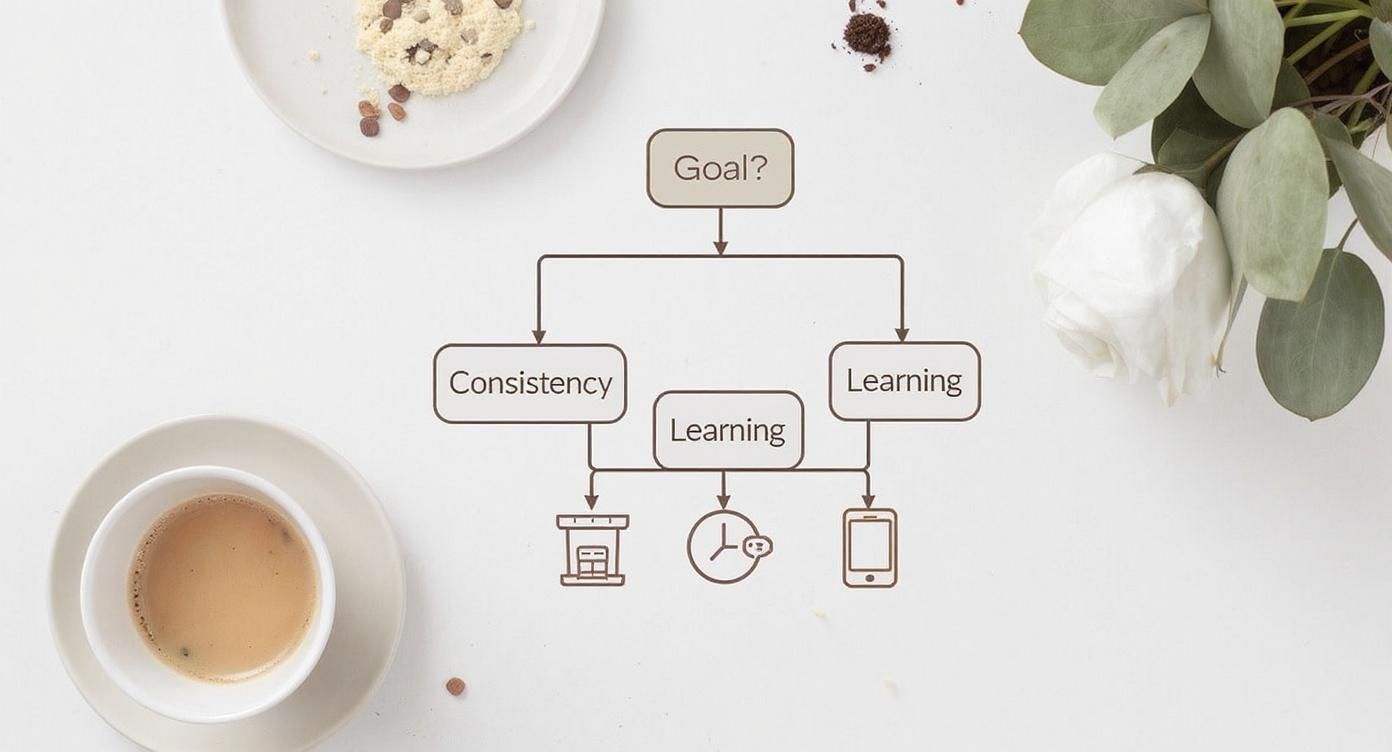
As the flowchart shows, if consistency is your main objective, a scale is the way to go. If you're just starting out and want to learn the basics of extraction speed, a timer is a great first tool.
Demystifying Advanced Scale Features
As you start comparing different espresso scales, you’ll notice that the premium models come loaded with advanced functions designed to make your workflow even smoother. These aren’t just gimmicks; they are genuinely practical tools that boost both your precision and convenience.
High-end scales like the famous Acaia Lunar are known for their intelligent modes that automate parts of the brewing process.
- Auto-Tare: This feature automatically zeros out the scale the moment you place your cup on it. It might sound minor, but it saves a button press and keeps the workflow moving fluidly.
- Auto-Start Timer: This is probably the most useful feature of the lot. The scale detects the very first drop of espresso hitting the cup and instantly starts the timer. This completely removes human reaction time from the equation, giving you a perfectly accurate reading of your extraction time.
These features might seem small, but they add up to a more streamlined and less stressful morning routine. By automating the most repetitive steps, they let you focus your attention entirely on the quality of the shot itself. This level of integration is what separates a basic kitchen scale from a purpose-built espresso tool, making the investment well worth it for any serious home barista.
Top Recommended Scales for Every UK Home Barista
Choosing between an espresso scale and a timer can feel like a complex puzzle, but picking the right tool for your setup doesn't have to be. The best purchase is always the one that fits your budget, your ambitions, and your daily coffee ritual. To help you invest wisely, here are our top picks for every type of UK home barista, featuring some brilliant models available directly from ADS Coffee Supplies.
Any one of these scales is a massive upgrade from guesswork. They all provide the precision you need to pull consistently delicious espresso, shot after shot.
For the Budget-Conscious Beginner
If you're just starting out and need a reliable tool that nails the basics without the hefty price tag, the Timemore Black Mirror Nano Scale is a fantastic choice. It gives you the core features you need to get to grips with weight-based brewing.
This little scale combines 0.1g accuracy with a built-in timer, putting both critical metrics into one compact device. It’s small enough to fit on most espresso machine drip trays, and its fast response time is a huge improvement on a standard kitchen scale, helping you hit your target yield without accidentally overshooting it. It's the perfect entry point.
For a beginner, the most important thing is simply to start weighing your dose and your liquid output. A scale like the Timemore Nano makes that process straightforward and affordable, delivering the biggest bang for your buck when it comes to improving your coffee.
You can find out more and grab the Timemore Black Mirror Nano Scale at ADS Coffee Supplies. It’s the ideal bit of kit to build good habits from day one.
For the Dedicated Home Enthusiast
For those who've moved past the basics and are now looking for more speed, better durability, and a smoother workflow, the Felicita Arc Espresso Scale is the logical next step up. It's a firm favourite among serious home baristas for good reason.
The Arc is known for its incredible responsiveness and a tough, water-resistant build, making it perfectly suited to the wet environment of a drip tray. Its automatic timer functions are a game-changer; they can start and stop based on the flow of espresso, which streamlines the whole process. This lets you focus purely on watching the extraction instead of fumbling with buttons.
This scale is a proper workhorse, built to give you professional-level precision while standing up to daily use. Take a look at the Felicita Arc Espresso Scale here to see how it can elevate your routine.
For the Prosumer Perfectionist
When only the absolute best will do, the Acaia Lunar is in a class of its own. It's the benchmark for prosumer and professional baristas who demand ultimate precision, a premium build, and advanced data-tracking features.
The Lunar delivers near-instantaneous response times, is housed in a beautiful aluminium body, and is completely water-resistant. Its real power, though, is its Bluetooth connectivity. The Acaia app lets you track and save data from every shot, analyse flow rates in real-time, and follow recipes with an accuracy that’s second to none. For the perfectionist who wants to control every last variable, the Lunar is the ultimate tool for data-driven espresso mastery.
Frequently Asked Questions
As you weigh up (pun intended!) whether an espresso scale, a timer, or both is right for you, a few common questions tend to surface. Let’s clear those up to help you make a confident choice.
Can I Just Use My Kitchen Scale For Espresso?
While a standard kitchen scale is definitely better than nothing for weighing your dry coffee dose, it falls short when it comes to measuring the liquid espresso as it pours. Scales designed for espresso are incredibly responsive, registering changes as small as 0.1g, and they’re built compact enough to actually fit on your machine’s drip tray.
Your average kitchen scale, on the other hand, often has a noticeable delay, or 'lag'. That small delay is just enough to make you overshoot your target yield, leaving you with an over-extracted, disappointing shot. For consistent, repeatable results, a proper espresso scale is a game-changer.
Is My Espresso Machine's Built-In Timer Enough?
Having a built-in shot timer is a fantastic feature, no doubt. It’s perfect for keeping an eye on your extraction speed. But it only tells you how long the shot ran for, not how much espresso ended up in your cup. To truly dial in a recipe and lock down a consistent flavour profile, you still need a scale to measure your output.
Think of it this way: the machine’s timer diagnoses the speed of your shot, while the scale confirms the result. Using them together gives you the complete picture of your extraction and a seriously precise workflow.
What Is a Good Starting Point For Brew Ratio and Time?
A brilliant place to start for almost any espresso is a 1:2 brew ratio. It's simple: for every 1 gram of dry coffee grounds you put in your basket, you want to get 2 grams of liquid espresso out in the cup.
So, a classic recipe looks something like this:
- An 18-gram dose of ground coffee.
- To produce a 36-gram espresso shot.
The ideal time to hit that target is usually between 25 and 35 seconds. This gives you a solid baseline. From there, you can start adjusting your grind size or tweaking the ratio to fine-tune the taste until it's exactly how you like it.
At Seven Sisters Coffee Co, we believe precision is the key to unlocking amazing flavour. Explore our range of freshly roasted, single-origin coffees to experience the difference that quality beans and accurate brewing can make in your daily cup. Find your perfect brew at https://sevensisterscoffee.co.uk.